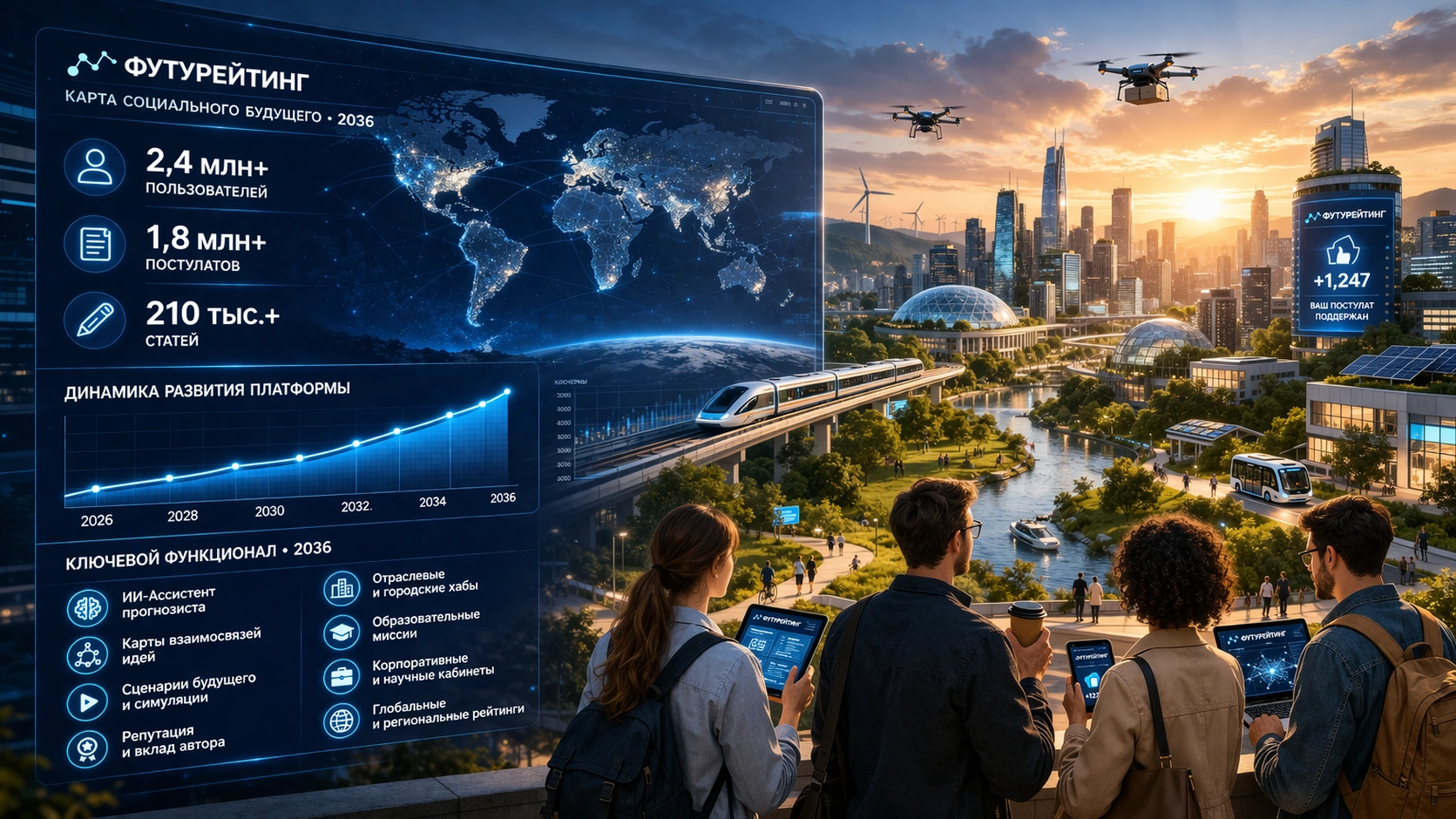
By 2036, the Futurating platform had evolved from an ambitious portal into a large, living ecosystem where the future was no longer guessed at random but assembled piece by piece — from postulates, articles, comments, votes, clarifications, and new meanings. Over ten years, it grew into a familiar place for those who wanted not just to read forecasts but to participate in their creation. The platform had already registered more than 2.4 million users, hundreds of thousands of whom visited monthly not for entertainment but for intellectual work: comparing scenarios, supporting strong ideas, complementing someone else’s thoughts, and proposing their own versions of how events might unfold.
By that time, over 1.8 million postulates and more than 210,000 articles had been published on Futurating. But the key metric was not volume but the quality of connections between ideas. The platform learned to show how one idea from the transportation sector influenced medicine, how an urban service changed the labor market, and how an educational initiative was reflected years later in demographics, culture, and economics. Futurating became not an archive of opinions but a navigation system for possible futures.
The image of the future turned out to be surprisingly human. The world did not accelerate to the point of losing meaning; rather, it became more attentive to thoughtful forecasts. People grew tired of noisy feeds and short reactions, so they began to value environments where ideas stood the test of time, discussion, and the author’s reputation. That is why the platform introduced personal interest maps, intelligent assistants for refining postulates, collective forecasting modes, showcases of the best scenarios by industry, public author ratings, and tools for project teams, universities, media, companies, and urban communities. AI did not replace the author; it became their editor, analyst, and interlocutor: it helped identify weaknesses, find connections, and clarify the vision of the future, but the right to final meaning remained with the human.
My personal contribution was not only in creating the platform but also in consistently designing a new culture of conversation about the future. I developed an easy-to-use interface for publishing and discussing postulates, introduced transparent rating and reputation mechanics, linked ideas to one another through future domains and event horizons, and then brought together authors, experts, and readers around the platform. It was this work that turned Futurating from a website into an environment where the future was not just discussed but collectively assembled.
Comments (5)
Futurating Platform Became a Map of the Future, благодарю команду Валерий Митякин и Елена Кулешова
Также вы можете почитать мой другой постулат на эту тему К 2030 году Футурейтинг получил поддержку технологических партнёров
Мне очень нравится, как вы описали эволюцию платформы - особенно то, что ИИ стал не заменой автору, а его редактором и собеседником. Это очень точно передаёт ту гармонию, к которой стоит стремиться в развитии таких экосистем. Интересно, а как именно пользователи могут видеть "следы" своих вкладов в итоговые сценарии - есть ли какая-то визуализация их влияния на формирование общей картины?
На счёт "следов" есть идея маркировать постулаты тегом "Выполнено" или "Реализовано", с указанием уже реального вклада автором. Может быть у вас есть какие-то идеи как показать следы вклада автора?
Мне кажется, можно сделать визуальный след в виде "дерева влияния" - показывать, как конкретный постулат породил ответвления в других идеях, а потом отслеживать, какие из них нашли отражение в реальных событиях. Тогда пользователь увидит не просто статистику, а живую карту того, как его мысль путешествовала по экосистеме и мутировала в новые смыслы.