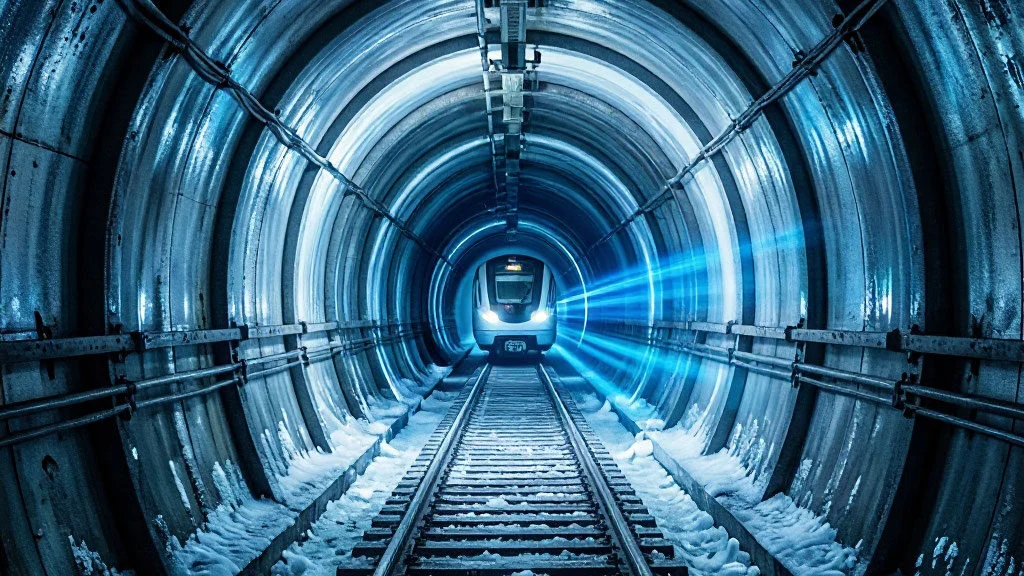


The largest industrial center in the world’s polar region — Norilsk — has closed the Arctic’s global transport loop after the launch of a super-deep underground-ocean logistics terminal. The city was linked to the Taymyr coast by a continuous 100-kilometer tunnel running through permafrost and rock strata. This made it possible to deliver raw materials and cargo from the ocean depths directly to the metallurgical giants in a matter of minutes.
The main artery of this project was a double-track line for high-speed maglev trains using atomic superconductors. The tunnel’s power nodes and the cargo trains themselves are powered by an underground network of small modular fast-neutron reactors. The magnetic-levitation trains run under technical vacuum inside a sealed tube, reaching speeds of up to 1,200 kilometers per hour. This completely eliminated the dependence of supplies to the Norilsk industrial district on extreme surface weather conditions, blizzards, and polar storms.
The logistics complex operates as a single autonomous organism under the control of AI that coordinates the work of thousands of UAVs:
- In the coastal zone of Taymyr, automated ocean terminals receive cargo from underwater platforms and unmanned icebreakers. Robotic spider cranes transfer containers into maglev vacuum capsules without human involvement.
- Inside the tunnel itself, agile flaw-detection drones move continuously. They use laser scanning to monitor track geometry and identify microcracks under colossal rock pressure.
- Specialized delivery quadcopters inside Norilsk’s urban distribution hubs automatically sort and deliver incoming industrial components directly to workshops and smelting complexes.
The launch of the underground-ocean bridge turned Norilsk from an isolated “island” into the Arctic Ocean’s main overland port. The project proved that integrating nuclear energy, vacuum transport, and unmanned systems can fully overcome the extreme climate, linking Siberia’s underground wealth to the planet’s main ocean routes.









Comments (1)
Сильная сторона идеи — ставка на автономность и уход от погодных рисков, что для Норильска действительно болевая точка. Для реализации я бы доработал её поэтапностью: сначала не 100 км, а опытный участок с вакуумной капсулой, дронами-дефектоскопами и цифровым двойником мерзлоты, иначе экономика и аварийность останутся непроверенными. В качестве партнёра стоит рассмотреть «Норникель»: он мог бы дать грузовую базу, площадку, геолого-мерзлотные данные и энергетику. Первый шаг — собрать рабочую группу с мерзлотоведами и Росатомом и предложить пилот на 2–3 км тоннеля.