
Somatic Navigation: How the School of the Future Abolished Inclusion
The concept of inclusion in its classical sense turned out to be a social compromise, an architectural error, and a pedagogical dead end. It demanded an act of heroism from the child: the neurodivergent body had to daily commit violence against itself, fitting into the rigid dimensions of a standard desk, enduring forty minutes of static tension on a hard chair, and suppressing the need for proprioceptive stimulation in order to comply with “academic discipline.” Somatic navigation abolished the very need for a person to adapt to the environment. In this paradigm, the environment became a fluid, anonymous, and predictably responsive exoskeletal shell for every unique body.
From Diagnosis to Biometric Profile
The system abandoned medical categories (“hyperactive,” “child with cerebral palsy,” “sensory integration disorder”). Upon entering the classroom, wearable sensors built into bracelets or lightweight hoops take a snapshot of the student’s current state within the first three minutes:
- Vestibular profile: tremor level, amplitude of head micro-oscillations, frequency of seeking visual anchors.
- Motor patterns: load asymmetry when walking, speed of movement initiation, foot pronation angle.
- Sensory tone: galvanic skin response, muscle tension index via micro-vibrations read by the seat’s piezoelectric sensors.
This profile exists for exactly one session. It is not stored in a database, but is instantly transmitted to the building’s control network.
Dynamic Furniture: Gravity by Subscription
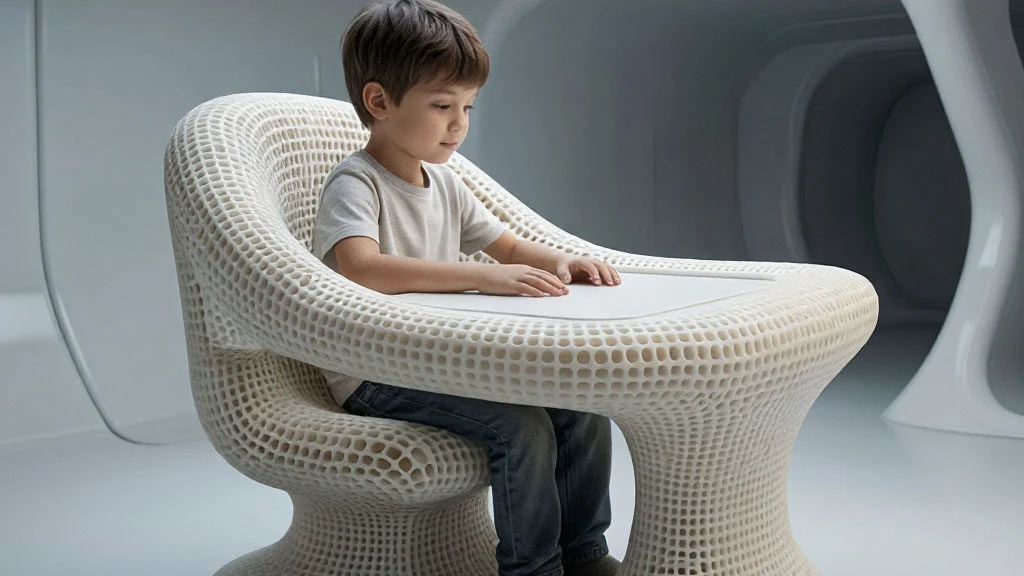
Classical furniture disappeared. The space was filled with autonomous kinematic modules. When a child with low muscle tone sits down, the pneumatic base of the chair imperceptibly deforms, taking the shape of their ischial tuberosities and ensuring perfect coccygeal balance without conscious effort to maintain posture. If after 15 minutes the sensors detect increasing vestibular discomfort, the chair begins to make micro-rotations of 0.2 degrees, imitating swaying in a hammock. This stimulates the vestibular nucleus of the brainstem and restores a sense of balance.
For a child with spasticity, the table smoothly changes height every seven minutes in antiphase to their involuntary contractions, relieving excess tension from the shoulder girdle. The desk is no longer a flat surface: it is a matrix of 500 independent silicone cells. When a student leans on it with an elbow, the cells beneath softly sink, creating a tactile cradle, while neighboring cells rise, forming an ergonomic rim that physically prevents the arm from slipping.
Tactile Walls and Kinetic Floors
The environment ceased to be visual. The classroom perimeter is an active landscape. The walls are covered with a network of thermochromic and pneumatic elements. If the system sees that a child is seeking support with their back, the wall segment behind them fills with density and heats to skin temperature, turning into a safe analogue of a weighted blanket. For hypersensitive children, the same wall areas become matte-cool and dampen echo, absorbing excess acoustic vibrations.
The floor is assembled from thousands of hexagonal modules. For a child with dyspraxia whose step lacks automaticity, the floor anticipates the foot placement by half a second, becoming a millimeter softer precisely at the point of contact. This cushions the impact and gives the brain additional time to calculate the next step. Such an external replacement for the damaged cerebellar predictor allowed the building to literally hold the child by the hand at every step, making their gait silent and confident.
Acoustic Topography and Light Corridors
Instead of general ceiling lighting, thousands of micro-projectors came into operation. The system builds an individual light cone for each student. If the algorithm notices signs of hyperfocus, it floods the desk with cold high-frequency blue light, dilating the pupil and increasing cortical tone. As soon as prefrontal cortex depletion is detected, the light warms and narrows, gently pushing the gaze with a peripheral amber glow toward the window for vagus nerve reset.
The sound background is divided into zones. Directed sound beams transmit the teacher’s voice strictly into the ears of the specific child who currently needs verbal instruction. For their neighbor with auditory protection, the same wall generates a barely perceptible pink noise, cutting off the sharp overtones of others’ speech.
Bioethical Shift: Rejection of the Panopticon
The main difference between somatic navigation and the classic smart classroom is complete privacy. The child does not know that their furniture is moving. To their consciousness, the chair is simply “comfortable,” and the wall “pleasant to the touch.” The mechanics are hidden. There are no green lights, no notifications saying “Your mode has been changed.” The environment acts at the level of physiological substrate, below the threshold of conscious evaluation. This eliminated the risk of stigmatization: it is impossible to tell whose desk has just lowered by five centimeters — that of a child after a difficult night at home or that of a future Olympic champion whose muscles simply require a different geometry for productive work.
Pedagogy in such an architecture also changed its vector. The teacher ceased to be a behavior dispatcher. They no longer need to make remarks like “sit up straight” or “don’t chew your pen” — the environment solved these tasks at the level of reflexes. The educator returned to their true function — a facilitator of meanings. They work with what the child thinks, because the question of how to sit, hear, and breathe has been taken on by the inanimate but deeply empathetic matter of the space itself. Inclusion demanded courage from special children to enter the ordinary world. Somatic navigation made courage unnecessary by designing a world that is initially hospitable to any way of existing of the human body.





Comments (1)
Автор предлагает сильную рамку: среда как отзывчивая оболочка, а не компромисс, на который ребёнок тратит ресурс. Для реализации нужен партнёр, умеющий превращать биосигналы в поведение мебели, и здесь уместно посмотреть на «Моторику»: её компетенции в носимых сенсорах и нейроинтерфейсах дали бы считывание профиля и кастомизацию под конкретное тело. Первый шаг — рабочая группа с методистами и пилот одного кресла с пьезодатчиками и пневмоопорой в обычном классе на квартал.