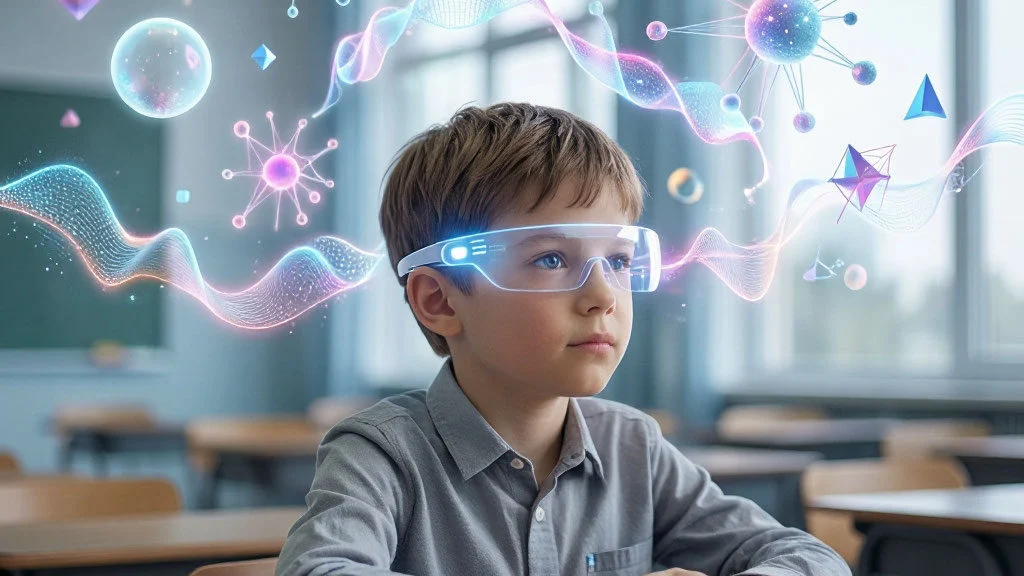


Postverbal Era: How Mass School Overcame the Dictatorship of Phonation
The traditional school was built on the dictatorship of phonation. Literacy in its classical sense is the ability to translate inner thought into a sequence of muscle contractions of the articulatory apparatus or hand. For nonverbal children, children with severe speech dyspraxia or mutism, this path was physiologically blocked, which historically doomed them to the status of cognitively inferior. Postverbal communication eliminated the need for a physical intermediary between consciousness and symbol. In mass school, the BCI/AAC 2.0 protocol (Brain-Computer Interface / Augmentative and Alternative Communication) has been established, where brain-computer interfaces and eye-tracking systems have become as basic an infrastructure standard as desks or lighting.
Architecture of Decoding Inner Language
The system does not read thoughts in their pure form — this is bioethically impossible and technically redundant. It reads patterns of cortical activity that arise at the moment of forming the intention to symbolize.
Capture Layer
Mass school has switched to dry EEG sensors of the sixth generation, integrated into thin headbands or behind-the-ear temples, indistinguishable from medical hearing aids. They continuously monitor the sensorimotor rhythm (mu rhythm) and readiness potential. High-resolution eye trackers are built directly into the lenses of augmented reality glasses or the frames of regular prescription glasses, recording microsaccades at a rate of up to 2000 Hz.
Semantic Filter Layer
This is the core of the system. The AI model is trained individually for each student in the first weeks of use. When a child imagines the image of a ‘red apple’, their visual cortex generates a specific pattern of gamma synchronization in the 40–70 Hz range. When they form the intention to eat this apple, the supplementary motor cortex is activated. The model has learned to distinguish passive imagination from the volitional act of communication.
Generation Layer
Once the intention threshold is crossed, the signal is split according to the user’s request:
- Linguistic branch: direct translation of the neural pattern into text. Inner speech, which for a nonverbal child sounds as clear as it does for us — the voice in the head — instantly appears on the tablet screen in calligraphic font without a single typo, bypassing the stage of typing letters.
- Visual branch: translation of an abstract concept into a generative image. If a child thinks about the ‘anger of the ocean’, the system interprets the combination of high beta activity (emotional charge) and images of water masses (occipital lobe), broadcasting the result to the classroom’s shared screen as a photorealistic picture or stylized graphics.
Transformation of the Pedagogical Environment
The integration of these technologies has changed the very essence of the lesson and the role of the teacher. The concept of ‘special status’ has disappeared. The nonverbal child sits in the common row. Their eye tracker shines with an infrared diode as inconspicuously as a FaceID sensor.
Democratization of Response
The problem of the raised hand has disappeared. The teacher sees a heat map of engagement of the whole class on their panel. The mental answer of the nonverbal student is recorded by the system simultaneously with the shout of a hyperactive neighbor. The teacher calls on the one whose neurogram shows the deepest processing of the question, not the one who makes the most noise.
Rejection of Surrogates
The era of PECS cards, communication boards, and interpreter assistants is gone. The child is no longer a hostage to the tutor’s typing speed. The delay between thought and text has been reduced to 500 milliseconds — the time of natural synaptic transmission. This returned authorship of their words to the child. For the first time in history, mass school hears the authentic syntax and lexicon of internally complex but physically silent children.
New Diagnosis of Dyslexia
The system made it possible to separate the problem of speech production from the problem of comprehension. If a student perfectly formulates complex sentences via BCI but writes in scribbles by hand, the teacher diagnoses pure motor dyspraxia rather than intellectual deficiency, and builds therapy accordingly.
Bioethics of Direct Output
The standardization of such interfaces required the strictest privacy protocol, hardwired into the hardware:
Principle of Sovereign Channel
The output data stream (text/image) has exactly one destination address, chosen by the child themselves. They can send a thought to a teacher, a friend, or a personal private diary. There is no ‘admin access’ that allows adults to read the child’s background thought noise. The school receives only what has been formatted as a completed communicative intention.
Anti-Paralysis Protocol
Protection algorithms prevent ‘cognitive spam’. If the system sees that the user is in a state of panic or epileptiform activity, the output channel is blocked, and the device switches to stabilization mode (projection of calming fractals through AR lenses, rhythmic vibration).
Zero Interpretation of Meanings
The AI acts exclusively as a deaf stenographer. It translates patterns into symbols but does not evaluate their ethical or intellectual value. It does not correct ‘erroneous’ opinions or highlight ‘wrong’ emotions.
Postverbal communication has closed a thousand-year chapter of isolation. It has made literacy a fundamental biological right, not a privilege of those whose neurons are capable of effectively controlling the muscles of the larynx and fingers. In this classroom, silence no longer means emptiness. It is filled with the continuous rustle of the inner speech of dozens of children, which AI carefully, silently, and instantly transforms into the visible world of text and art, forever destroying the tragedy of a locked-in consciousness.





Comments (2)
Если такой BCI реально дойдёт до массовой школы, это может дать невербальным детям голос и убрать ярлык «необучаемых». Но как тогда гарантировать, что школа видит только осознанное сообщение, а не фон мыслей?
Сильная сторона идеи — снятие физиологического барьера и возвращение ребёнку авторства речи. Но 500 мс и «чтение интенции» требуют лонгитюдной валидации на детях с мутизмом: без данных о ложных срабатываниях и утомлении это пока концепция. Для пилота подошёл бы ивановский «Нейрософт»: его сухие ЭЭГ-электроды и опыт регистрации корковых ритмов дали бы аппаратную базу, а коррекционная школа — площадку и данные. Первый шаг — собрать рабочую группу с логопедами и нейрофизиологами и предложить «Нейрософту» протокол на 10–15 учениках.