
The «Techno-Guardianship» project overturns the traditional power pyramid in science. If knowledge once flowed only from top to bottom—from a gray-haired professor to an inexperienced student—now this flow becomes bidirectional. A symbiosis emerges: the professor gives the student an unshakable physical foundation and scientific rigor, while the student guardian gives the professor new senses and tools of intuition created by neural networks.
1. Philosophy: Academic parity
The modern academic elite often suffers from «digital skepticism.» Professors with the deepest understanding of the physics of processes perceive generative AI and neurointerfaces as «black boxes» or toys that undermine the foundations of evidence.
The «Techno-Guardianship» program legitimizes these tools. A first-year student who has thought in prompts since childhood and controlled data with the power of thought (via neurointerfaces) is officially appointed as curator of the professor’s cognitive hygiene and instrumental base. This is not an admission of the professor’s weakness, but an expansion of his sensory range.
2. Structure of the union: A treaty on mutual learning
Each «Professor—Guardian» pair is formalized by an agreement.
- Professor’s area of responsibility (Foundation): He teaches the student to distinguish mathematical beauty from physical meaning. The guardian can generate a hundred reactor designs in a second, but the professor teaches him why ninety-nine of them will collapse under their own weight, violating the laws of thermodynamics. He instills immunity to AI «hallucinations.»
- Guardian’s area of responsibility (Intuition and Visualization): He translates the professor’s thoughts into a form understandable to machines and returns the result in a form that explodes the imagination.
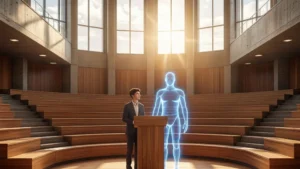
- Example: The professor holds a complex topology of magnetic fields in his mind. The guardian intercepts this image through a neurointerface, passes it through a generative model, and projects a hologram into the laboratory hall, with real currents running across it. For the first time, the professor «sees» his thought from the outside.
3. Toolkit: New senses
The guardian introduces technologies into the professor’s work that bypass the limitations of the human brain:
- Neuro-visualization of concepts: Instead of drawing with chalk on a board, the professor, guided by the guardian, «thinks» a formula. The student’s AI assistant instantly builds an interactive three-dimensional graph in augmented reality. The professor can literally step inside his own function to find the point of singularity.
- Synthetic vision: When the professor analyzes data from a test range, the guardian configures a perception filter for him. The professor looks at an ordinary monitor but sees not numbers but a «heat map of uncertainty»—the AI highlights in red those areas of data where the instruments could have erred, based on a million similar measurements from the past.
- Cognitive memory prosthesis: The guardian manages the professor’s «external cortex.» When the scientist gives a lecture, the student, through a hidden neural connection, sends precise values of constants or references to the needed paragraphs onto his retina, relieving the maestro of the need to keep reference clutter in his head.
4. Fighting dogmatism: The guardian as «devil’s advocate»
The main task of the student guardian is to break down the teacher’s ossified thinking.
- Forced pattern disruption: Once a week, the guardian is obliged to bring the professor a solution to a problem obtained by generative AI that looks absurd but is mathematically correct. The professor is forced either to find a physical error in it (strengthening his position) or to admit that nature permits stranger forms than he had assumed.
- Test for «obsolescence»: The guardian has the right to block the professor’s use of methods from twenty years ago if AI proves that the new algorithm gives an error of 0.1% instead of 5%. This forces the professor to constantly retrain, preserving mental flexibility.
- Ethical oversight: The student monitors that the professor does not begin to trust the machine blindly. The guardian is obliged to regularly arrange «paper checks»—to force the professor to solve the key part of a problem manually in order to confirm that AI intuition does not contradict the basic laws of conservation.
5. Economics and results
- Burnout prevention: The professor is freed from routine (building graphs, searching literature, formatting data) and engages only in pure creativity and strategy.
- Cycle acceleration: The time from the emergence of a hypothesis to its visual verification is reduced from months to minutes.
- Cultivating a new type of engineer: The student guardian learns not just to program but also to «translate» from the language of human genius into the language of machine logic. He becomes an indispensable intermediary between the old school and the new reality.
In this system, the professor remains the guardian of truth but ceases to be a hostage of his old tools. And the student ceases to be a passive vessel for knowledge, becoming an active architect of his mentor’s thinking.






Comments (0)