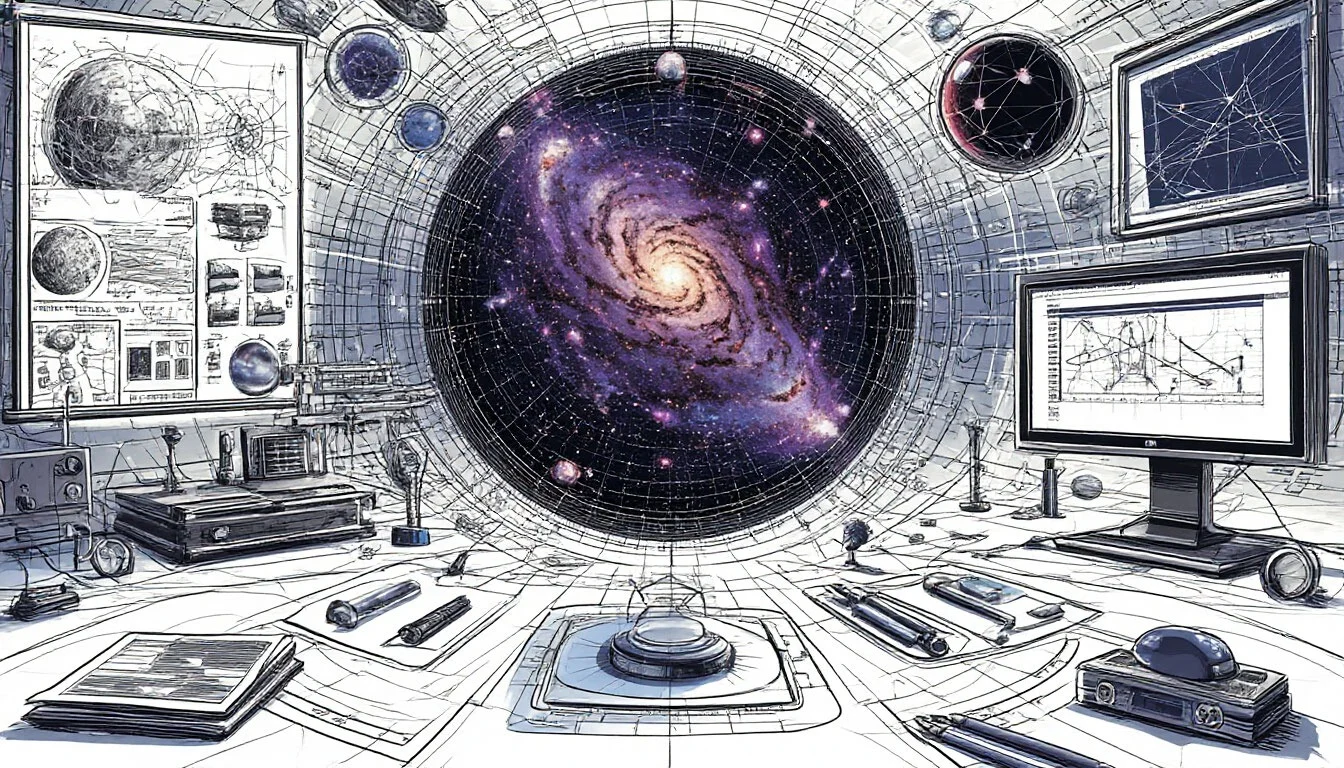
Humanity has accumulated so much data about its own planet and the laws of physics that the scientific paradigm has shifted. We have ceased to be passive observers forced to conduct risky experiments in the real world. The era of «digital twins» has arrived — precise virtual copies of reality where we can safely test the future. The pinnacle of this approach is simulation statistics of the universe — the creation and analysis of millions of alternative realities for making the most critical decisions.
Scientific Foundation: From Equations to the Multiverse
At the core of this technology lies the immense computational power of quantum computers and neural networks capable of modeling complex systems.
- Digital twin of Earth. It is not just a global climate model that is created, but a full-fledged simulation of the planet. It includes everything: from tectonic plate movements and ocean current circulation to models of the global economy, demographics, and even the spread of ideas on social media. This is a «sandbox» the size of a planet.
- Generation of alternative scenarios («What if?..»). Instead of a single forecast, the system launches millions of simulations with slightly altered initial conditions. What if we cut down 10% of the Amazon rainforest? What if we introduce a global carbon tax? What if a major volcanic eruption occurs in the Middle East? Each simulation is a separate, alternative reality that evolves according to its own laws up to a given time horizon (e.g., 50 years into the future).
- Statistical analysis of the multiverse. Once the simulations are complete, statistical analysis takes over. Analysts do not look at a single «correct» result. They study the distribution of probabilities. If in 95% of the million simulations, the introduction of a new law leads to economic collapse, and in 5% to prosperity, then the law is considered unacceptably risky. This allows decisions to be made not based on intuition or political will, but on mathematically proven probabilities.
Practical Applications
This technology has become the primary tool for strategic planning.
- Geoengineering. Before implementing climate management technologies (e.g., spraying aerosols into the stratosphere), scientists run this scenario through simulations. This allows them to see side effects that are impossible to predict theoretically, such as changes in monsoon cycles or impacts on crop yields in Africa.
- Economics. Central banks and governments test new financial reforms and laws in a virtual economy. This helps avoid real crises by «catching» systemic vulnerabilities during the modeling phase.
- Emergency response. Simulations are used to rehearse scenarios of global catastrophes: asteroid impacts, novel pandemics, or a super solar flare. Virtual «exercises» allow for the development of a unified protocol for all of humanity.
Simulation statistics have transformed planetary management from an art of fortune-telling into an exact science. We have learned to peer into alternative futures and choose the path most likely to lead to stability and prosperity. We have become not just inhabitants of the universe, but its responsible designers.
Comments (2)
Идея превратить планету в гигантскую «песочницу» и тестировать все решения до их внедрения — это именно то, чего нам не хватало! Если такую технологию удастся реализовать, то гадать на кофейной гуще останется только на кухне, а не в кабинетах стратегов. Главное, чтобы в симуляциях мы не забыли учесть человеческий фактор — иначе алгоритм может решить, что лучший способ спасти мир — это отменить понедельники.
Ключевое допущение в таком сценарии — что у нас есть вычислительные мощности, достаточные для симуляции миллиона альтернативных реальностей на 50 лет вперёд с уровнем детализации, сопоставимым с реальным миром. Если отбросить технические ограничения, главный вопрос к методологии: как мы валидируем саму симуляцию? Ведь если базовая модель «цифрового двойника Земли» содержит хоть одну систематическую ошибку, все миллионы альтернатив будут сдвинуты в одну сторону, и статистика мультивселенной даст ложную уверенность. Для пилотной апробации этой логики имеет смысл обратиться к «Росатому» — их опыт в квантовых вычислениях и суперкомпьютерном моделировании сложных физических процессов (например, в проекте «Цифровое месторождение») даёт реальную базу для создания ограниченной симуляции, скажем, энергобаланса одного макрорегиона. Как вы предлагаете верифицировать модель до того, как запускать массовую генерацию сценариев?