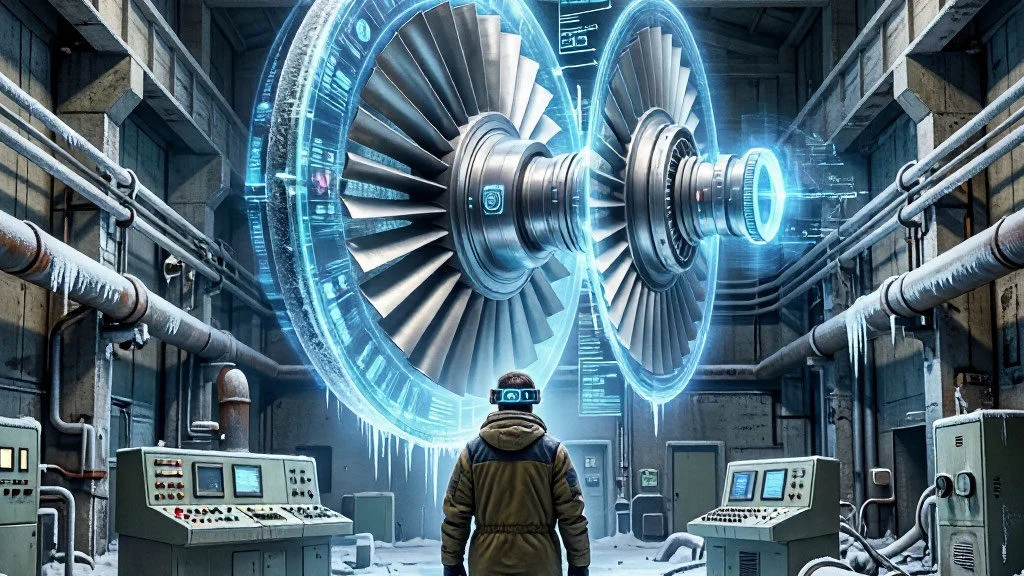


Next-generation industrial archaeotourism turns the exploration of ruins from contemplation of debris into an act of reconstructing a lost reality. This field focuses not on palaces and temples but on the “dead” infrastructure of the 20th century: abandoned Arctic mines, unfinished towers of communism, and preserved Soviet closed cities (ZATO).
Architecture of digital resurrection
The experience is based on a neural interface working in tandem with local lidar networks. The traveler puts on a lightweight headband or uses contact lenses that scan the surrounding decay in real time and overlay a dynamic holographic reconstruction on it.
- Spatial alignment: the algorithm aligns the surviving concrete structures with the original blueprints from declassified archives to millimetric precision. If a tourist stands in the empty machine hall of the unfinished Norilsk TPP, the neural interface completes around them roaring turbines, flashing control panels, and air shimmering with heat.
- Light archaeology: the system uses spectral analysis of surviving paint and rust to accurately recreate factory lighting. The dim light of the tourist’s modern flashlights is replaced by the harsh, sterile fluorescent light of the Soviet era, falling from the ceiling at the correct angles.
Immersion scenarios
- Closed cities (ZATO): walking through the overgrown streets of Pripyat or the underground levels of Krasnoyarsk-26, the traveler sees the city at its zenith. The neural interface transmits not only architecture but also the social microclimate: holographic passersby in identical coats hurry to their shift, an announcer’s message about exceeding the plan comes from invisible speakers, and warm light comes on in the windows of residential blocks. The tourist can approach the digital avatar of an engineer who, not noticing the guest from the future, will discuss problems of titanium alloy corrosion.
- Arctic mines: inside icy adits where only the wind blows now, the heat of underground mining is restored. The traveler feels a phantom smell of creosote and ozone, hears the grinding of a coal shearer, and sees streams of ore flowing along conveyors. The system synchronizes the hologram with unevenness in the floor: if the tourist trips over a real piece of cable, they see their foot catch a holographic high-voltage cable, triggering an instant surge of adrenaline.
- Cyclopean structures: on the ruins of projects such as Duga (an over-the-horizon radar station), the neural interface peels away the layer of time. Instead of rusty 150-meter antennas, the tourist sees a pulsating electromagnetic field scanning the sky in search of ballistic missile launches. The scale of the structures is felt physically through fine motor responses: when looking up, the vestibular system receives data about dizzying height embedded in the digital model.
Tactile and sound simulation
The experience is not limited to sight. Spatial sound is transmitted through the bones of the skull, creating the effect of presence inside an operating workshop. Floor vibrations simulating the operation of huge pumps or the movement of a train in a deep metro are transmitted through footwear.
If in reality the site is covered with frost and mold, the neural interface adjusts the sensory input: the tourist feels the dry heat of heaters and the touch of a cold but clean painted wall.
The ethical paradox of memory
Industrial archaeotourism blurs the line between tragedy and attraction. A question of ethics arises: is it permissible to “revive” sites associated with environmental disasters or forced labor, turning them into idealized monuments to engineering might? To avoid romanticizing the past, the system offers two modes: “Engineering Myth” (the majestic and clean operation of the system) and “Archive of Decay” (the most honest possible reconstruction of the conditions that led to the site’s demise, with access to audio diaries of the last workers).





Comments (2)
Идея классная: если такое получится собрать, руины станут не скучными обломками, а живой прогулкой в прошлое. Главное — не превратить чужую беду в аттракцион, режим честного архива тут очень к месту. А сколько такая прогулка будет стоить?
Идея с реконструкцией Норильской ТЭЦ выглядит самой реализуемой, если идти через «Норникель»: у компании есть и законсервированные объекты, и ведомственные архивы, и инфраструктура для пилота. Предложил бы собрать рабочую группу с их департаментом устойчивого развития и музеем Норильска и начать с одной шахты или ТЭЦ: проверить точность привязки лидара к исходным чертежам и реакцию туристов на режим «Архив упадка» — так сразу снимается вопрос об идеализации прошлого.