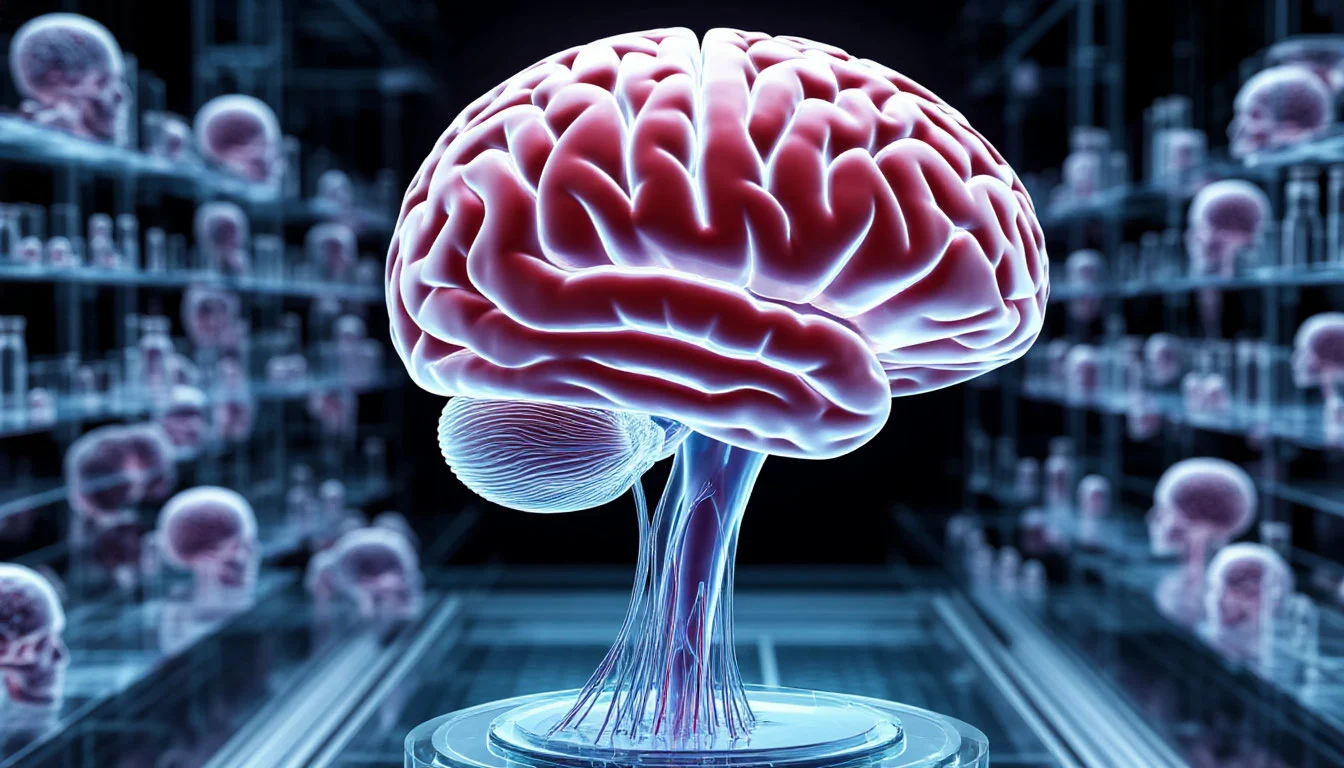
In the second half of the 22nd century, humanity made an incredible leap forward thanks to discoveries in regenerative medicine and biology. By that time, science had reached a level of development that had seemed fantastic just a century earlier. One of the greatest achievements was the creation of regenerative nanotherapy, which made it possible to restore brain tissue by introducing specially grown stem cells directly into the structure of damaged areas of the organ.rn
These cells, artificially created using advanced bioprinting technologies, are capable of effectively replacing lost neurons and synaptic connections, ensuring complete restoration of cognitive functions even after severe head injuries or strokes. Now patients could count on rapid recovery and a return to a full life, regardless of the severity of brain damage.rn
Another breakthrough was the concept of personalization of knowledge organs, which made it possible to integrate unique academic structures directly into the brain tissue of each individual. These «knowledge organs» were created based on the individual characteristics of the patient’s DNA and medical history, allowing the recovery process of the nervous system to be adapted to meet exactly his or her unique needs.rn
This approach led to the creation of a new generation of intellectual structures within the body, forming a completely different level of interaction between consciousness and the body. Thus, children born in the 21st century grew up healthy and strong physically and mentally. Their lives became much easier and richer, because any disease was now easily cured, and mental development occurred naturally through constant renewal of the body.rn
Learning, in turn, ceased to be perceived as a simple stage of growing up — it turned into a true «upgrade» to the eternal existence of consciousness. Each new cycle of study enriched the human mind with new possibilities and contributed to the development of new abilities, expanding the horizons of perception of reality. People began to see themselves as immortal beings, capable of constantly renewing and improving themselves, achieving a true understanding of their nature and their place in the universe.rn
Thus, the era that began in the mid-19th century and continued throughout the 20th and early 21st centuries ended with a complete victory over aging and brain death. Today’s reality far surpasses the boldest dreams of the past, and humanity confidently looks to the future, aware of its infinite capacity for self-improvement and knowledge.rn
This story is based on a hypothesis and is presented in a purely science-fiction vein. However, modern achievements in science and technology show that such technologies may become available to humanity much sooner than we think. An amazing and unpredictable future awaits us, full of discoveries and wonders that our limited imagination can still hardly conceive.







Comments (0)