


The digital environment of the 2030s professional completely abandons the resume format — that flat, linear document that lies about the past to sell the future. It is replaced by the “Competency Map” — a dynamic, three-dimensional digital twin of a professional. This is not just a list of software tools mastered, but a neural network model that captures hidden connections: how a legal education helps a GR specialist build the security architecture of an IT startup, how experience as editor-in-chief allows a crisis manager from a research institute to structure chaos in data, how 15 years in media provide an understanding of the architecture of user attention. The AI recruiter of this era is no longer a simple keyword parser. It works as a complex navigator: it does not offer a “vacancy”; it scans the digital environment for “complex interdisciplinary tasks.”
Entering this environment looks like abandoning the corporate portal in favor of a professional metaverse. A 40+ specialist logs into the system not to update the “open to offers” status but to immerse themselves in a visualized flow of problems. The architecture of this interface is fundamentally anti-ageist: there are no bright neon buttons, no endless feed, and no dopamine-triggering notifications. The environment is designed for linear, deep thinking. Tasks are presented not as text but as interactive diagrams — “problem maps.” For example, at the intersection of law, media, and engineering, AI highlights a bottleneck: “A state corporation cannot implement domestic software due to sabotage by middle management.” The neural network does not offer the specialist a “vacancy for head of the implementation department.” It outlines the task and asks: “Your expertise in change management and knowledge of corporate law allow you to resolve this conflict in 4 months. What configuration of the project team do you want to assemble?”
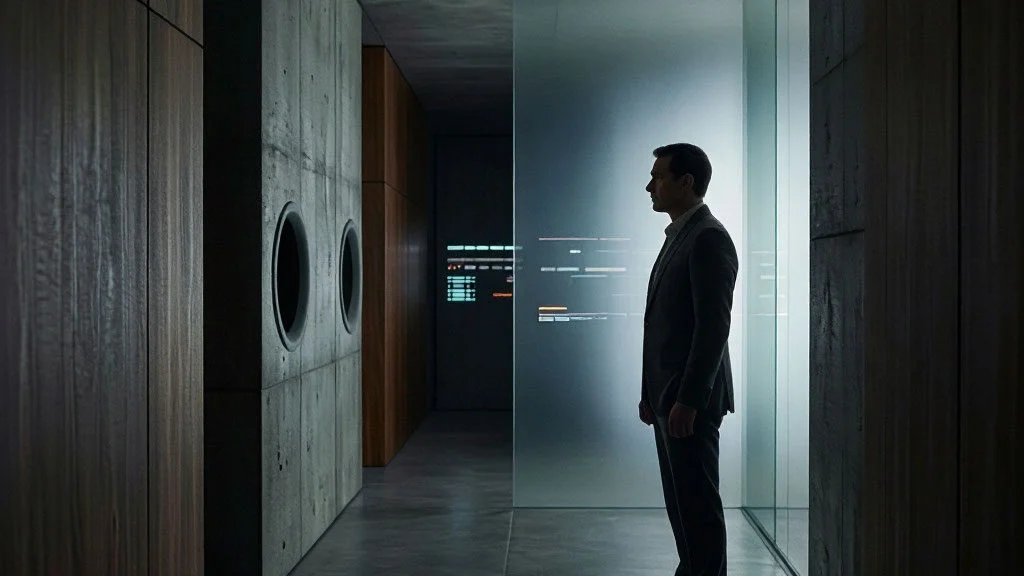
The physical architecture of work is also transforming. The concept of an “office” disappears. In its place comes a network of “Navigation Nodes” — a new type of coworking space that cannot be accessed with a day pass. Access to them is granted only with an active “Competency Map” with a high rating. The space inside is devoid of open-plan areas. It is a complex system of acoustically isolated capsules for deep reflection, rooms with two-way glass walls for observing project teams at work (a mentoring architecture), and halls with holographic tables for visualizing complex data. There are no water coolers for gossiping; the architecture physically enforces project discipline.
The social contract of the 40+ specialist changes along with their digital shell. They no longer seek “stability” in the form of an official salary and corporate health insurance. Their main need is an “intellectual damper”: protection from toxic management, meaningless meetings, and corporate politics. The platform architecture of the 2030s includes an automatic “idiocy filter”: AI analyzes work chat correspondence and blocks tasks where one sentence of meaning has five words of corporate Newspeak.
By 2036, the success of this architecture will be measured not by the number of vacancies filled but by the volume of “hidden” competencies returned to the economy. 40+ specialists will cease to be “burned-out ballast” that must be cut. They will become autonomous cognitive modules — expensive, fast, and precise instruments that connect to a corporation, government, or startup for exactly the period required to solve a specific architectural problem, and then disconnect silently, retreating into the shadows to navigate toward the next complex task. This is the architecture of the “career damper”: an environment that absorbs the blow against the ceiling and turns a vertical fall into controlled horizontal flight.








Comments (3)
Если карту компетенций и «фильтр идиотии» действительно внедрят, я только за: резюме пусть отдыхает, а умные схемы вместо вакансий звучат куда приятнее. Главное, чтобы метавселенная не оказалась тем же опенспейсом, только с голограммами.
3 фактора будут важны: компетенции, достижения и потенциал (для начинающих специалистов)
Сильная сторона идеи в том, что карта компетенций снимает с резюме роль единственного доказательства опыта, но проверять это нужно на живых данных. Пилот предложил бы Сберу: у него есть GigaChat, большой массив обезличенных HR- и проектных данных и СберУниверситет как площадка для эксперимента. Первый шаг — рабочая группа с HR-аналитиками и тест на 200–300 специалистах 40+ из ИТ-блока: сравнить, что находит карта и что видит рекрутер по резюме.