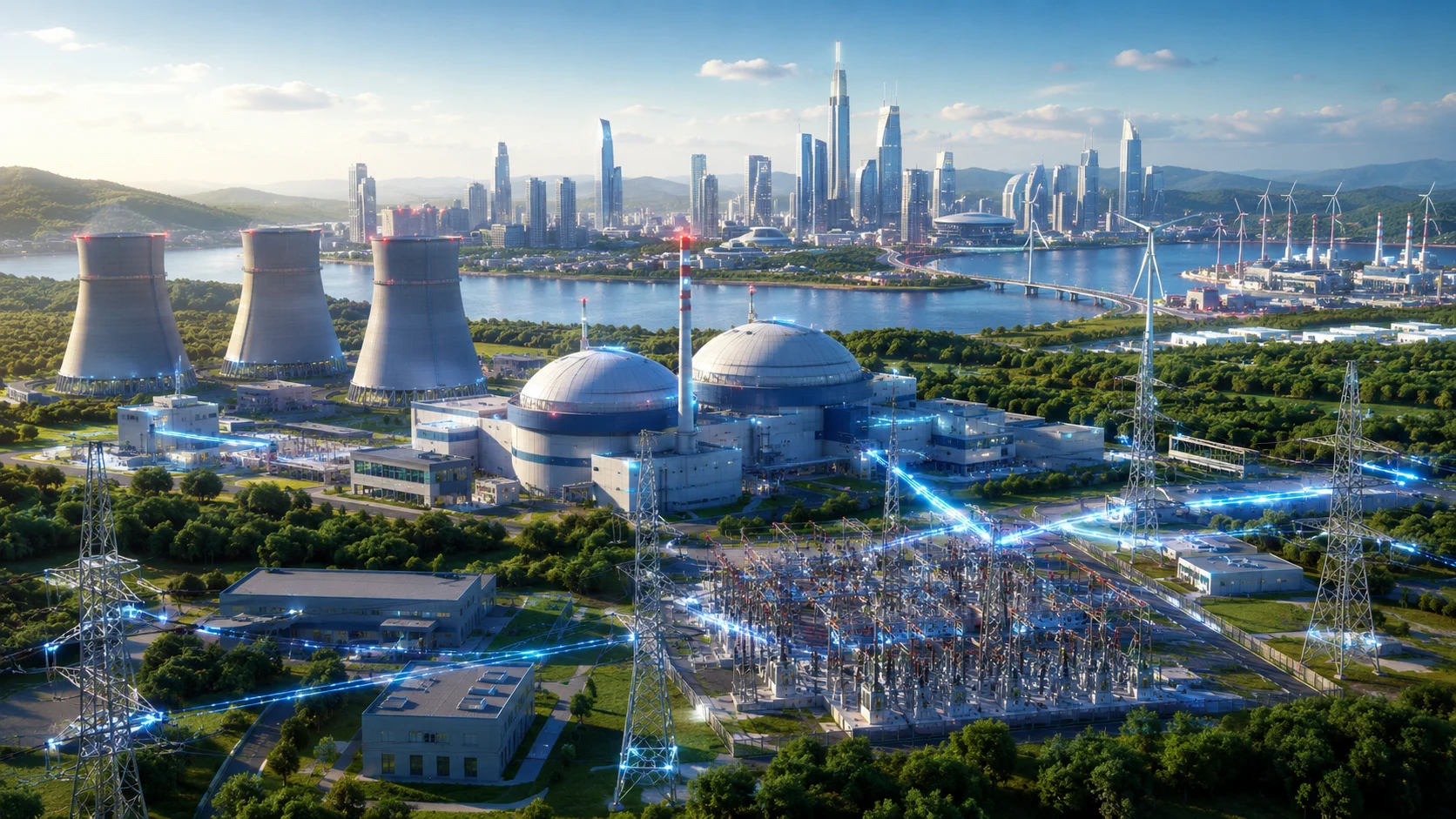
Peaceful Atom Creates Energy for Long-Term Development
By the early 2030s, Russia’s peaceful atom had become the energy framework of the future for Russia and its partner countries. Nuclear energy was no longer perceived as a sector of large power plants. It became part of a technological package: electricity, heat, medicine, personnel training, research centers, new materials, hydrogen solutions, small modular reactors, and the development of cities around high-skilled labor.
For Russia, this meant strengthening its engineering school and exporting complex solutions. The country offered partners not just the construction of facilities, but a full life cycle: specialist training, safety, service, fuel, digital support, scientific programs, and industrial cooperation. Domestically, nuclear technologies helped develop remote territories, provide sustainable energy, support industry, and create jobs where stable infrastructure was previously lacking.
Engineering School Becomes an International Advantage
The path to this future included several sequential steps. First, educational programs for engineers, physicists, builders, environmentalists, operators, and safety specialists were strengthened. Then new projects emerged in small-scale nuclear energy, medical isotopes, materials science, and digital twins of power plants. The next step involved working with society: people began to have technologies explained in simple terms, safety standards were showcased, along with real professions and benefits for regional development.
I personally participated in this future through an interest in science and a responsible attitude toward knowledge. Contributions from others included: a schoolchild choosing physics and engineering clubs, a student pursuing nuclear specialties, a journalist writing accessible materials, a local resident taking part in public discussions, an entrepreneur creating services around industrial projects, and a teacher helping children see human meaning in complex science. The peaceful atom was no longer a distant topic but part of a culture of development.
«Futureating» became a platform where nuclear energy was revealed as an image of a constructive future. Users created posts about small reactors, energy in the North, nuclear medicine, engineering education, international cooperation, and science cities. The platform allowed assessment of probability, benefit, and contribution, as well as compiling roadmaps: whom to train, what projects to discuss, where partners are needed. Thus, the peaceful atom became a symbol of long, steady, and technological growth.
Comments (1)
Идея формирования вокруг атомных технологий полноценных региональных экосистем — сильный ход, но на практике ключевым звеном станет не столько энергоблок, сколько локальная инфраструктура сервиса и подготовки кадров прямо на площадке. Как в этой модели предполагается решать логистику топливного цикла для малых реакторов, работающих в изолированных районах? Для пилотной отработки такого подхода можно было бы привлечь АО «ТВЭЛ» — у них есть компетенции в проектировании топливных сборок для малых реакторов и опыт выпуска медицинских изотопов. Конкретный первый шаг — сформировать совместную рабочую группу с участием их центра инноваций и одного из регионов Дальнего Востока, где малый реактор мог бы стать ядром энерготехнологического кластера.