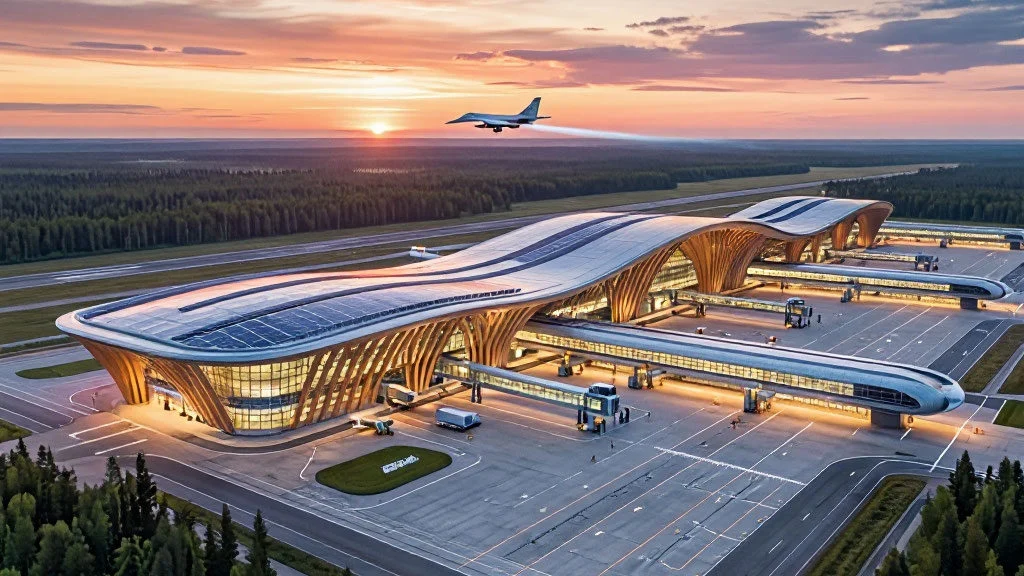



Boom in airport and airfield construction in Russia
The inevitable emergence of transport into the 3rd dimension caused a boom in the construction of airports and airfields in Russia.
By 2075, more than 500 airports and airfields had been built and modernized in the country. All this infrastructure was developed and managed by public trusts in the Noonomy paradigm. For mass transportation of passengers and cargo, large comfortable airliners remained; for individual travel in cities and over short distances, individual drone taxis. Most aircraft became supersonic: the technical problem of eliminating the sonic boom when crossing the sound barrier was solved. Of course, Russia became one of the leaders in national drone and aircraft manufacturing entirely on its own technological base. There was a transition from kerosene as fuel to other types of energy, without a carbon footprint. Every third aircraft and drone in the world was made in Russia. All airports — in an architectural sense — are works of art, in a technical sense — wonders of engineering thought, where everything is extremely thought out, organized, convenient, comfortable and fast. A high degree of robotization, all airport logistics and processes optimized with the help of AI. Thus, the strategic task was successfully solved, on which the connectivity of a huge territory, the economic growth of regions and the quality of life of people directly depended. Below I present the implemented 50-year plan.
Classification and priorities
According to the Air Code of the Russian Federation, airports were historically divided into federal (hubs between Moscow, St. Petersburg, the new capital Noograd in the Minusinsk Basin, and the capitals of regions, as well as international), regional (between subjects and within them) and local (within settlements, for small aviation, helicopters and drones).
Priorities were built and implemented according to importance for the country:
- I. Critical priority: Large hubs (Moscow, St. Petersburg, Noograd) were modernized and expanded, as well as a supporting network for territorial connectivity (Far East, Arctic).
- II. High priority: Development of regional hubs for direct interregional flights (bypassing Moscow) and creation of international hubs in the east.
- III. Medium priority: Restoration of the network of small aviation airfields for local transportation and air ambulance.
- IV. Special priority: Construction of helipads for hard-to-reach areas and tourism development.
Below — for concreteness — is a breakdown by categories with approximate costs incurred.
I. Large hubs (Moscow aviation hub and St. Petersburg, Noograd)
- Facilities: Sheremetyevo, Domodedovo, Vnukovo, Pulkovo, Nooport
- Activities: Construction of new runways (RWY), terminals, integration into a single complex, development of high-speed railway lines.
- Costs: Vnukovo ~150 billion rubles. Moscow aviation hubs — 900 billion rubles. Nooport — 1.5 trillion rubles. Construction of a runway at Tolmachevo (Novosibirsk) ~120 billion rubles.
II. Supporting network and the Far East/Arctic
- Facilities: Khabarovsk, Vladivostok, Yuzhno-Sakhalinsk, Blagoveshchensk, Yakutsk, Magadan, Petropavlovsk-Kamchatsky, Anadyr, Norilsk, Tiksi, Dikson, Pevek.
- Activities: Reconstruction of runways, construction of new terminals (capacity up to 1000 passengers/hour), creation of international hubs.
- Costs: Terminal in Blagoveshchensk >13 billion rubles; terminal in Pevek 2 billion rubles.
III. Regional hubs (Interregional flights)
- Facilities: Omsk (new airport), Irkutsk (new airport), Gorno-Altaysk, Smolensk, Yoshkar-Ola, Makhachkala, Krasnoyarsk, Karachay-Cherkessia.
- Activities: Construction «from scratch» (runway [phone removed] m), reconstruction, creation of hubs for China.
- Costs: Omsk-Fedorovka 51 billion rubles; airport in KChR 36.5 billion rubles; reconstruction of Smolensk 5.7 billion rubles; Makhachkala 13 billion rubles.
IV. Small aviation and local airfields
- Facilities: Airfields for modernized An-2, An-28, Mi-8 helicopters (example: 10 airfields in Nizhny Novgorod Oblast).
- Activities: Restoration of runways, construction of landing pads.
- Costs: 8.3 billion rubles for 10 airfields (of which 3 billion — for 4 pilot ones).
V. Helipads and specialized infrastructure
- Facilities: Heliports in Moscow, Sochi, Ufa; emergency rescue centers in the Arctic.
- Activities: Construction of terminals, pads (including aluminum ones for drones).
- Costs: Terminal in Ufa ~1 billion rubles.
Financing and timelines
The total cost of the program was estimated in trillions of rubles, which were allocated by the Central Bank in the form of targeted emission, as for railways, bridges and tunnels. This emission paradoxically caused deflation and lower prices. This large-scale plan allowed Russia to create one of the most extensive aviation networks in the world, ensuring territorial connectivity and economic growth.


Comments (1)
Если такую программу разворачивать, узкое место окажется не в бетоне ВПП, а в сертификации электро- и водородных силовых установок и в правилах совместных полётов дронов с лайнерами — без этого сеть останется красивой картинкой. Пилот по ИИ-логистике и роботизации терминалов стоило бы отрабатывать с «Новапортом»: холдинг даёт готовые площадки, статистику пассажиропотока и доступ к региональным аэропортам. Первый шаг — рабочая группа с их операционным блоком и Минтрансом под один хаб. Вопрос: нормативную рамку для дронов-такси держит единый оператор или регионы?