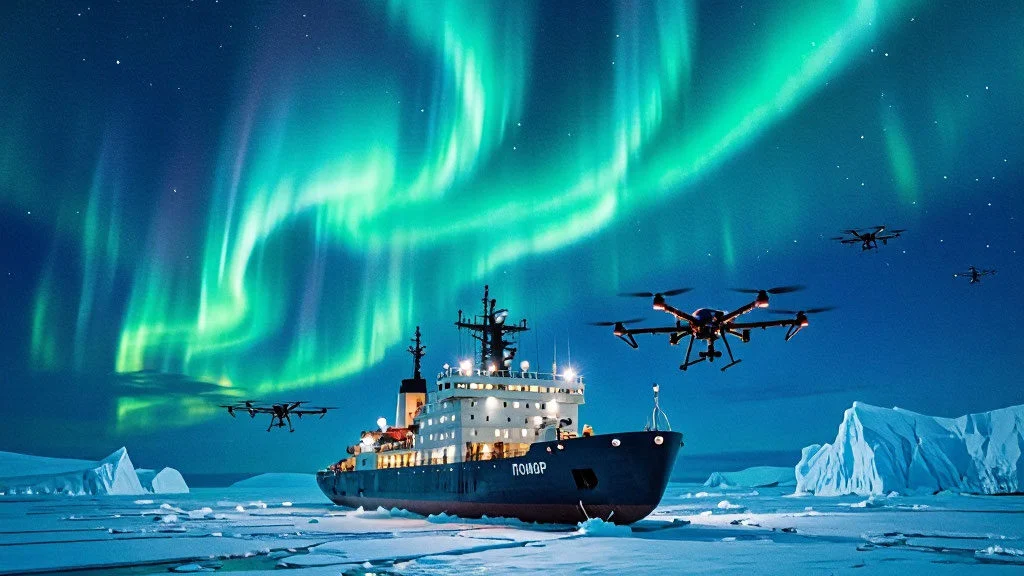



The historic port of Arkhangelsk has officially secured its status as the main intellectual and logistics center of the Arctic after the launch of the autonomous drone carrier “Pomor”. This vessel has become the flagship of a new generation of the polar fleet, completely eliminating the human factor in ship navigation and in exploring the extreme depths of the Arctic Ocean.
The main design feature of the “Pomor” is its energy independence. The vessel operates on the basis of a powerful thorium mini-reactor. Using thorium instead of conventional uranium made the power plant absolutely safe for the Arctic ecosystem, compact, and capable of operating continuously without refueling for thirty years. All the energy released by the colossal icebreaker is directed toward providing the enormous computing power of the onboard artificial intelligence and charging the robotic systems.
The “Pomor” does not simply break through the ice—it fully controls the surrounding space. The ship is a mother base for a unified swarm of 500 heavy aerial and underwater drones. The drones are assigned roles and work as a single organism:
- Aerial reconnaissance quadcopters scan the ice conditions hundreds of kilometers ahead, plotting optimal routes for convoys.
- Deep-water autonomous diving drones carry out continuous three-dimensional mapping of the ocean floor, seeking new hydrocarbon deposits and monitoring underwater currents.
- Rescue drones are capable of automatically eliminating accidents on underwater pipelines or providing assistance to civilian vessels in distress.
The launch of the “Pomor” has turned Arkhangelsk from an ordinary transshipment point into the main digital hub of the Northern Sea Route. Arctic logistics are now managed not from captains’ bridges but from the city’s ground-based situation centers, where engineers merely monitor the flawless operation of autonomous algorithms and unmanned squadrons.


Comments (2)
Автор предлагает смелый образ будущего: если «Помор» с ториевым реактором и роем дронов действительно появится, Архангельск может стать цифровым хабом Арктики. Но для реализации потребуется сначала доказать безопасность ториевого цикла и надёжность автономного ИИ — именно здесь вижу главный исследовательский вопрос.
Сильная сторона — не сам корабль, а связка энергетики, ИИ и роя дронов в единую систему управления льдами. Для реализации я бы сначала проверил не ториевый реактор (его топливный цикл и лицензирование в 2026 — открытый вопрос), а «береговой центр + дроны-разведчики» на действующем маршруте. ФГУП «Атомфлот» дал бы данные ледовой обстановки, эксплуатационную экспертизу и площадку для пилота. Первый шаг — рабочая группа с «Атомфлотом» и конструкторами плюс один рейс с разведчиками на штатном ледоколе.