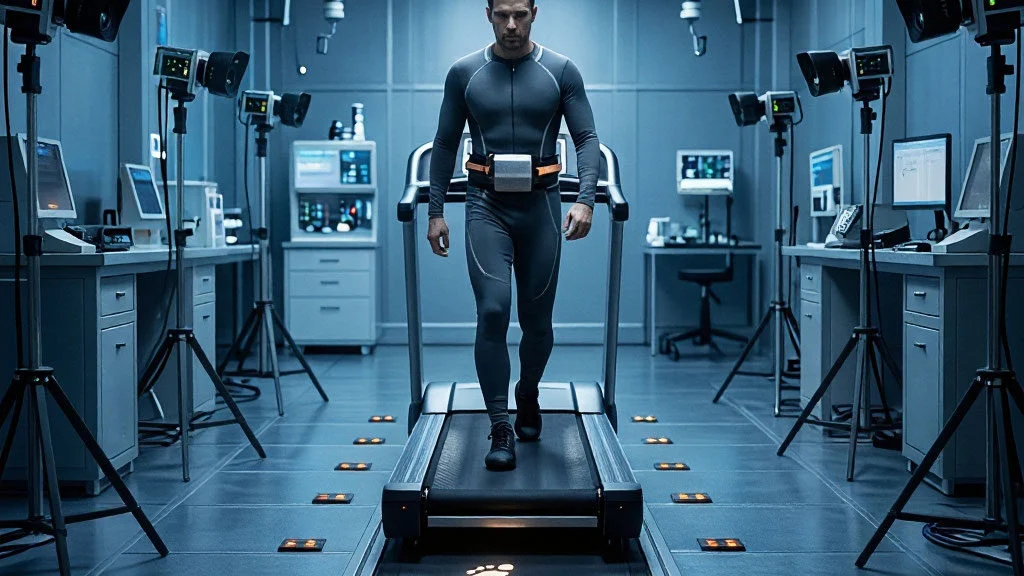


A person’s gait proves to be a far more stable and unique identifier than facial geometry, since it is governed by the deep biomechanics of the skeleton, which is almost impossible to fully alter through willpower. In data-collection laboratories, test subjects turn into living mechanisms whose movement patterns are recorded with obsessive precision. They pace for hours on treadmills and complex stair flights, but the experimental conditions keep changing. They are fitted with uncomfortable shoes two sizes too large, weights are attached to their waists to simulate heavy loads, and special sprayers simulate freezing rain, forcing the body to instinctively contract and shift its center of gravity. A separate group imitates various types of limping and injury, shifting weight to the inner or outer edge of the foot.
Floor pressure sensors and high-speed cameras from different angles record this ‘gait passport’. The system records not just the movement trajectory but a highly complex force profile: the time the heel contacts the surface, the angle of foot pronation, the vertical oscillations of the center of mass, and the micro-rotation of the pelvis that compensates for stride asymmetry. This data forms a closed dataset that will never enter public access, since it is the key to security systems capable of recognizing people in a crowd even in baggy clothes and balaclavas.
To train algorithms, statisticians confront the classic problem of imbalanced data. A sample will always contain a huge number of examples of ‘normal’ gait and only a few recordings of specific patterns, for example, the movement of a person with an old knee injury. To prevent the neural network from ignoring rare classes, a weighted loss function is used. The algorithm is penalized much more severely for an error in recognizing a rare type of limping than for confusing two ordinary pedestrians.
The main mathematical task becomes calculating gait entropy. This is a measure of uncertainty that the algorithm must overcome. Statisticians seek the point at which the information noise introduced by clothing, load, and weather is outweighed by the unique biomechanical signature of a particular person. Using sequential analysis, they calculate the minimum number of steps the system needs to distinguish one individual from another with 95 percent probability.
It turns out that for basic identification under ideal conditions, the algorithm needs three to four full gait cycles. However, in the presence of interfering factors—for example, if a person is carrying a heavy asymmetric load—entropy rises sharply. In such cases the model needs to track the object over twelve to fifteen meters to accumulate enough data about exactly how the spine and knees compensate for this weight. Once the accumulated information lowers uncertainty below the critical threshold, the system places an invisible label on the digital twin in the crowd, permanently linking the anonymous figure to its unique biomechanical profile.





Comments (3)
Проверять это стоит на независимой выборке, публикуя долю ложных срабатываний при разном размере толпы, а не только точность; и начинать с режима подсказки оператору, прописав срок хранения метки и правовые гарантии до пилота.
Автор предлагает методологически честный ход — обучать модель на вариативных условиях и взвешенной функции потерь, это сильная сторона. Но если это реализовать, смущают три вещи: закрытый датасет без правовых гарантий, обещание узнавать людей в балаклавах при признанном росте энтропии от груза и обуви, и цифра 95% без указания доли ложных срабатываний в толпе. Как вы предлагаете это проверять?
Идея с энтропией походки сильна тем, что переносит идентификацию туда, где лицо закрыто, но для реализации автору не хватает протокола валидации на «грязных» данных: разные камеры, ракурсы, сезонная одежда. Если доводить до пилота, логично идти к NtechLab — их видеоаналитика и опыт разметки дадут готовые пайплайны и доступ к площадкам заказчиков. Первый шаг: собрать рабочую группу с оператором транспортного узла и проверить устойчивость сигнатуры на записях камер метро при грузе и хромоте, прежде чем фиксировать пороги.