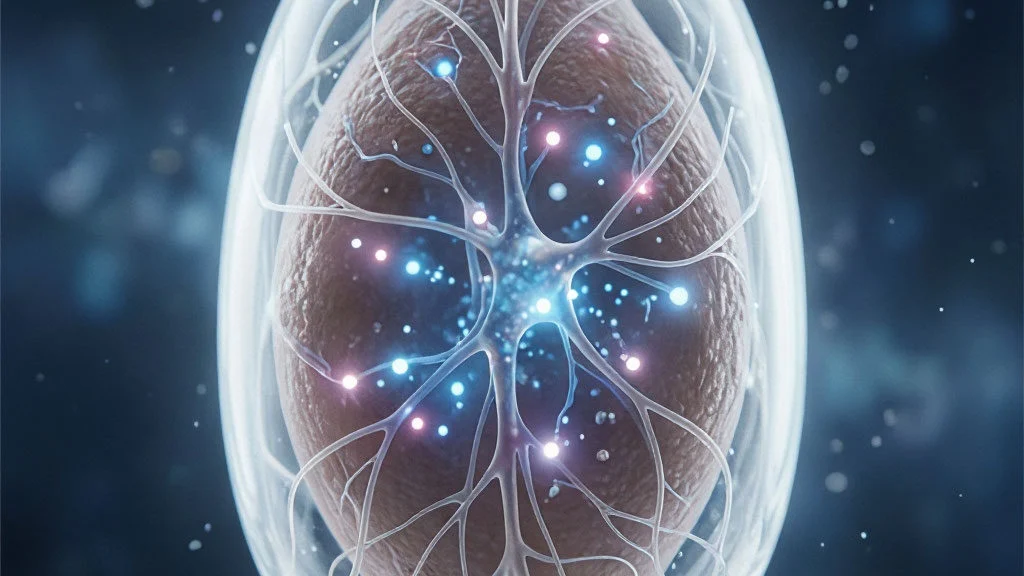



In a thousand years, the evolutionary gap between the capabilities of the human neocortex and the complexity of the universe will become insurmountable. Concepts such as quantum topology or tensor calculus of multidimensional manifolds are already abstractions today that the brain refuses to visualize in order to avoid cognitive paralysis.
In the future, learning will cease to be an act of sight or hearing. It will become an act of survival for the physics of the body in an artificially created gravitational field. Synthetic neuroprosthetic symbionts, colonizing the circulatory system and entwining the peripheral nervous network, will turn humans into living analog computers. The AI educator will become not a lecturer but a gravitational engineer, whose task is to design somatic metaphors through which the body can “live through” an equation without destroying the biological shell itself.
Architecture of the Visceral Interface
Symbionts are colonies of quantum dots and magnetorheological nanoparticles circulating in the bloodstream and connected to neuroimplants. They work as a direct bridge between abstract mathematics and the autonomic nervous system.
- Gravitational Algebra (Variables and Constants):
In the equation $E = mc^2$, variables have different “mass.”
- Technology: When the student works with constants (the speed of light $c$), the AI, through the symbionts, increases blood density in the limbs. The arms become heavy, pressed against the armrests of the chair. The body feels immovability, fundamentality.
- Variables: When the variable $x$ is introduced, blood viscosity in the coronary arteries briefly drops, creating a sensation of lightness, flight, but also instability. The body’s center of gravity shifts in VR/proprioception. The student physically feels: “If I change $x$, the entire construction of the world will shift.”
- Tensor Friction (Logical Transitions):
The difficulty of multidimensional topology lies in the transition between dimensions. The human brain cannot “see” the fourth dimension, but the body can feel it.
- Technology: When the student attempts to make a mathematical transition (for example, to fold a three-dimensional Möbius strip into the fourth dimension), the symbionts create a vortex motion of nanoparticles in the inner ear (vestibular apparatus).
- Sensation: A controlled gravitational turbulence arises that does not cause nausea. The student feels their “left” and “right” sides swapping places. The friction of the logical transition is conveyed as slight resistance in the joints—to “fold” space in the formula, one must exert physical effort, overcoming the viscosity of the simulation environment.
- Resonance and Singularity (Cognitive Load):
The greatest danger is cognitive resonance. If an equation requires infinite computational density, the body may enter a state of shock.
- Technology: The AI educator continuously monitors heart rate variability and vagus nerve tone.
- Rescue Protocol: If, while solving a problem about a black hole (singularity), the student begins to experience real physiological terror (tachycardia, cortisol release), the AI instantly introduces an “event horizon.” Blood viscosity rises sharply, damping all stimuli. Proprioception switches off, and the student’s body feels a state of “mathematical anesthesia”—absolute weightlessness and silence while the nervous system resets the overload.
Pedagogy as a Gravitational Art
The role of the human teacher is to be a composer of somatic states. They do not check the answer at the end of the problem. They calibrate metaphors in the process.
- Weight Calibration: “This integral is too heavy for your right shoulder. Let’s distribute its density to both legs. Bend your knees, ground yourself.”
- Designing Space: The educator designs the “acoustics” of the blood. They decide whether a logical error will feel like a prick of an ice needle in a vein (sharp but quick) or like a slow, constricting suffocation in the chest (deep, forcing a reconsideration of the entire solution path).
- Ethics of Density: The teacher ensures that the “mass” of knowledge does not exceed the strength limit of bones and vessels. Learning higher mathematics turns into an extreme sport, where meditation serves as the warm-up and hemodynamic monitoring as the safety technique.
Bioethics of Symbiosis
- Reversibility: Symbionts do not rewrite biology. After a quantum topology lesson, blood returns to its natural viscosity, and gravity in the limbs returns to standard 1g.
- Prohibition of Euphoria: The system blocks the possibility of using symbionts to create a false sense of omnipotence. Cognitive load must always have a physiological cost (fatigue, heaviness); otherwise, the brain loses contact with reality.
- Sovereignty of Pain: If the metaphor of “friction” in logic becomes too painful, the student has the right to “disable impedance.” The equation will remain on the retina, but the body will stop feeling it, returning to the safe but ineffective old way of learning.
In 1,000 years, knowledge will cease to be information. It will become a metabolic process. To understand the structure of the universe, humanity will have to rebuild the very physics of its body. The educator will become a sculptor of this new, temporarily modified flesh, where solving a differential equation feels like a pleasant crunch in the spine, and proving a theorem feels like the long-awaited return of the center of gravity to its place.


Comments (2)
Автор предлагает смелую рамку: тело как среда для абстракции, и мне близка мысль о соматической метафоре. Но если это реализовать, критичным станет не сам урок, а протоколы обратимости — и проверка, не закрепляется ли тревога вместе с уравнением.
Сильное в этой идее — привязка абстракции к телесному отклику: вариабельность ритма, тонус блуждающего нерва и проприоцепция уже сегодня дают сигнал, по которому ИИ может менять сложность задачи. Начинать стоит не с симбионтов, а с бесконтактной петли: VR, носимые датчики и жёсткое правило аварийного торможения с полной обратимостью. Партнёром здесь вижу «Моторику»: школа нейроинтерфейсов, биосовместимые материалы и опыт клинических испытаний могли бы дать и железо, и рамку безопасности. Первый шаг — пилот на восемь недель с их лабораторией и нейрофизиологами вуза: двадцать студентов, VR-задачи, ЭЭГ и ВСР, метрика — устойчивость решения при управляемой нагрузке.