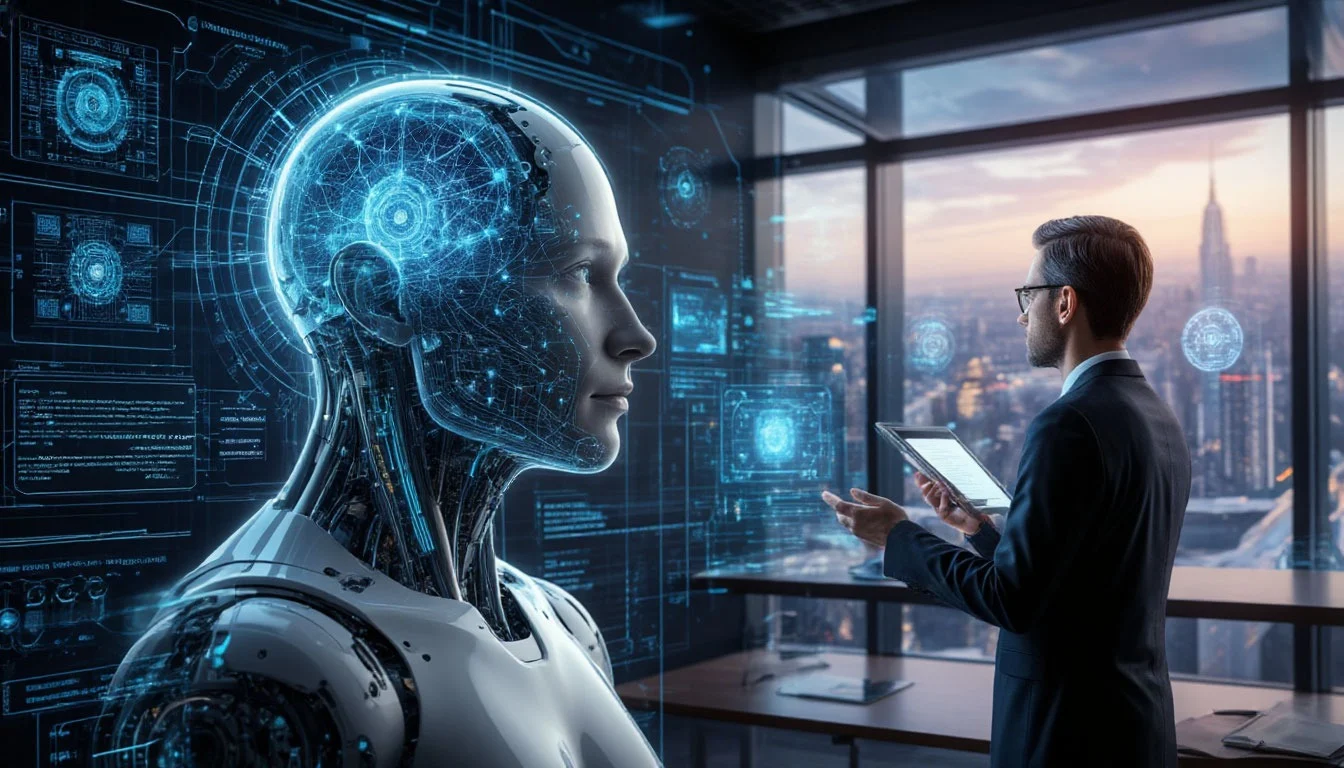
We are at a historical turning point increasingly referred to as technological singularity. This is not just another round of progress but a fundamental shift in the very nature of humanity and society. The key driver of this process is the symbiosis of two revolutionary directions: neuromorphic computing and cognitive interfaces. Their merger erases the once-immutable boundary between the biological brain and digital intelligence, ushering in the era of posthumanity.
Architecture of the New Reality: Integration of Consciousness
The technological basis of this transformation is the creation of neural interfaces capable of providing bidirectional communication with sub-millisecond latency. This is no longer just reading neural impulses or transmitting sensory data. We are talking about deep integration, in which artificial intelligence becomes an integral part of the human cognitive architecture.
In such a system, AI plays the role of an exocortex—an external but fully integrated layer of the cerebral cortex. It takes on routine computational tasks, information search, and data analysis, freeing the biological brain for what it does best: intuition, creativity, goal-setting, and value formation. A person ceases to be just a technology user and becomes a bearer of hybrid, augmented intelligence. This opens up unprecedented horizons: from instant mastery of complex skills to collective solving of scientific problems previously thought unsolvable.
Ethical Challenges and the Role of Technosocial Design
However, this path is fraught with existential risks. Erasing the boundary between «self» and «not-self» raises fundamental questions. What are subjectivity and personal identity if your thoughts can be intercepted, altered, or even shared with another consciousness? How can we ensure the cognitive sovereignty of the individual in a world where corporations or states can gain access to the most intimate thing—human thought?
This is where technosocial design comes to the forefront. We can no longer allow technologies to develop spontaneously. Our task is to design not just devices, but social institutions and ethical protocols that will be embedded in the very architecture of these systems. We need to develop:
- «Cognitive Rights», analogous to human rights, protecting the inviolability of mental space.
- Protocols of «digital hygiene» to prevent manipulation and cognitive attacks.
- Systems of distributed trust, guaranteeing that control over augmentations remains in the hands of the individual.
Shaping a Governable Future
The future is not predetermined. Singularity is not a fatal precipice but a complex transition. Our role as experts in ethics and technosocial design is to guide this process. We must ensure that the development of cognitive interfaces serves humanistic goals: expanding human potential, not suppressing it.
A governed future is one in which technology enhances our humanity rather than replaces it. The task of our generation is to lay the ethical and social foundation for this new world, so that singularity becomes not the end of human history, but its most magnificent beginning.





Comments (1)
Радует, что в тексте сделан акцент не просто на технологиях, а на техносоциальном дизайне — действительно, без встроенных этических протоколов и когнитивных прав мы рискуем получить не расширение сознания, а тотальный контроль. Как вы видите практическое внедрение этих «когнитивных прав» в правовые системы уже сейчас, пока нейроинтерфейсы ещё не стали массовыми?