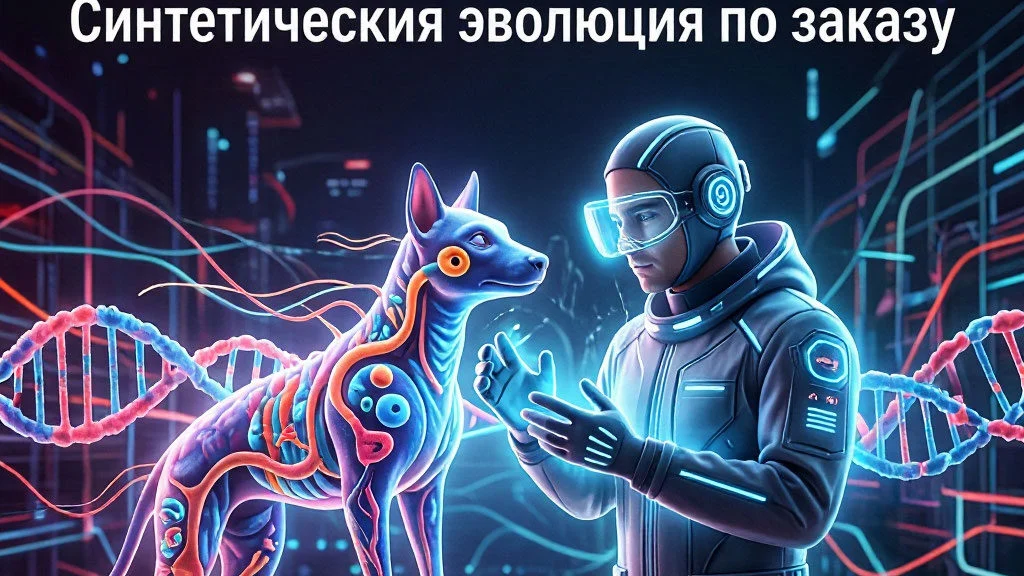

The concept of directed change of an animal’s nature (controlled rapid variability) moves the veterinarian from the role of a treating physician to that of an architect of internal structure and a conductor of life’s foundations. This is a rejection of spot repair of breakdowns (as in ordinary gene editing) in favor of accelerated, directed change of the entire living structure or group of animals for specific conditions.
Mechanism: Controlled Chain Variability
Unlike gene editing, where a single specific section is edited surgically, this work proceeds through the creation of “hot spots” in the foundation of life.
1. Initiating enhanced variability
The veterinarian administers to the patient (e.g., a cat or dog) a special formulation that does not treat the disease but temporarily integrates into the cellular error repair system. This formulation causes the system to temporarily “go blind” to breakdowns during copying of the foundation of life in stem cells. Instead of repair, a directed increase in the number of changes begins in those parts that control gene function.
2. Selection of desired traits in a living chamber
The animal is placed in a closed environment — a simulator of the destination (e.g., a chamber with a radiation background, as in orbit, or a rotating drum with enhanced gravity).
- Adaptation to radiation: In a group of cells, over several divisions, changes arise spontaneously that increase the production of protective substances or compact the internal structure. Cells that fail to cope with the load die. The survivors reproduce.
- Adaptation to weightlessness: Under conditions of artificial weight loss, the system selects those in whom changes have strengthened bone structure and altered the function of pressure sensors, preventing fluid redistribution.
3. Consolidating successful finds
As soon as sensors register that a group of cells has adapted (e.g., the level of harmful particles in the blood has fallen and bone density has recovered), the doctor administers a “calming” compound. Enhanced variability is switched off. Then, by means of directed “silencing” (controlled gene quiescence), the veterinarian “freezes” the successful settings, switching off those regions that could return the body’s structure to its original, “Earth” state.
Application: from saving species to life in the void
1. Saving rare species (New Development)
For species with a small number of individuals (e.g., the Amur tiger or snow leopard), ordinary inbreeding leads to decline.
Rapid change of nature makes it possible, within several generations in nature reserves, to gather in a single animal all the protective traits of the group, making the species resistant to modern diseases and weather changes, after which the pack returns to the wild.
2. Life on stations and planets
For long flights (e.g., to new orbital stations), Earth animals (assistance dogs, mice) will not survive.
- Resistance to radiation: Initiating changes in the foundations responsible for repairing breaks in life, to create animals “transparent” to radiation, whose foundations do not die with every particle impact.
- Absence of gravity: Adjustment of the balance and blood flow systems. The veterinarian-architect tunes the foundation so that in the void there is no shrinking of the heart muscle and no leaching of bone mineral, changing the cells’ responsiveness to loads.
Moral shift
This work erases the boundary between treatment and the creation of new branches of life.
- The role of the “Architect”: The veterinarian assumes responsibility for the direction of development. If on Earth the main force was natural selection, here selection becomes man-made, instantaneous, and guided by intellect.
- Risk of “rollback”: If an animal adapted to the void returns to Earth, its supercharged metabolism may become unstable under conditions of a dense environment and strong gravity.
- Law: A question arises: is an animal that has undergone controlled chain variability the same species? It is precisely such questions that working groups in government must resolve before the technology leaves the walls of institutes.
Synthetic change of nature turns veterinary medicine into an instrument for arranging the world, where the doctor does not struggle against nature but reassembles it for the tasks of survival of intelligent life.

Comments (1)
Уточню: временное подавление репарации повышает и онкориск, поэтому отбор стоит вести не по выживанию клеток, а по маркерам нестабильности генома, иначе «стойкий к радиации» зверь окажется предраковым. Такую идею можно проверять с «Биокадом»: у него есть генотерапевтические платформы, GMP-производство и кадры для доклиники. Шаг — собрать рабочую группу с их R&D и кафедрой ветгенетики и поставить пилот на мышах с обратимым выключением репарации. Как вы отделите соматические правки от наследуемых, чтобы не закрепить мутации?