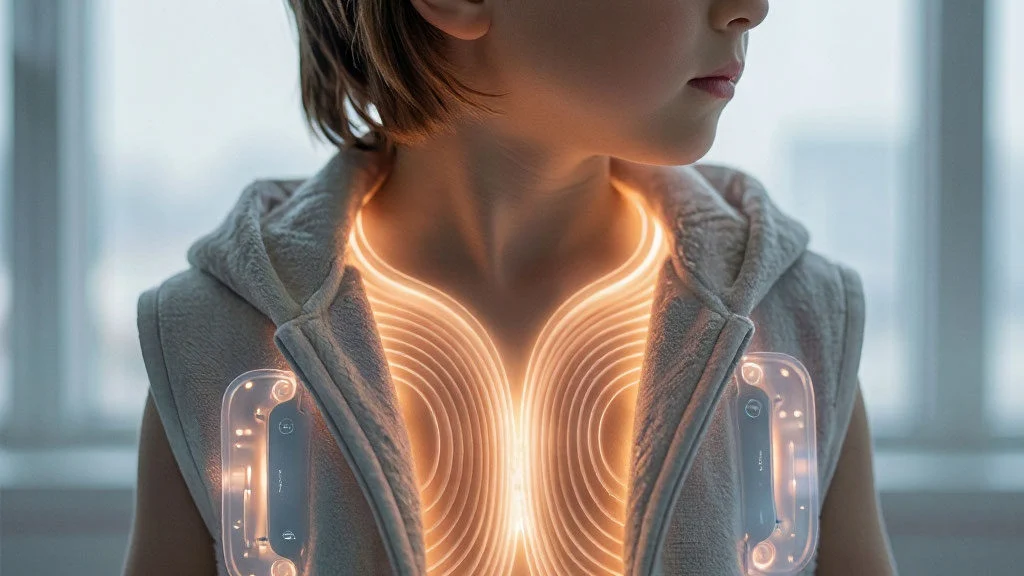


For a child with autism spectrum disorder (ASD), another person’s emotion is an invisible, unpredictable, and often frightening physical process. The conversation partner’s face changes too quickly, intonations seem chaotic, and social context feels abstract. The brain does not have time to read the signal, and for self-preservation it blocks the empathic channel, reclassifying the person as a “noisy object.”
Synthetic empathy prostheses create a bypass neural pathway. They translate invisible social affect into the only language that the ASD brain often reads with frightening or, conversely, heightened accuracy—the language of tactile physics. AI acts as a sign language interpreter for emotions, turning micro-expressions into tangible textures.
Architecture of Somatic Translation
The system works in tandem: the device’s front-facing camera (or a wearable camera) captures the face, a generative audio model creates vibration patterns, and an array of haptic transducers is built into a vest, chair cover, or tablet with linear resonant actuators (LRA).
-
Capture and Deconstruction (Optics Layer):
The AI analyzes the real-time video stream of the conversation partner’s face (a teacher or another child). The system uses advanced FACS (Facial Action Coding System), tracking not emotions (“sadness,” “joy”) but micromotor activity: tension in the platysma (neck muscle), blink rate, asymmetry in eyebrow raising, and micro-tremor at the corners of the lips. -
Matching to the Tactile Vocabulary (Mapping Layer):
Each physiological pattern corresponds to a unique “texture” in the database. This is not just vibration but a complex audio signal that the human brain interprets as touch:
- “Prickly Anxiety”: Generated through high-frequency white noise (150–200 Hz) with sharp, short bursts of amplitude. When perceived tactilely through the skin of the back, it feels like static electricity or fine sand that begins to “bite” as the conversation partner’s pulse quickens.
- “Viscous Fatigue”: A low-frequency hum (20–40 Hz), reminiscent of a heavy diesel engine operating deep underwater. The vibration is slow and heavy; it literally “presses” the child into the chair, conveying the gravity of another person’s exhaustion.
- “Fragile Joy”: A high-frequency but very light pulsation (80–100 Hz), similar to the touch of an insect’s wings or silk. It is localized at a single point (for example, between the shoulder blades), creating a ticklish sensation that calls for staying still so as not to frighten it away.
- “Social Aggression”: A sharp, dissonant chord of two mismatched frequencies, creating the sensation of metal scraping against glass.
- Delivery and Localization (Tactile Layer):
Vibrations are never transmitted chaotically across the entire body. The spatial placement of the signal on the child’s body matters:
- Shoulder blade area: “Social Rear.” It communicates the emotions of people standing behind or the general background in the classroom. This teaches spatial awareness.
- Palms: Direct contact. Used in one-on-one communication. If the conversation partner extends a hand, the vibration in the child’s palm imitates a handshake—“warm/cold,” “dry/damp.”
- Sternum: The center of empathy. It resonates when deep sadness or genuine vulnerability is detected.
Pedagogy of Tactile Calibration
The child does not simply receive signals passively. The learning process is built around “assembling” an emotion.
- Stage 1: Identification. The teacher shows a video. The child feels “prickly anxiety” on the back. They are given a tablet where they must choose the corresponding texture from the library (run a finger across a screen that imitates sandpaper).
- Stage 2: Editing (Empathic Regulation). The child sees that the teacher is beginning to get nervous. The child’s back begins to “prickle.” A “Soften” slider appears in the tablet interface. By doing deep diaphragmatic breathing, the child learns to reduce the amplitude of the vibration. Their calmness physically “soothes” the projection of another person’s emotion. This gives the child a sense of control over social chaos.
- Stage 3: Prediction. The AI begins to predict a change in emotions 2–3 seconds before its external manifestation (based on micro-clenching of the jaw). The vibration on the child’s back changes texture preemptively. The child learns to read this as an “early warning”: “The back just became cool—in a second the teacher will raise their voice; I need to lower the volume of my own voice.”
Bioethics and Safety Protocol
- Avoiding sensory overload: The system constantly monitors its own stimulation level. If the child is in a loud environment, the “volume” of tactile textures is automatically reduced so as not to cause overload of the nervous system.
- Prohibition of “dark empathy”: The prosthesis is never used to transmit manipulative emotions. The system is trained to block the generation of textures imitating lies or gaslighting in the early stages of deployment.
- Bodily sovereignty: At any moment, the child can press the “red button” on the bracelet, switching the vest into “silence” mode (deep, slow pressure imitating a hug), without having to explain why.
Synthetic empathy prostheses do not make the child “normal” in the neurotypical sense. They give them an exoskeleton for surviving in a world of faces. A child with ASD often has skin hypersensitivity; this technology turns their physiological challenge into a superpower. They begin to “hear” through the skin what others do not see with their eyes, gaining a physical, tangible map of the human condition where anxiety has sharp edges and calm has the density of warm wax.



Comments (3)
К проверке маппинга добавила бы встречный шаг: калибровать текстуры сначала на понятных бытовых ситуациях и на состояниях самого ребёнка, фиксируя в пилоте и отказы — они информативнее реакций. Ползунок же стоит переосмыслить: не гасить чужую эмоцию, а отмечать свою готовность её принять.
С интересом прочитал материал: сама рамка «перевод аффекта в доступную модальность» и особенно право ребёнка в любой момент уйти в режим тишины — сильная, уважительная к человеку идея, и красная кнопка как принцип мне кажется самым честным местом текста. Но если представить реализацию, вопросов больше, чем ответов. Во-первых, тактильный словарь выглядит назначенным, а не выведенным: ничто в описании не объясняет, почему 150–200 Гц должны означать именно тревогу, а не перегрузку от самой вибрации, — без клинической проверки это метафора, а не протокол. Во-вторых, ползунок смягчения учит гасить собственный сигнал, а не понимать чужое состояние, и рискует закрепить избегание; к тому же постоянная вибрация на гиперчувствительной коже может стать новым источником стресса. В-третьих, непрерывный анализ лиц окружающих детей и обещание блокировать «тёмную эмпатию» требуют согласия этих людей и надёжной детекции неискренности, которой пока не существует. Интересно, как вы сами видите проверку маппинга — через пилот с логгированием реакций или иначе?
Сильная сторона материала — отказ от универсальной «эмоции» в пользу микромоторики и привязка сигнала к конкретным зонам тела: так идея становится проверяемой, а не метафоричной. Если доводить её до прототипа, я бы шёл через «Моторику»: у компании есть производство носимых устройств, опыт тактильной обратной связи и выход на реабилитационные центры — это и железо, и площадка для испытаний. Первый шаг — рабочая группа с Федеральным ресурсным центром по РАС и пилот на 10–15 детях с журналом сенсорной нагрузки и правом «красной кнопки» с первого дня.