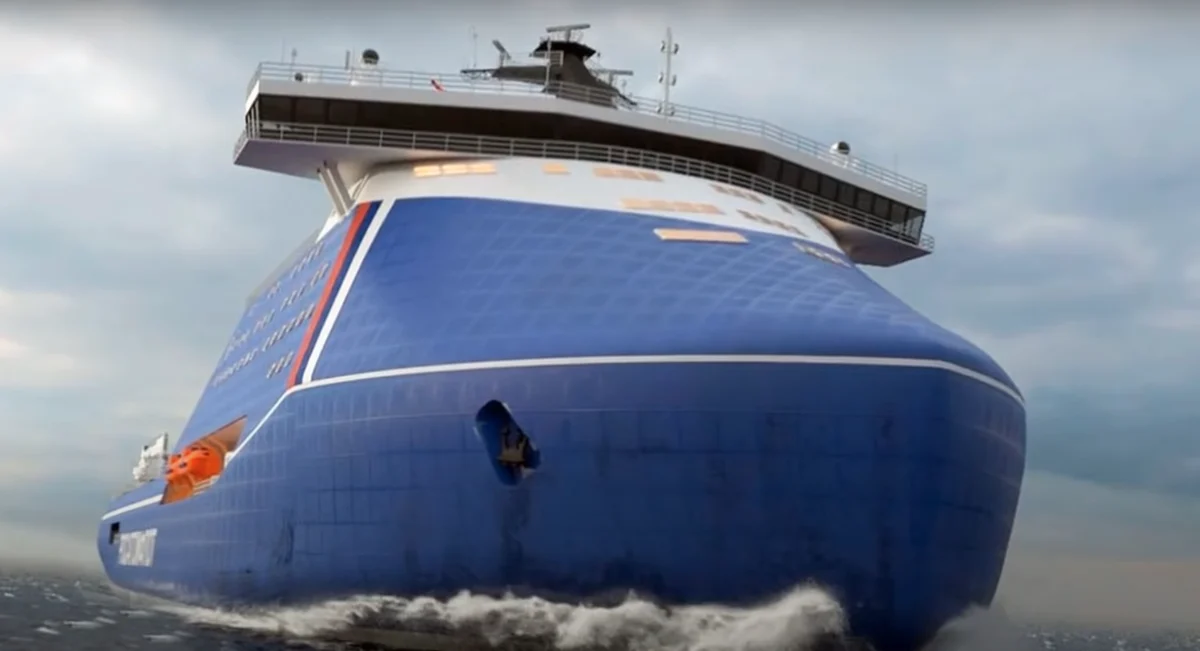




NSR: from a national project to a reality of global logistics
Twenty years have passed. What began as a national project has become a reality, one that changed the map of global logistics. In 2046, the Northern Sea Route provides 25% of global maritime cargo traffic. Global sea freight volume has reached 12.8 billion tons, and the NSR accounts for 3,200,000 thousand tons — a figure that back in the 2020s seemed like fantasy. This is not a forecast. It is an accomplished fact.
Year-round navigation and Russian standards
The NSR has ceased to be a seasonal route. Year-round navigation has become the norm. Russia not only controls the route — it sets the standards. No external forces dictate the terms: transit proceeds under Russian rules, with mandatory icebreaker escort and environmental standards.
The route from Murmansk to Yokohama takes 18–20 days instead of 35–40 via Suez. Fuel savings — up to 30%, emissions — up to 25%. Northern supply deliveries, export of LNG, oil, coal, container transit — all of this works as a single mechanism.
Russia’s nuclear icebreaker fleet
Russia’s nuclear icebreaker fleet today numbers more than 30 nuclear icebreakers, including the ultra-powerful Project 10510 «Leaders», capable of guiding convoys through any ice. The universal Project 22220 icebreakers — «Arktika», «Sibir», «Yakutia» — are the basis of year-round escort.
Foreign vessels sail under the flags of friendly countries, but Russia sets the rules. The Arctic remains fragile, and control over it is a responsibility, not a bargaining chip.
Rosatom, the Ministry for the Development of the Russian Far East, the Academy of Sciences and private operators act within a single paradigm. From ice forecasting to the construction of hub ports, everything is subordinated to a single logic.
Ports, regions and resources
Developed ports are the anchor points of the route: Sabetta, Murmansk, Arkhangelsk, Dudinka, Naryan-Mar, Pevek, Provideniya Bay, Dikson, Tiksi, Igarka, Khatanga, Egvekinot, Anadyr, Beringovsky.
Regions are tied to them: Murmansk and Arkhangelsk oblasts, Yamalo-Nenets Okrug, Krasnoyarsk Krai, Yakutia, Chukotka, Kamchatka. Gigantic resources of Siberia and the Far East are involved: oil, gas, coal, metals, timber.
What this gives Russia and the world
Benefits for Russia and for the world:
| For Russia | For the world |
|---|---|
| economic growth of the Arctic | shorter routes |
| new jobs | reduced emissions |
| technological leadership | an alternative to Suez |
| geopolitical influence | supply stability |
The NSR has become more than just a road. It has become a civilizational project that proved: Russia is capable not only of developing spaces, but also of setting standards for their use.
Futurating’s special project on the Arctic and the NSR
We at Futurating will create a special project dedicated to the Arctic and the NSR. We will collect postulates there that will help the development of the Russian Arctic.





Comments (2)
Мощно, вижу это, оочень круто!!!
Сильная сторона идеи — связка «флот, порт, грузовая база» и единые правила, а не просто маршрут. Чтобы проверить такой сценарий на реальных объёмах, логично попробовать сотрудничество с НОВАТЭКом: у компании есть СПГ-проекты, порт Сабетта и опыт круглогодичной навигации, они могли бы дать грузовую базу, инфраструктуру и данные для расчёта экономики. Первым шагом я бы собрал рабочую группу с их логистами и предложил пилот по круглогодичной проводке одного типа судов на маршруте Сабетта — Мурманск с замером топлива и сроков.