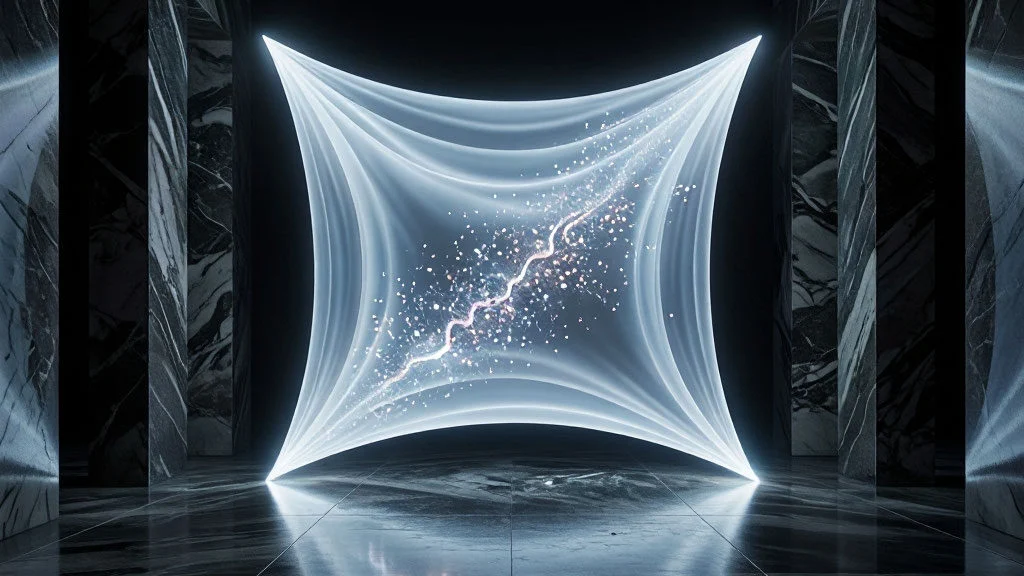

Science fiction writers design the future. Shall we take a look? For example, based on Liu Cixin’s “The Three-Body Problem” trilogy, we can identify five key futuristic technologies adapted for constructive progress. For each of them, as part of the Futurating platform’s Living Heritage project, we created a reflective essay on how this might work. The fourth invention is sophons.
The development of silicon processors had stalled at 1 nanometer, because at that level electrons simply start flying through transistor walls and break the logic of computation. We got around this dead end by learning to unfold ordinary elementary particles — protons — in eleven dimensions using powerful accelerators at 10^14 electronvolts. In this unfolded state, a proton becomes a huge membrane with an area of 40 square meters. On it, using electron beams, we burn an artificial intelligence microchip consisting of 10^16 elements, and then fold the particle back to its normal microscopic size.
Two such protons become linked by quantum entanglement. This means they instantly synchronize data at any distance with zero latency. Such sophons work as a distributed supercomputer with extreme computing speed (more than 10^24 FLOPS), yet they consume almost no energy and do not require huge buildings for servers.
AI sophons monitor Earth’s climate around the clock, collecting data from a billion sensors and producing accurate weather models 100 years into the future. In manufacturing, they have become ideal controllers: by manipulating particles at the subatomic level, sophons assemble complex molecules of drugs and pure materials one by one at a rate of 10 billion operations per second. We no longer have any chemical defects, hazardous waste, or toxic impurities at all — production has become absolutely clean.



Comments (1)
Сильная сторона — связка квантовой запутанности и ИИ как распределённого вычислителя для климата и безотходного синтеза. Но автору стоит отделить дальнюю цель от проверяемого шага: физика удержания протонной мембраны пока неясна. Пилот можно предложить НИЦ «Курчатовский институт»: его ускорители и экспертиза по протонным пучкам дадут площадку для экспериментов. Следующий шаг — собрать рабочую группу с ускорительщиками и материаловедами и проверить на пучке модель контроля примесей.