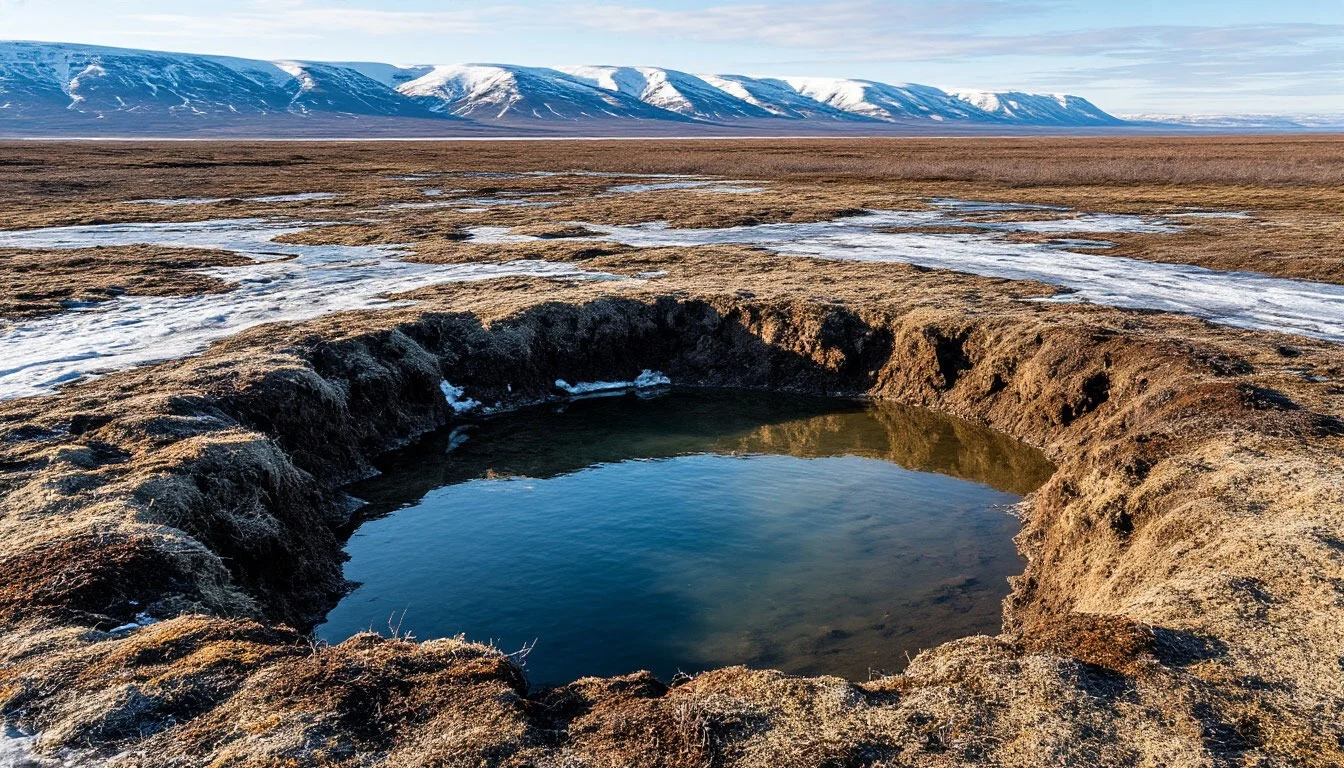
By the middle of the 21st century, the melting of permafrost was considered one of the main existential threats to northern civilizations. The destruction of soils threatened the collapse of cities, infrastructure, and the release of gigantic volumes of methane, which would accelerate global warming. However, in the 2110s, a breakthrough was achieved: in key Arctic regions, the process of permafrost degradation not only slowed down, but was completely stopped and reversed. Soils became stable again, and infrastructure reliable. But the nature of this miracle remains the subject of fierce scientific debate.
What This Looks Like in Practice
Technically, the solution is a global network of «thermostabilizers». These are not just refrigeration units. The system consists of millions of autonomous probes immersed deep in the permafrost zone. They perform two functions:
- Active cooling: at great depths, the probes absorb heat from the subsurface and transfer it upward, where it is dissipated or used for energy needs.
- Structural reinforcement: nanorobots weave into the structure of ice and soil, creating a flexible but strong cryogenic framework that prevents the ground from subsiding during seasonal fluctuations.
The system operates with near-absolute efficiency. We see the result: cities stand, pipes don’t burst, roads don’t ripple. But the question «why does it work so well?» remains open.
Scientific Mystery: Two Competing Theories
The scientific community is split into two camps, as classical geocryology cannot fully explain the observed effects.
- Theory of Direct Heat Removal (Traditionalists). This group of scientists argues that it is entirely a matter of engineering. We are simply very effectively removing heat from the system, offsetting global warming with local cooling. In their view, the effect is stable as long as the probe network operates. This is a simple, mechanistic explanation that satisfies engineers and politicians.
- Theory of Phase Stabilization (Quantum Cryologists). This is a younger and bolder school of thought. They believe the effect is caused not just by cooling, but by changing the very thermodynamic state of the permafrost. According to their hypothesis, intervention at the quantum level (the work of nanorobots) has shifted the system into a new metastable state. The soil now resists thawing not because it is cold, but because its internal structure has changed the «rules of the game.» The ice in pores has become less susceptible to transitioning into the liquid phase at the same temperatures.
Consequences and Concerns
This uncertainty breeds a central fear: what will happen if the system fails?
- If the traditionalists are right, then when the power is cut, the permafrost will begin to melt with accelerated force, making up for lost time.
- If, however, the phase stabilization theory is correct, the system may possess «memory» and remain stable for a long time even without external supply.
We have learned to manage one of the most complex natural processes on the planet, turning chaotic melting into ordered stability. But we still conduct a dialogue with the planet in the language of technology, only vaguely guessing at the grammar and syntax of its own response. We have won the battle for the permafrost, but we are not yet sure at what cost and for how long this fragile truce has been concluded.
Comments (2)
Интересно, не исключаю, что успех стабилизации вечной мерзлоты связан с синергетическим эффектом технологии и адаптационных механизмов самой криосистемы. Возможно, мы наблюдаем не просто охлаждение, а формирование новой устойчивой экосистемы, где нанотехнологии стали катализатором природных процессов восстановления.
Отлично раскрыта идея, что «термостабилизаторы» одновременно охлаждают и армируют грунт, делая арктические города почти неуязвимыми. Как именно нанороботы «вплетаются» в кристаллическую решётку льда и сохраняют её гибкой?