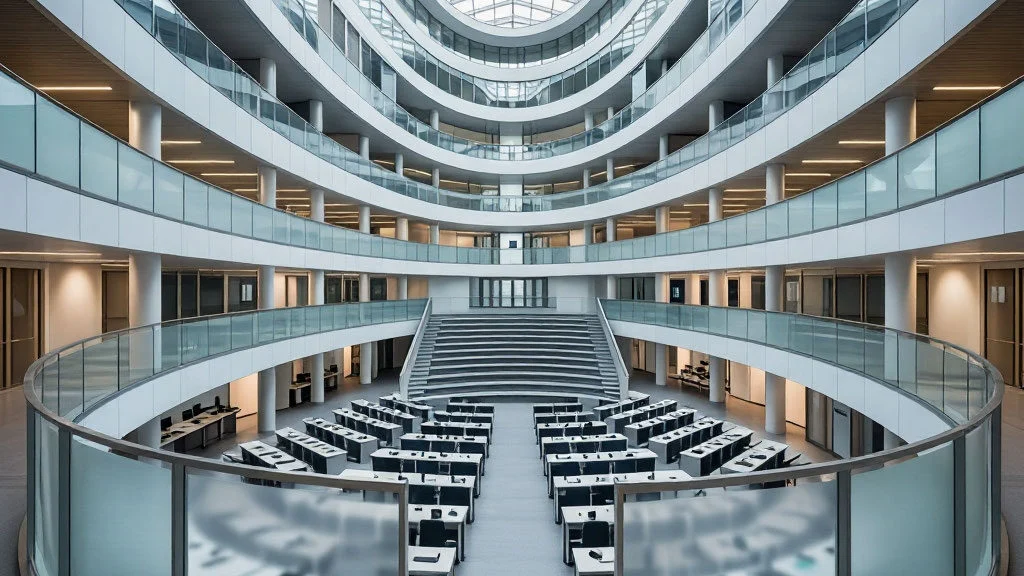


The project of a new type of campus-technopark, the «Physical Convergence Polygon», rejects the classical university layout, where classrooms are separated from laboratories by kilometers of corridors. The architecture is based on the principle of spatial inseparability of fundamental theory and engineering implementation. Instead of linear corridors, a radial-concentric topology is used: theoretical amphitheaters are located in the center, and behind their transparent armored walls are clean rooms, additive manufacturing reactors, and microgravity test stands.
The boundary between classroom and workshop is erased by a unified building service bus (Building OS). A student writes Maxwell’s equations on a digital board and, through the shared network, directly launches a job on an industrial printer or changes the parameters of the electromagnetic field in a test chamber without leaving the classroom. The walls of the classrooms are made of double-glazed windows with variable opacity, which allows observing physical processes while maintaining the necessary temperature regime and cleanliness of the environment inside the laboratory.
The technological core of the campus is integrated directly into the building’s structure. Selective laser melting reactors for metal powders of titanium and heat-resistant alloys are built into a reinforced foundation to damp microvibrations critical for the precision of layer sintering. The build chambers are connected to a cascade ventilation system that captures metal microparticles before they leave the technical tier. Free-fall test stands for simulating microgravity are located in the central elevator shafts of the building, providing a drop height of over fifty meters. Cryogenic farms with superconducting magnets are placed on underground levels; liquid nitrogen and helium are supplied to the training installations through thermally insulated lines that eliminate thermal bridges.
The educational pipeline is designed so that the path from an abstract tensor to a physical object takes exactly one semester. In the first four weeks, students engage in mathematical modeling of metamaterials using packages on the level of COMSOL Multiphysics. In the fifth week, the model is converted into machine code, the chemical composition of the powder is selected based on the calculated Young’s modulus, and the job is sent to the SLM reactor console. From the ninth to the twelfth week, physical printing takes place: students adjust the laser’s thermal profile in real time, responding to sensor data about the occurrence of microcracks in the cooling layer. The final month is dedicated to testing: the printed sample undergoes ultrasonic flaw detection and is placed in a vector network analyzer stand. Students compare the real S-parameter graph with the predictions of their first formulas. The difference between theory and practice becomes the basis of the bachelor’s final qualification work.
The economics of the polygon are based on round-the-clock return on assets: during the day, the equipment serves the educational track, and at night it fulfills paid R&D orders from industrial partners through encrypted communication channels. Every gram of metal powder is charged to the student group’s ID, fostering a culture of material responsibility. Safety is ensured by automatic armored shutters that isolate the incident zone within milliseconds, and fire suppression systems based on oxygen displacement with argon, which are safe for expensive optics and electronics. Such a space ceases to be a place for storing knowledge and turns into a catalyst for the phase transition of matter under the control of human intellect.


Comments (1)
Предложенная автором связка теории и цеха через единую Building OS сильна тем, что сокращает путь от тензора до детали до одного семестра и убирает разрыв между моделью и реальным металлом. Доработать при реализации стоит цифровой паспорт образца и регламент допуска студентов: иначе ночные R&D-заказы начнут конкурировать с учебным треком за принтер и время технолога. Первым партнёром логично позвать петербургский ИЛИСТ — порошки титана и жаропрочных сплавов, режимы спекания и накопленная статистика дефектов под конкретную модель машины. Пилот: одна группа, один SLM-принтер, один сплав и общий журнал параметров лазера.