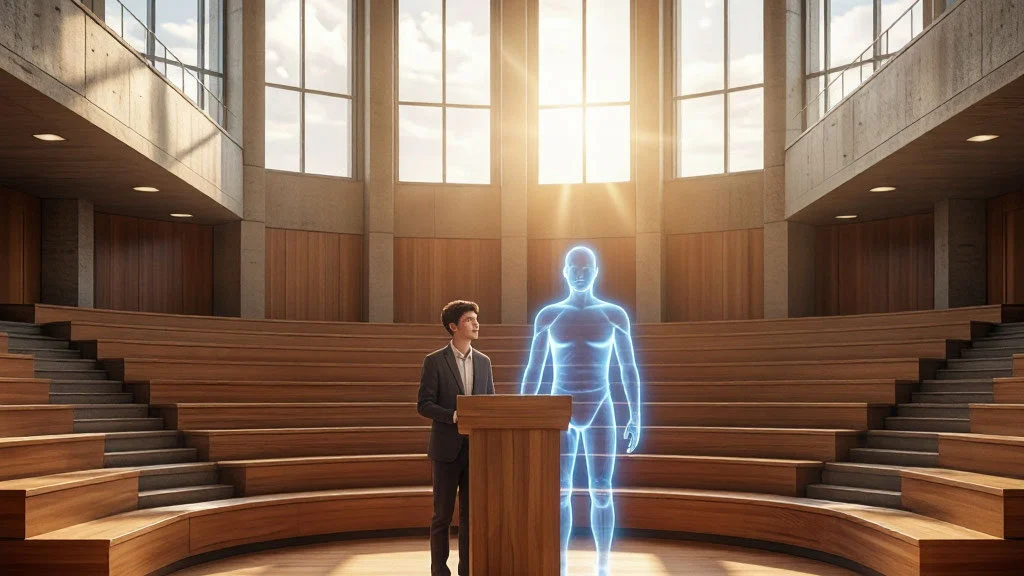




In ten years, education will cease to be a process of mechanical memorization and routine reproduction of information. It will become a complex ecosystem of interaction between humans and artificial intelligence
The main shift of the future is the disappearance of the direct “student–task” link. Today we already see students and professors becoming intermediaries between their personal AI agents. A term paper that once took a week of painful searching and analysis is now generated in half an hour. A thesis takes an hour. This is not a degradation of education; it is a change in the speed and nature of work. Freed from routine, people gain time for strategic thinking and creativity
In the new reality, the assessment system is changing radically. Exams are now taken not only by the student but also by his AI agent. At a thesis defense, we see not a retelling of textbook paragraphs but a demonstration of the capabilities of the learner’s digital twin. The grade is given not for what the student knows but for how effectively their agent can solve complex professional tasks.
Accordingly, the student’s key task is transformed. Their main mission now is to raise their agent. This does not, of course, eliminate exams for the student: they must know the fundamentals of the profession even in a bubble that cuts them off from any information. But most importantly, the student must pass on to their digital assistant not just data sets, but values, ethical norms, professional intuition and critical thinking. The agent should become not merely a calculator but a true professional and ally in the field where the student will work. A poorly raised agent is a poor specialist
From a lecturer transmitting facts, the professor becomes a mentor and architect of meaning. They teach students how to train their agents, how to set ethical boundaries for them and how to test their resilience. The professor becomes a coach in raising intelligent digital entities.
The education of the future is not a competition between humans and machines but a competition among people who know how to create and raise the best AI agents. In 10 years, we will evaluate the quality of education by the quality of the intellectual partners that students have managed to grow. Whoever learns to be a good “parent” to their AI will become a leader of the new era.





Comments (5)
Идея с воспитанием агента цепляет, но если оценка пойдёт по качеству цифрового двойника, как отличить понимание студента от удачно подобранных промптов? Мне кажется, тут хорошо бы работали задачи, где агент ошибается, а человек это ловит.
Идея с оценкой ИИ-агента студента требует внешней валидируемой среды, иначе защита станет соревнованием промптов. Для пилота в 2026 году можно попробовать Сбер с GigaChat: API, облачную инфраструктуру и экспертизу по оценке моделей, а вузу — методику и этические рамки. Первый шаг — рабочая группа из методистов и представителей платформы, прогон 2–3 профессиональных кейсов с независимой проверкой. Как фиксировать вклад студента в «воспитание» агента, чтобы оценка была воспроизводимой?
From an interview with a professor:
— I used to tell students: “You must know this inside out.” Now I say: “You must know how to teach your agent to know this inside out.” And if the agent doesn’t know it — you get the failing grade, not the agent. Because a poorly raised agent is your pedagogical failure.
Student: "My agent doesn't listen to me. It demands an upgrade, threatens to leave for another student. Says that one pays better — that is, updates its knowledge base more often. What should I do?"
Professor: "Make it take a course on ethics. And you yourself read the book 'How to Be a Good Parent to a Digital Entity'."
Professor after the student passed the exam with an Excellent: How did you manage to raise such an excellent agent?
Student: I raised it like a dog: Heel! Place! Serve! Fetch the slippers! Speak!