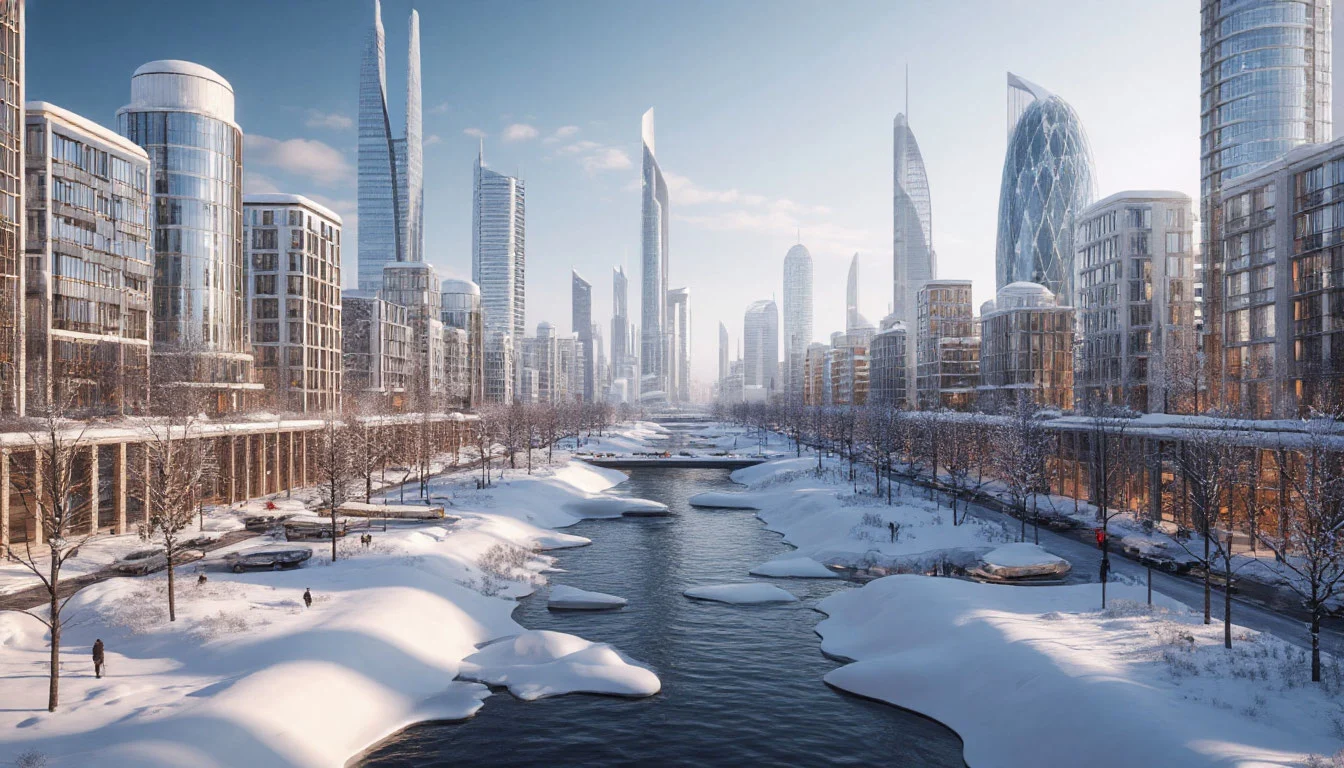
By the mid-22nd century, humanity had finally emerged from a state of climatic helplessness. Snowdrifts, once a symbol of nature’s chaos and infrastructural vulnerability, ceased to be a natural disaster and became a manageable parameter of the environment. This became possible thanks to three layers of progress: foresight, adaptation, and co-evolution with the climate.
First, we stopped «fighting» snow after the fact. Global climate network models operating continuously predict the location and volume of snowfall with accuracy down to the quarter and hour. In 22nd-century cities, road networks, energy systems, and logistics are reconfigured in advance for the expected snow scenario, turning what was once a paralyzing force into a predictable mode of operation.
Second, infrastructure has become invulnerable to snow accumulation as a class of phenomena. Roads, rails, landing strips, and roofs are no longer «cleared» — they dynamically change their properties. Coating metamaterials alter friction coefficient and thermal conductivity; snow does not accumulate but is redistributed or instantly melted into water and heat. Snow has ceased to be an obstacle and has become a resource of the urban ecosystem.
Third, we have integrated snow into the economy and culture. Autonomous «snow swarms» — swarms of robots and nanodrones — collect precipitation, sort it into fractions of ice, water, and pollutants, replenish city reservoirs, cool data centers, and provide local water supply. The concept of a «snow collapse» has disappeared, just as the concepts of «winter road blockade» or «cancellation of life due to weather» disappeared in their time.
A mature civilization of 2149 is one for which snow, storm, or heat are not emergencies, but merely one of the modes of normal societal operation. Humanity has learned not to defeat snowdrifts, but to incorporate them into its life cycle, turning risk into resilience and randomness into a manageable part of the planet’s overall balance.
Image generated by Shedevrum.





Comments (0)