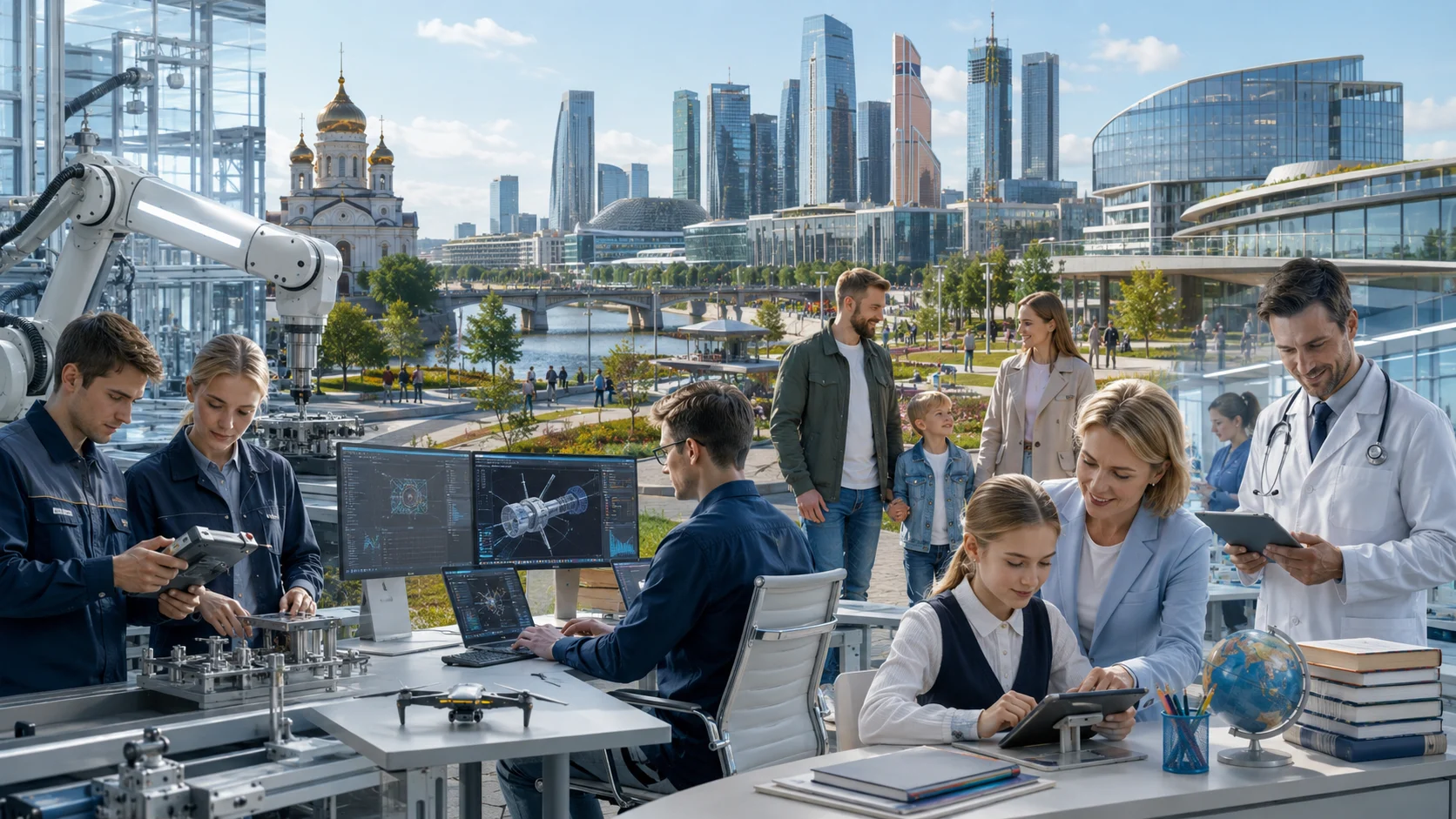
Independence becomes a practical strength of the country
By the early 2030s, sovereignty had become the state’s main capital. It was no longer understood solely as political independence. It manifested in the country’s ability to teach children in its own language of the future, produce critically important technologies, protect citizens’ data, develop culture, create jobs, and independently choose a path of development. Russia strengthened such sovereignty — practical, human, and creative.
In this future, independence did not mean isolation. On the contrary, the country became more open to equal cooperation because it relied on its own strengths. When you have your own engineers, medicines, platforms, schools, research centers, logistics, and financial mechanisms, partnership becomes fairer. Russia could negotiate without haste or dependence, offering the world not only resources but also ideas, technologies, cultural meanings, educational programs, and the experience of developing a vast territory.
Sovereignty is built from daily decisions
The sovereignty roadmap was assembled from concrete actions. First, the country identified critical areas: data, communications, energy, transport, medicine, food, education, microelectronics, software, and urban infrastructure. Then, for each area, national projects appeared with clear indicators, production orders, and personnel training. After that, work began on the culture of the future: people were explained that sovereignty is built not only by laws but also by daily choices of quality, responsibility, and competence.
Ordinary people contributed through professionalism. A doctor mastered domestic digital tools, a teacher prepared students for engineering thinking, a programmer wrote secure code, an entrepreneur developed local production, a parent supported a child’s interest in science, a city resident participated in discussing development projects. Sovereignty proved not to be an abstraction, but the sum of millions of jobs done well.
The «Futurating» platform became a space where people formulated sovereignty as an image of the desired future. Here, postulates emerged about technological independence, cultural confidence, data protection, new professions, and strong regions. Users not only voted but also wrote what they were ready to do themselves: learn, test a service, propose a project, connect experts, talk about an enterprise. Thus, the main capital of the state gained a human dimension.
Comments (0)