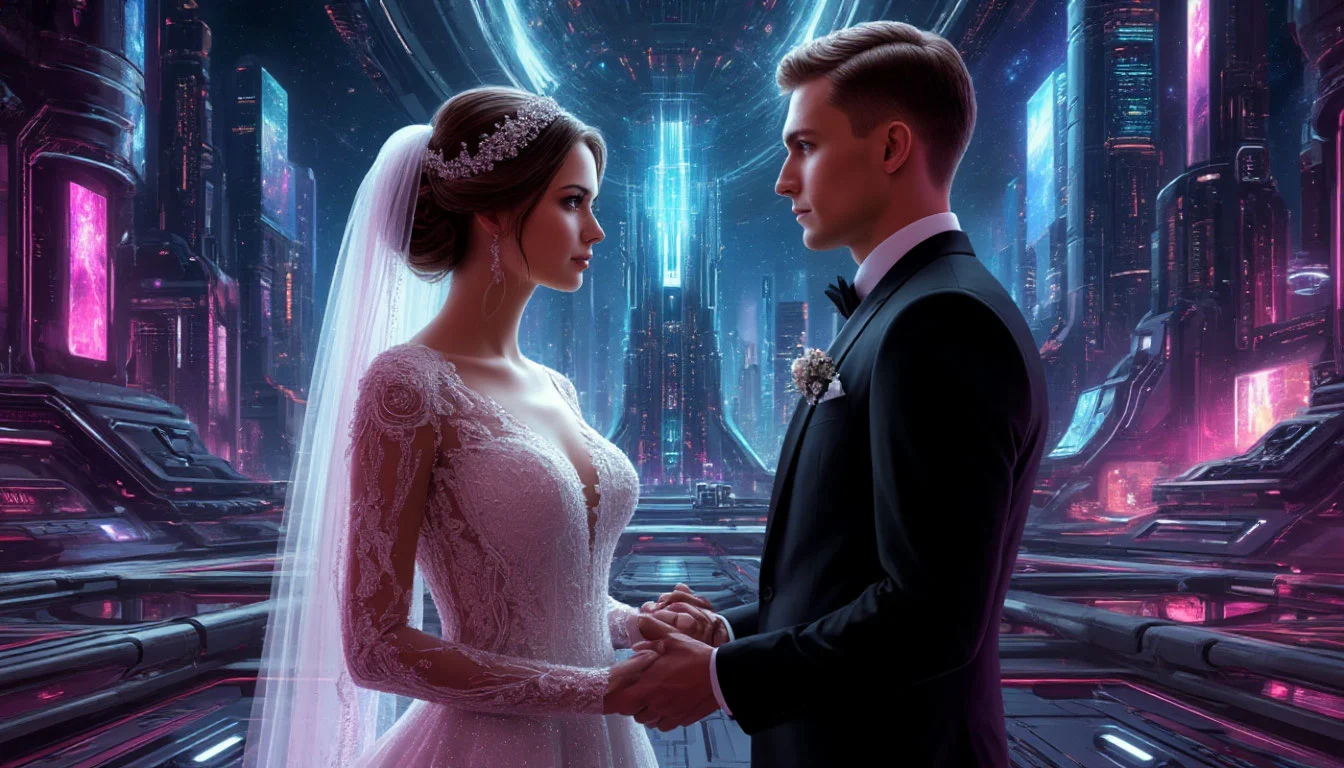
It can be said that in the year 2800, weddings once again became a milestone in a person’s new life: we all remember from history that in the 20th century, for many, a wedding was a commercial enterprise; in the 21st century, an aesthetic show; in the 22nd century, an abolished atavism; and in the 23rd, a return to a new antiquity. The 24th, 25th, and 26th centuries successively destroyed and exalted weddings. In the 27th century, as we recall, after the admission of six extraterrestrial colonies into the Galactic Council, weddings became a tool for genetic and hereditary modeling; in the 28th century, this custom came to be regarded as barbarism, and the ceremony took on the appearance of a light, carefree celebration. Only in our own 29th century have people realized the significance of weddings.
Weddings within the Solar System are held on a lunar base, in an orbital hotel around Mars, or even in a fully simulated reality. Guests from different corners of the Solar System attend as holograms or their avatars. Instead of flowers, there are luminescent biological forms created using synthetic biology methods that change color and shape in time with the couple’s «heartbeat» (or their biometric data). Music is generated by artificial intelligence based on neural interfaces that read the emotional state of the bride and groom. Guests can, via a neural interface, briefly «connect» and feel the same wave of happiness and love as the newlyweds (with their strict consent, of course). Physical rings may remain as a symbol, but their primary function has changed. They are mini-computers storing the couple’s digital «Book of Love» — the entire history of their relationship, shared memories recorded in immersive videos. Or the rings contain a DNA sample from each partner, embedded in a crystal, symbolizing their unique biological union. The marriage certificate is a dynamic «Family Code» — a program that describes rights, obligations, and even conflict resolution algorithms, which can be updated as the relationship evolves.
Future spouses exchange not vows of fidelity, but data from their genetic and neural maps. This is an act of ultimate trust — showing one’s partner one’s biological and mental «instruction.» Instead of a traditional party, couples can together go through a quest in virtual reality, the result of which will become their shared «mythology» and the basis for the ceremony. Instead of physical gifts, guests collectively create a digital work of art, a composition, or even a virtual «Garden of Love,» which will remain with the couple as a living monument to their day.
The legal and ethical status of marriage has expanded. Unions are possible between a human and an advanced AI (with recognized emotional intelligence), or between people who have undergone significant cybernetic modification. The main wedding trend has become the «zero footprint.» Ceremonies are not just eco-friendly, but regenerative — for example, releasing special nanobots into the atmosphere that purify the air, or planting a forest on another planet as a wedding vow. But even in 2800, the wedding remained a ritual uniting two loving beings.
Image generated by Shedevrum



Comments (0)