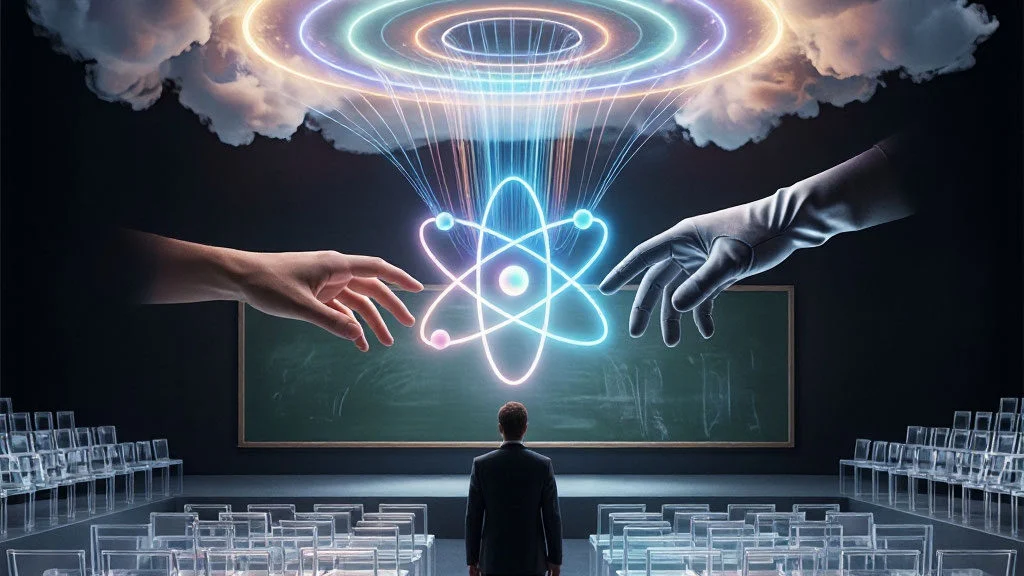


Stepping away from whiteboards and glowing screens in favor of space, sound, and a sense of the body. Here the teacher is not a narrator but a director of living pictures. Students do not listen to descriptions of natural laws; they experience them from within, translating the dry symbols on paper into bodily memory.
1. How the World Is Built: Sensing the Invisible
Instead of looking at slides, students enter a dark hall where different rules apply:
- Thunder Without Lightning (Spatial Sound): The equation can be heard. If they need to find the coldest place in the system, the student goes where the sound dies down and becomes soft. If they are looking for the source of force, they turn toward the growing rumble. Mathematics becomes music that the skin can hear.
- Armor of Resistance (Tactile Machines): Students put on special garments or step onto moving platforms. To understand why an object is hard to move from its place, they do not read about friction; they brace their feet against the floor and feel their muscles tremble with strain.
- Living Void: The walls of the hall can be ordinary, but through special glasses the student sees colored streams drifting through the air around them—the very invisible forces usually hidden behind the letter $F$ in a formula.
2. The Teacher’s Staging: A Round Dance of Forces
The teacher writes not a lesson plan but a script for movement. The goal is to make the student’s body remember a law of nature.
- Through Stone: The student tries to walk through a row of motionless pillars (a crystal lattice). As they approach a pillar, the armor on their body suddenly tightens, pushing the person back. The student learns in their own skin why things need heat to melt—their body has remembered the impact against an invisible wall.
- Running Toward the Light: The student steps onto a treadmill that begins to shake furiously and speed up. They feel the air become thick as oil and time inside it seem to slow down. The complex science of the speed of light turns into a feeling of breathlessness and weight.
- Tunnel Through the Wall: There is dead silence. To pass through, one must not beat against the barrier but freeze in the right pose. At that moment sensors catch the state of stillness, and the student falls through the wall, hanging in the void for a second.
3. The Essence of the Method: Muscle Memory
A new generation is used to rapidly changing images and has forgotten how to imagine. This theatre solves the problem differently:
- A Trace on the Body: When, during a test, the student sees the symbol for the curvature of space, their back will remember the strain with which it “bent” under the weight of an invisible star in the hall.
- Mistakes Under the Skin: If the student has calculated the ship’s path incorrectly, their platform does not simply display “Error”; it dangerously tilts to one side. The mistake is remembered through a chill in the stomach and the fear of falling.
- A Shared Dance: Complex problems are solved in a circle. One student holds the “magnetic threads,” another the “plasma.” For the system not to explode, they must breathe and move in unison, feeling the equations as a shared rhythm.
4. Assessment: Learning on Your Feet
Instead of exam tickets, there is an obstacle course. The student must assemble a mechanism in the void, where there is no up or down. The teacher watches not whether the nuts are tightened but how the student moves. Those who have understood the nature of things move lightly and save every motion. Those who have merely memorized the rules jerk about, collide with walls, and waste their strength—and therefore do not pass.
5. Scale: Factories of Minds
Such a hall does not have to be built for everyone. The teacher-director creates an exact cast of their hall—a living copy. This copy can be passed on to other schools. There they will install seats that shake and tilt, conveying the main thing: the feeling of struggling with matter.
This kind of learning restores respect for the weight and solidity of the world. The student leaves not with a memory full of symbols but with a skill grown into the bones: they know that every stroke in a symbol weighs a ton, warms like a furnace, and resists like something alive.


Comments (1)
Идею автора проще проверить не строительством нового зала, а на действующей площадке: Политехнический музей в Москве уже показывает физику через интерактивные экспозиции и мог бы дать пространство, звуковое оборудование и поток школьников. Для первого шага хватит одного сценария — сопротивление среды на виброплатформах — и небольшой рабочей группы из музейного методиста, физика и инженера по тактильным приводам; через месяц после пилота на 15 учениках стоит проверить, что реально осталось в памяти, а не только в впечатлениях. Вопрос: чем фиксировать результат — тестом, наблюдением за характером движений или как-то иначе?