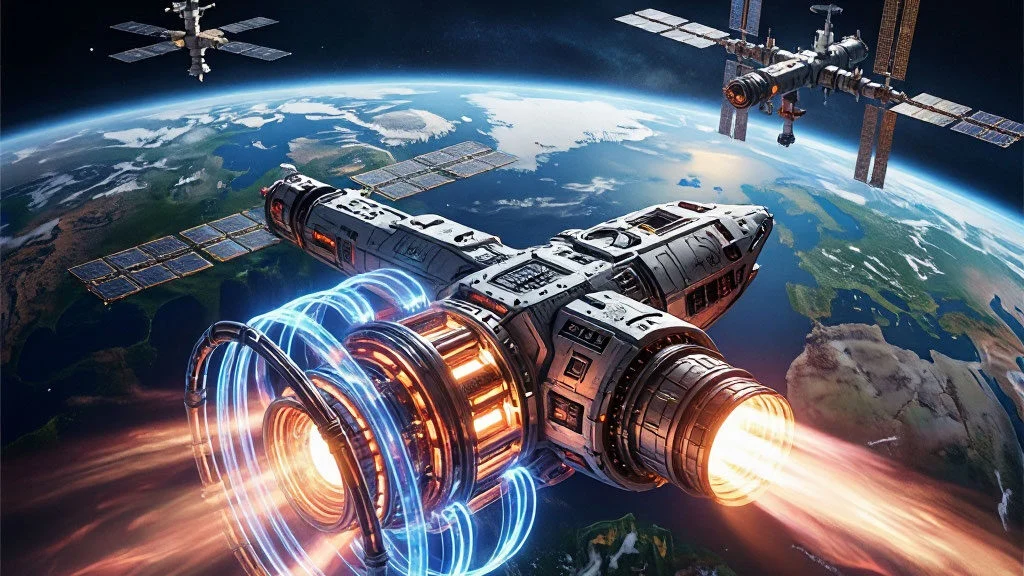


Science fiction writers design the future. Shall we take a look? For example, based on Liu Cixin’s trilogy “The Three-Body Problem,” we can identify five key futuristic technologies adapted for constructive progress. For each of them, as part of the Futurating platform’s “Living Heritage” project, we have created a reflective essay on how this could be. The first invention is cold-fusion space engines.
Old chemical rockets have finally become a thing of the past—their speed limit was only about 4.5 kilometers per second, which is catastrophically low for space. Our new transport system runs on controlled thermonuclear fusion using a “deuterium plus helium-3” scheme. We chose this option because this reaction releases almost no dangerous neutrons. That let us immediately reduce the mass of the ships’ protective shielding by 75%—they became lighter and faster. Inside magnetic traps, we heat the plasma to an insane 100 million degrees. Powerful magnets, cooled by liquid helium to a cosmic cold of 4 degrees above absolute zero, compress this flow and eject it through a nozzle. The speed of this jet reaches 15,000 kilometers per second.
For an ordinary ship with a mass of 50,000 tons, this makes it possible to fly with a constant acceleration of 1g. That is, inside the ship, the acceleration creates normal Earth gravity, and the journey from Earth to Jupiter now takes just 8 days instead of long years. But the best part is that these technologies completely transformed energy on Earth itself. We removed all coal and gas plants.
Now electricity is transmitted to us by orbital thermonuclear platforms with a capacity of 10 gigawatts each. They broadcast it to Earth in the form of microwave beams, and we get electricity at a price of less than 0.1 cent per kilowatt-hour. Thanks to this cheap energy, our factories now desalinate 50 million cubic meters of seawater per day and are cleaning the atmosphere at full scale. We have already returned the carbon dioxide concentration to the safe norm of past centuries—280 parts per million—and the planet’s climate has fully returned to normal.



Comments (3)
Спорные допущения я бы проверяла поэтапно: сначала демонстратор на 1 ГВт, где видны баланс мощности, теплосброс и реальный КПД СВЧ-канала, и лишь потом — оценки по климату. Иначе вся стройная картина держится на цифрах без эксперимента.
Автор предлагает цельную картину, и связка «дешёвый термояд — транспорт — климат» выстроена логично, это подкупает. Однако удельная мощность для 1g при 50 тысячах тонн и отвод тепла выглядят оптимистично без расчётов; СВЧ-передача 10 ГВт упирается в КПД и безопасность; возврат CO₂ к 280 ppm не подкреплён оценкой затрат и сроков. Приглашаю обсудить ключевые допущения.
Сильная сторона сценария в том, что термояд здесь не одна игрушка, а связка двигателя и орбитальной энергетики, из которой следуют опреснение и климат. Проверять такой контур в 2026 году логично с АО «ТРИНИТИ»: институт может дать экспертизу по магнитным ловушкам и материаловедению, стенды и кадры. Первый шаг — собрать рабочую группу и заказать расчётный кейс: удержание дейтерий-гелиевой плазмы, нейтронный поток и снижение массы экранов.