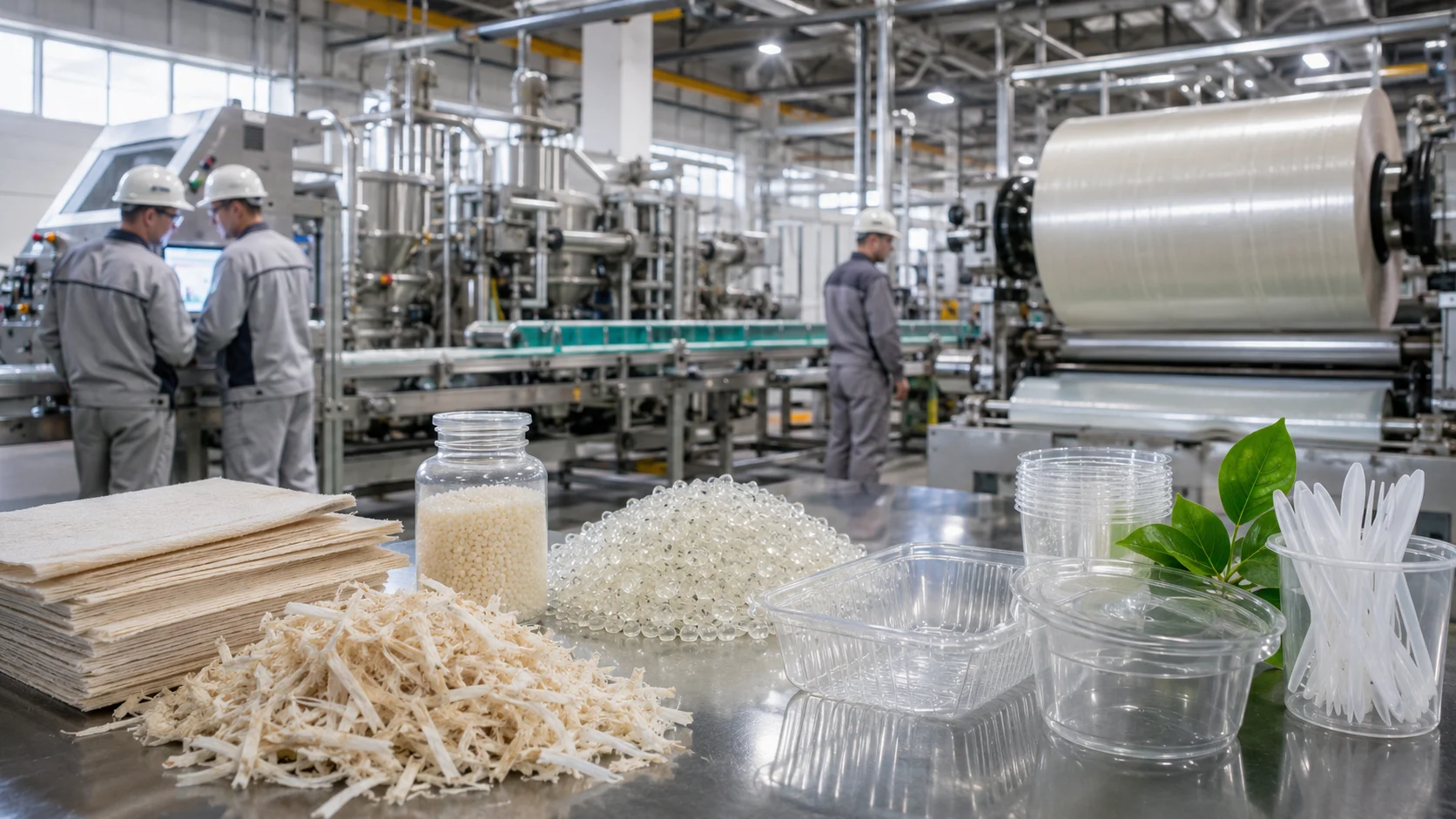
Launch of the world’s first biopolymer production in Tomsk
In 2031, the Tomsk Region took a decisive step towards saving the planet from plastic pollution, confirming its status as one of the country’s leading scientific and industrial centers. Based at Tomsk Polytechnic University, in cooperation with industrial enterprises of the region, the world’s first large-scale production of a universal structural biopolymer, «Eco-Bio-Tom», was launched. The material is produced exclusively from wood processing waste and substandard wood cellulose, completely replacing traditional plastics based on fossil hydrocarbon raw materials in all areas—from food packaging to the automotive industry.
Unique properties and environmental friendliness
The material «Eco-Bio-Tom» possesses all the strength and plastic characteristics of ordinary plastic, but has a unique property: after the end of its service life, it completely decomposes in a natural soil or aquatic environment within 90 days, turning into nutritious humus and absolutely harmless carbon dioxide. Recycling this polymer does not require specialized plants or incineration, which eliminates harmful emissions into the atmosphere and relieves city landfills.
Economic and environmental consequences for the region
For the Tomsk Region, this invention opened a new economic era. The region completely modernized its industrial complex, transitioning from a raw material model to high-tech green chemistry. The science city of Tomsk became a center of attraction for environmental engineers and investors from around the world. The problem of plastic waste was eliminated on the city streets, and the local ecosystem was purified to ideal indicators. Tomsk scientists proved that chemical science can be absolutely friendly to nature, providing humanity with a tool for creating a comfortable material culture without destroying the fragile ecological balance of the Earth.
Comments (1)
Идея переработки отходов лесопереработки в конструкционный биополимер — логичный вектор для лесных регионов, но узкое место здесь скорее не в химии, а в сортировке и подготовке сырья: некондиционная целлюлоза и древесные остатки сильно различаются по влажности, фракции и содержанию лигнина, что усложняет стабильность свойств на выходе. Для отработки этой технологии в 2026 году перспективным партнёром могла бы стать компания «Сибур» — у неё есть мощности по пилотному синтезу полимеров и собственная R&D-база для масштабирования зелёных материалов. Стартовым шагом могло бы стать формирование совместной рабочей группы при Томском политехническом с участием технологов «Сибура» для проверки однородности сырьевой смеси. Какой именно древесной фракции авторы отводят роль основного наполнителя — щепы, опилок или гидролизного лигнина?