

Did the works of Arkady and Boris Strugatsky contain a future one would want to live in? Certainly — yes, and that is precisely why their works seem so appealing to us.
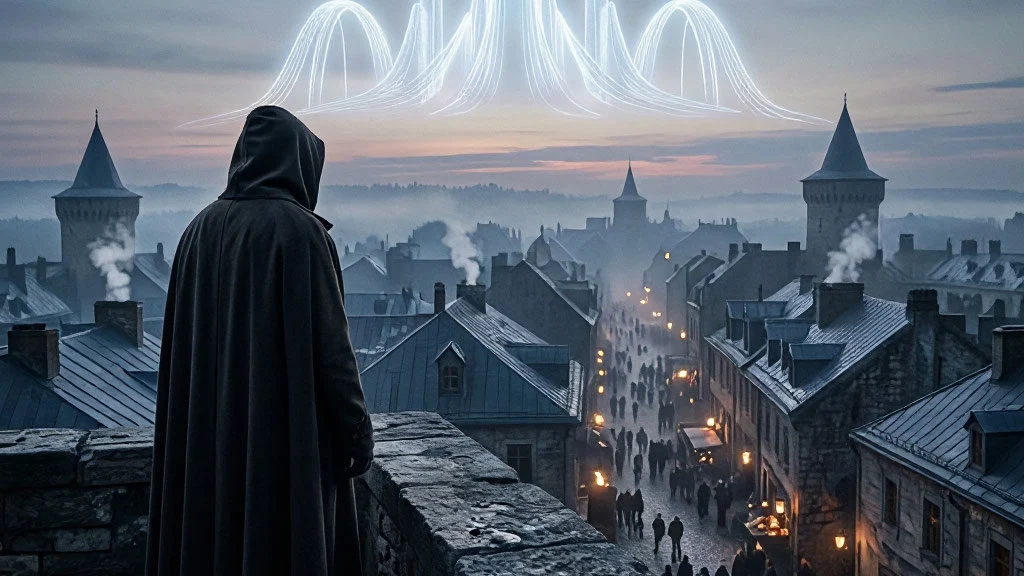
The Strugatsky brothers in their works did not merely construct the contours of a positive future — they clearly understood and openly demonstrated that the path to this ideal would never be simple, linear, or painless. Behind the façade of the harmonious and high-tech Noon Universe, there always hides the harsh drama of overcoming, difficult inner struggle, and the burden of ethical responsibility. The novella Hard to Be a God serves in this context as a crucial prognostic landmark. Describing the deep stagnation of the medieval kingdom of Arkanar — with its gray stormtroopers of Don Reba, pogroms against wagon workshops, and persecution of book lovers — the authors create not merely a gloomy dystopia. They form an extremely complex intellectual testing ground where the ideals of humanism undergo a severe test of strength when colliding with the historical resistance of matter.
Progressor Anton, operating in Arkanar under the name of the noble Don Rumata Estorsky, acts not as a passive observer of medieval mores but as a living bearer, a technological and moral standard of the future Earth. He is forced to painfully compare feudal regression with the ethical standards of his home planet, every second resolving the dilemma of the admissibility of interfering in the natural course of another history. It is through this tragic clash, through the total negation of Arkanar’s everyday life and the awareness of the colossal complexity of civilizational transit, that the Strugatskys formulate the parameters of a genuine positive future. This future is not given to humanity ready-made as a gift — it crystallizes through pain, reflection, and personal ethical choice, marking the main vector of the evolution of the spirit, where Reason takes responsibility for the world, and the moral imperative becomes the chief integration gateway of civilization.
Model of the “Educated Man” versus anthropological regression
The main systemic crisis of Arkanar lies not in the plane of a weak economy or the absence of steam engines, but in the degradation of human material. The positive future of Earth of the Noon Universe is based on the victory of the Theory of Education. The human being of the future, according to the Strugatskys, is a researcher for whom violence, lust for power, and egocentrism are overcome biological atavisms.
In this reflection emerges a prophecy about a future where the value of human communication and deep empathy are elevated to an absolute. The positive contour of the Strugatskys asserts that civilization takes a genuine step forward only when its basic unit — the individual — is freed from inner aggression. The New Man does not need external apparatuses of suppression; his behavior is coordinated by a developed internal ethical imperative, and productive cognition becomes his chief need.
Evolutionary Rejection of the Concept of the “Lesser Evil”
The key philosophical knot of the novella is tied to the famous conversation between Rumata and the Arkanar thinker Budakh. Budakh, discussing the possible intervention of an omnipotent deity in human affairs, proposes scenarios that exactly repeat the pragmatic schemes of Earth historians: give food to the hungry, punish the cruel, impose order with an iron hand. However, Rumata parries each thesis, proving that external beneficence not reinforced by an internal change in the consciousness of the masses inevitably leads to even greater violence: “Then the Lord said: ‘I would wipe you from the face of the earth and create you anew, even more beautiful…’”, to which Budakh replies: “My heart is full of pity, but make it so that we may live and create.”
This dialogue formulates the most important prognostic postulate of the Strugatskys: true progress is based on the universal human desire to create a better future.
The positive future of Noon is a civilization that has fully outgrown the compromises of Machiavellianism. Rumata understands that Earth has no right to impose humanism in Arkanar by force of arms. Progressorship is not colonization; it is the creation of complex conditions under which a society is capable of healing itself from ignorance, making a conscious transition to networked co-creation.
Ecological balance and recultivation of living space
The Earth of Noon declares the principles of global biocompatibility and noospheric purity, which are the foundation of the world of the future. Academician Nikita Nikolayevich Moiseyev, developing the theory of noospheric development, pointed to the danger of a consumerist attitude toward the environment: “The desire to conquer and possess makes us dependent on what we have conquered and possess!”. Arkanar tries to conquer the Forest and eradicate dissent, turning its world into a scorched desert. The Earth of Noon, from which researchers’ helicopters and base automata fly in, functions on the basis of precision biotechnologies fully integrated into the planet’s geochemical cycles.
A positive future is not a sterile plastic bunker, but a garden planet, where industry emits no toxic waste, and the scientific-technical complex operates in a mode of coevolution with nature, returning to humanity a clear sky, healthy homeostasis, and a safe space for life and creativity.
The Earth of Noon fully functions in the mode of “to be”: to be a researcher, to be a creator, to be useful to the common cause. The Strugatskys’ progressors have no bosses with whips over them; they are motivated by an inner passion for knowledge and a deep personal responsibility for the fate of the universe. A positive future is the dismantling of all bureaucratic apparatuses and the transition to the free co-creation of equals, where authority is formed exclusively by the scale of a person’s scientific and ethical achievements.






Comments (2)
Интересно автор предлагает: если взять из Стругацких этот Мир Полудня, то путь к нему точно не лёгкий — через ошибки и выбор каждого. Но идея-то хорошая: жить по совести и созидать. А мы сами готовы начать с себя?
Идея переносит этику Стругацких из литературоведения в проектную рамку — «Живое Наследие» может стать тренажёром морального выбора, в этом её сила. Доработать стоит измеримость: без критериев, что считать сдвигом, останется разговор о высоком. Для пилота к 2026 году подошло бы «Просвещение» — методисты, школьная сеть и цифровая платформа дадут апробацию и тираж. Шаг: рабочая группа с педагогами и запуск модуля в трёх школах.