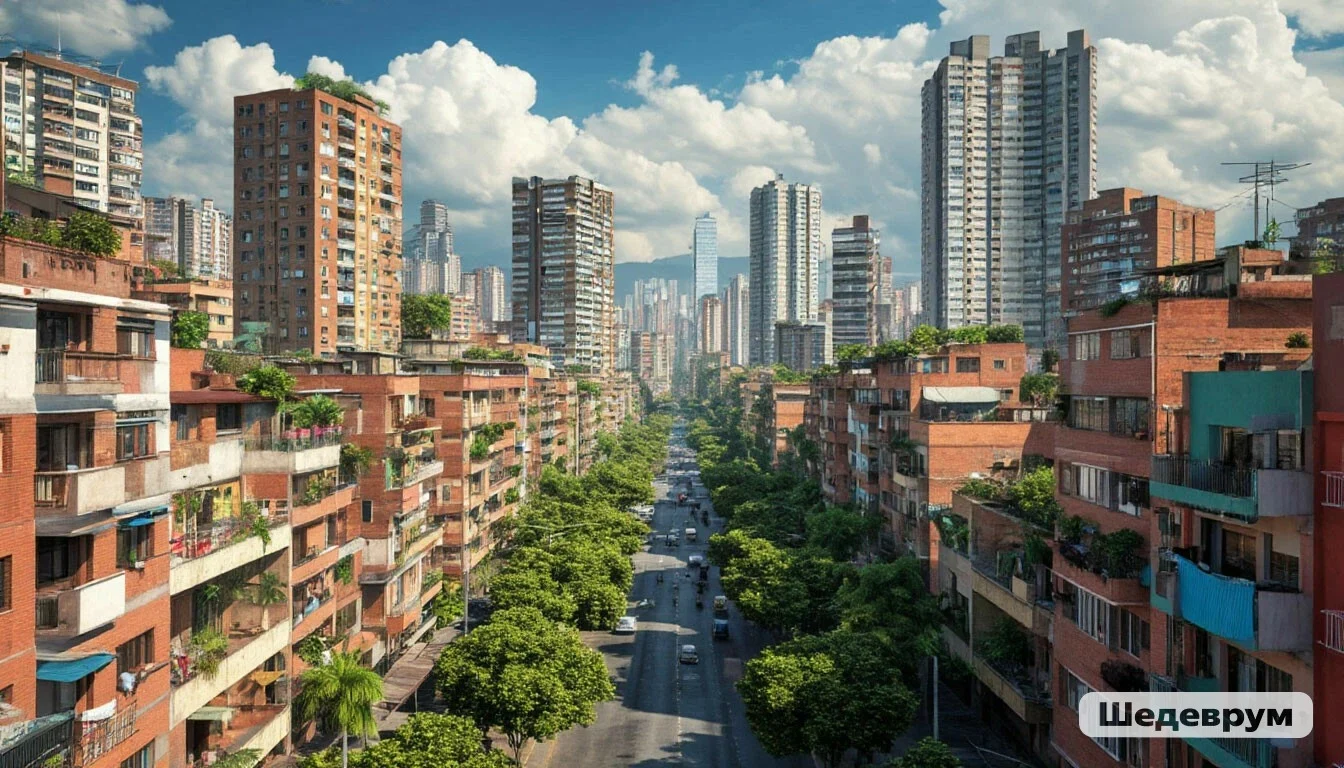
What do they think about the future in Latin America? Specially for Futureating, researcher and futurist Ruben Gali gave an interview, and we used AI to expand on the main postulates of his speech. You can read the interview on our platform in the «Interviews» section.
Modern mass culture is oversaturated with identical images of the future. On one hand, there are the sterile, high-tech utopias of Silicon Valley; on the other, the grim, neon cyberpunk dystopias broadcasted by Western cinema. But the real future is born not in the quiet of corporate laboratories, but on the bustling, chaotic, and incredibly vibrant streets of modern megacities. Cities like Mexico City or Monterrey are today becoming true laboratories of «street futurology,» creating completely new, hybrid, and human-centric development scenarios.
The uniqueness of these urban ecosystems lies in simultaneity — the coexistence of multiple historical epochs at once. Here, ancient cultural memory and colonial architecture directly collide with digital hypermodernity and unprecedented technological integration. In this melting pot, a unique form of urban resilience is born. Faced with infrastructural fragility, social inequality, and the challenges of automation, residents of megacities are forced to constantly improvise.
It is precisely from this everyday improvisation and cultural resilience that an alternative image of tomorrow crystallizes. This is a future where technology does not isolate people in virtual capsules, but adapts to the needs of real urban communities. It is not a cold world of robots, but a space of lively social interaction, where historical memory helps to rethink technological acceleration. The urban labyrinths of Latin America prove: the future can be complex, fragmented, and bubbling, but as long as its center remains the human being with their capacity for empathy and adaptation, it remains viable.
Comments (1)
Идея «уличной футурологии», рождающейся из хаоса и импровизации, действительно сильна тем, что предлагает альтернативу стерильным корпоративным сценариям — она ставит в центр не технологии, а способность сообществ адаптироваться и переизобретать пространство. Для переноса этой логики в российскую реальность имеет смысл не копировать мексиканский опыт, а искать аналогичную гибридность в наших постсоветских городах, где исторические слои и цифровизация уже сосуществуют в напряжённом, но живом взаимодействии. Конкретным партнёром для пилотного исследования мог бы выступить Сбер — через свою экосистему «Умный город» и дата-аналитику они могут предоставить обезличенные данные о мобильности и социальной активности в определённых районах, а также платформу для моделирования сценариев. Первым шагом стоило бы запустить проектную сессию с участием социологов, архитекторов и представителей Сбера на базе одного из крупных спальных районов Екатеринбурга или Казани, чтобы проверить, можно ли целенаправленно стимулировать ту самую «продуктивную импровизацию» через легкие изменения инфраструктуры и локальные ивенты.