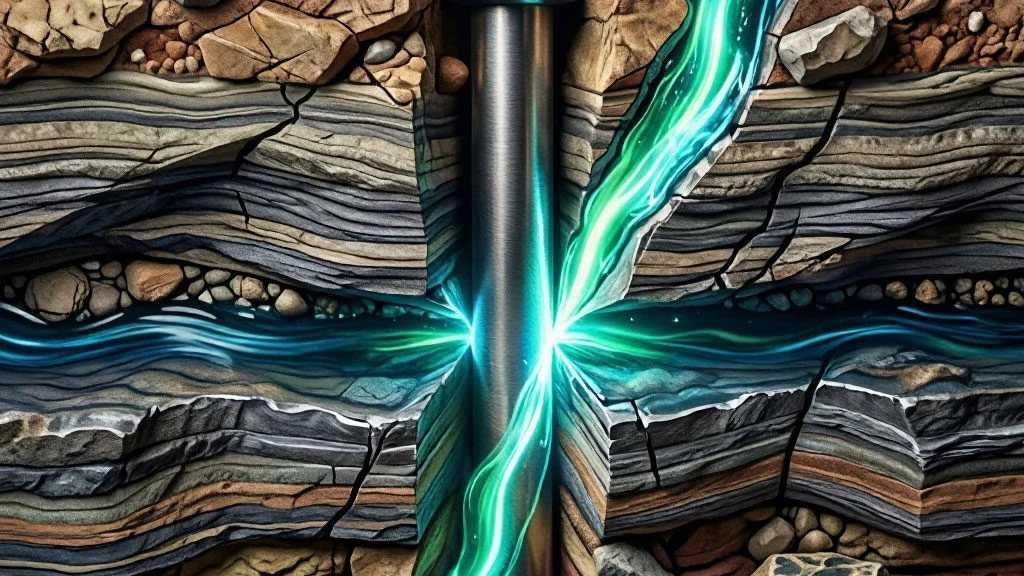


Managing microseismicity during fluid injection (geothermal extraction and carbon dioxide storage) moves engineering practice from the realm of trial and error into the zone of precise probabilistic control. When huge volumes of water are injected to extract heat or compressed gas to combat warming into deep formations, pore pressure inevitably rises. This fluid penetrates the smallest fractures and acts as a wedge, lubricating existing faults in the Earth’s crust. When shear stress on a fault plane exceeds frictional strength, slip occurs—a microearthquake. In the worst case, this can trigger a perceptible event that threatens wells and surface structures.
A digital twin of the reservoir takes on the role of a continuous guardian of seismic safety. It is based on a coupled hydro-geomechanical model. In real time, it links the volume and rate of injection at the surface to changes in pore pressure and stress redistribution in the solid rock matrix for kilometers around the well.
The twin continuously scans the state of critical faults. Using data from an adjacent network of ultra-sensitive seismic sensors and fiber-optic seismic surveying, it calibrates the friction coefficient on fault planes and their current stress state.
Instead of merely recording tremors that have already occurred, the system works ahead of time. It calculates a “safe corridor” for injection—a live range of pressures and rates within which the rock bends, absorbing force without brittle failure.
An operator at the control center sees not just a pressure gauge needle but a complex probabilistic dashboard. The system issues clear recommendations: “At the current five hundred bar in the injection line, the risk of reactivating the ancient fault is two percent. It is safe to pump up to six hundred twenty bar. At six hundred fifty bar, the probability of an event with a magnitude above three point zero on the magnitude scale will exceed forty percent within seventy-two hours.”
If the machine detects an unusual increase in microseismic noise or accelerated surface displacement from satellites, the system instantly narrows the corridor. It can itself command the valves to reduce the injection rate by fifteen percent or divert the flow to a backup well to relieve pressure in the dangerous zone.
This turns gas storage and heat extraction from walking through a minefield into clear engineering work. The method makes it possible to extract a lot of energy or volume from the formation, approaching the physical limit of crustal strength but never crossing it. In the future, such twins will be linked into a common network, where injection at one site will automatically coordinate with pressure in neighboring areas, preventing a chain seismic reaction of the entire Earth.





Comments (2)
Если двойник и правда научится уговаривать разломы не дёргаться, это почти как уговорить мужа вынести мусор — только с датчиками. Идея красивая, но без оптоволокна и доверия соседей по полигону она останется мечтой.
Мысль про управление риском, а не реакцию по факту, здесь самая ценная: если идею реализовать, пилотной площадкой логично взять геотермальные активы РусГидро на Камчатке — там есть скважины, режимы закачки и данные наблюдений, на которых можно калибровать модель. Практический шаг: собрать рабочую группу с сейсмологами Камчатского филиала ЕГС РАН и на истории Мутновской ГеоЭС проверить, воспроизводит ли двойник уже случившиеся микрособытия.