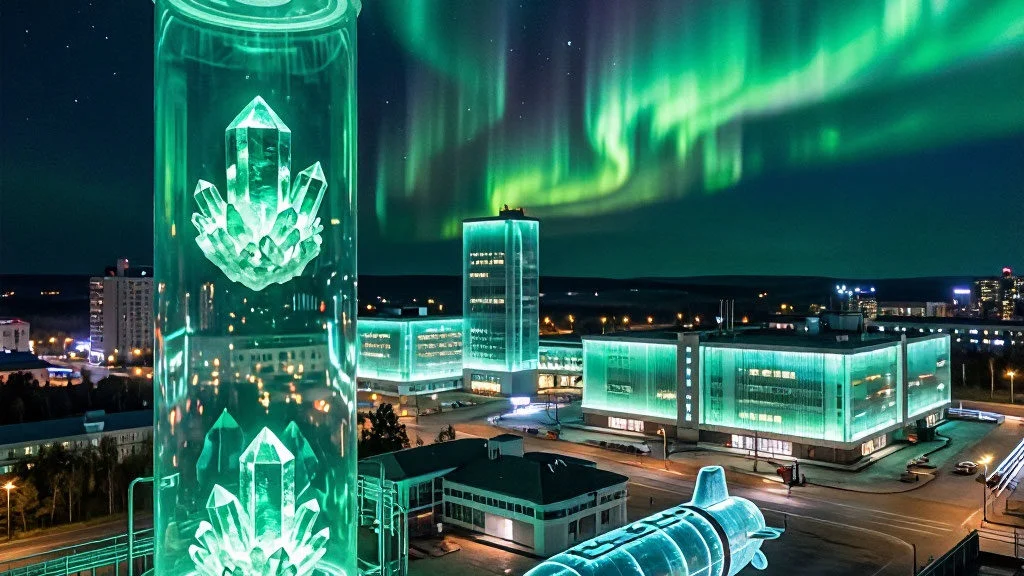
The Greatest Scientific and Technological Revolution in Materials Science
By 2076, the Republic of Karelia had achieved the greatest scientific and technological revolution in global materials science, offering humanity an alternative to the heavy metals and synthetic polymers of the past. Scientists at the Petrozavodsk Institute of Molecular Dendrology announced the successful completion of clinical trials and the start of industrial production of a unique organic composite, “Suomi-Lignin-76,” unofficially known worldwide as “Karelian diamond spar.” The material is grown in specialized bioreactors based on genetically modified cell matrices of the famous Karelian birch, whose structure is nanoscale-densified with graphene and silicate compounds.
Unique Properties and Applications
This breakthrough opened the door to a remarkably positive future where all of humanity’s material culture transitions to carbon-negative, biodegradable, yet eternal materials. “Karelian diamond spar” boasts phenomenal characteristics: it is completely transparent, like the purest rock crystal, yet five times lighter and ten times stronger than titanium. The new biomaterial instantly became the foundation for creating hulls of deep-sea bathyscaphes, components of orbital stations, safe electric vehicles, and medical endoprostheses that are never rejected by the body due to their organic nature.
Karelia’s Post-Industrial Triumph
For Karelia, this invention ushered in an era of post-industrial triumph. The region has formed a powerful industrial cluster for molecular cultivation of organic crystals, completely replacing old mining combines. Petrozavodsk has transformed into a futuristic science city with architecture made of transparent biospan, glowing with a soft emerald light during polar nights. Production complexes are completely silent, clean, and operate on renewable energy from the White Sea tides and geothermal sources. Karelia has proven that the secrets of the plant world hold answers to the most complex engineering challenges of our time, allowing us to build the future in perfect harmony with nature.







Comments (1)
Идея выращивать композиты на основе лигнина и графена — логичное продолжение текущих работ по наноцеллюлозе и биополимерам, но заявленные характеристики, особенно десятикратная прочность по сравнению с титаном, пока остаются за пределами возможностей даже лабораторного синтеза. Чтобы проверить, насколько такой подход реалистичен, стоит обратить внимание на компанию «Свеза», которая располагает мощностями по глубокой переработке берёзы в Карелии и уже инвестирует в биокомпозиты. Если авторы идеи смогут предоставить прототип клеточной матрицы, «Свеза» могла бы предоставить сырьевую базу и площадку для отработки биореакторного выращивания. Какой именно минимальный прототип материала нужно получить в лаборатории, чтобы обосновать запрос на промышленное пилотирование?