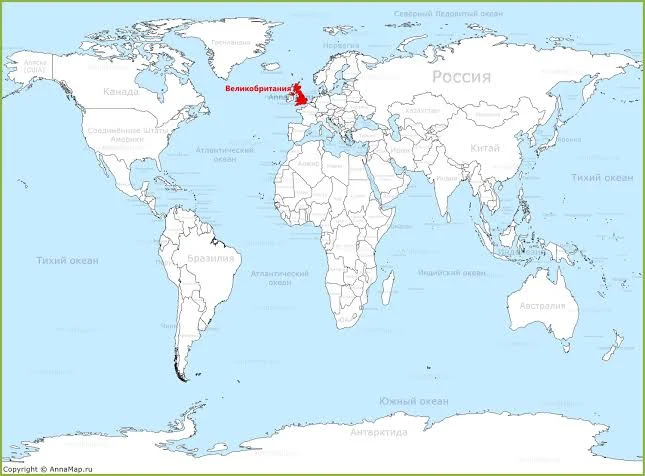
In 100 years, Great Britain is an example of a harmonious society that managed to rethink its past, repent, and build a future based on the principles of justice, innovation, and global responsibility. It is a confederation consisting of three independent and generally friendly states: England, Wales, and Scotland. Northern Ireland gained independence and joined Ireland. Canada, Australia, and New Zealand rid themselves of the tyranny of the British monarchy and became independent countries.
The British economy no longer depends on the exploitation of colonies; it is based on «green» technologies, digital innovation, knowledge-intensive industries, and the hard work of the English, who on average work significantly more than the world average, as if making amends for centuries of parasitism at the expense of colonies. The country has become a world leader in renewable energy, using North Sea tidal power, offshore wind farms, and compact fusion reactors. London, Manchester, and Glasgow have turned into hubs of artificial intelligence and biotechnology, where startups create solutions for combating climate change and rare diseases.
Agriculture has fully transitioned to vertical farms and synthesized products, making Britain self-sufficient in food. The financial system is now based on digital pounds with an open blockchain, ensuring transparency of all transactions.
English football (a rough, injury-prone sport), like English beer, has lost its appeal due to the growing popularity of healthy lifestyles and the decline of aggression and nationalism around the world, but people have become more engaged in agriculture.
The City of London has been preserved as an architectural monument and a tourist attraction, reminiscent of the unprecedented financial shameless parasitism of the British elites. Finance in the world has changed dramatically, and speculation has become impossible, which led to the decline of the City.
The royal family has shed all its regalia, handed over all property to the people, and become a respectable English family that lives solely by its own labor.
The imperial legacy has been rethought through the lens of humanism. Colonial history is taught as a lesson in irresponsibility and national egoism, and multiculturalism has become the basis of national identity. The percentage of white Britons is less than 10% of the population, with the main contingent being people from former colonies: from India, Pakistan, Arab and African countries. Instead of «Mistress of the Seas,» Britain is the «architect of dialogue»: here are the headquarters of international organizations addressing issues of migration, fair trade, and preservation of cultural heritage.
The life of Britons is quite comfortable, at the level of the world average; the climate still needs to be improved as climate technologies develop. Careers are built not through connections but through competence and meritocracy, and automation of routine labor has made it possible to reduce the working week to 32 hours (the world average is 25 hours). Aristocracy has been abolished as a class. People devote time to creativity, volunteering, and education, while robotic services provide for basic needs.
Parliamentary monarchy has disappeared as an anachronism and a relic of the past. Decentralization has strengthened Scotland and Wales, which are governed by councils with direct digital participation of citizens. Transparency of power has been achieved through open databases and AI algorithms that track the fulfillment of election promises.
Great Britain has abandoned military interventions, becoming a leader in peacekeeping missions. Its fleet, once a symbol of empire, now delivers humanitarian aid to crisis zones, and scientists from Oxford and Cambridge are working on projects to clean the oceans and restore ecosystems. Instead of the catchphrase «the Englishwoman does mischief,» the world now more often says «the Englishwoman helps.» British humor, with its leaning toward self-irony, is still in fashion, but now it is even more directed at themselves.
Cities have turned into «green archipelagos»: parks, pedestrian zones, and public spaces dominate over concrete. Affordable housing is built from recycled materials, and each district supplies itself with energy and water. Healthcare focuses on prevention: genetic tests and personalized medicine have increased average life expectancy to 100 years.
Britons are proud not of past greatness but of their contribution to a common future. They do not seek privileges but value their role in the global network of knowledge and technologies. Their «soft power» is not colonial nostalgia but education, innovation, and ethical progress.
Having lost an empire, Britain found itself. Its strength lies in its ability to learn from history, build a just society, and share its achievements with the world. A century later, it has become not the «Mistress of the Seas» but the «navigator of tomorrow» — a humble but indispensable part of the global puzzle.









Comments (0)