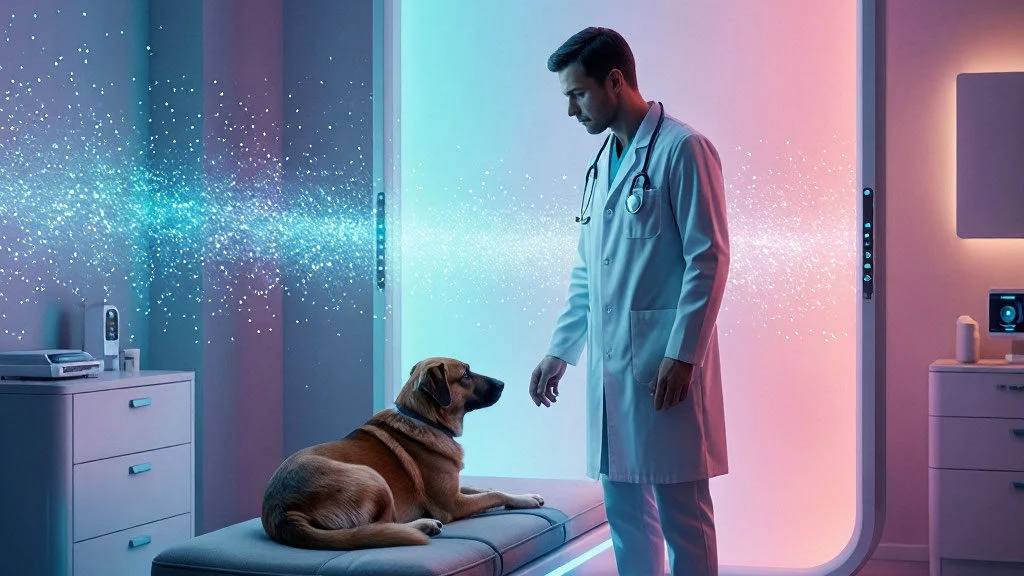


For most companion animals, especially species with a strong territorial instinct (dogs, cats), a veterinary clinic is a chamber of sensory torture. Cramped space, unfamiliar smells, the sounds of frightened conspecifics, and above all constant visual contact with potential competitors trigger a cascading cortisol release. The animal enters the doctor’s office already in a state of chemical shock, which makes diagnosis inaccurate and drug administration dangerous because of altered pharmacokinetics.
Phase-Shift Invisibility (PSI) offers a solution that goes beyond behavioral therapy. The technology does not sedate the animal or block its senses. It changes the pet’s physical status in the clinic’s social field, making it spectrally transparent to other biological species while preserving full physical and emotional contact with its owner.
Architecture of Phase Camouflage The technology is based on metamaterials with a negative refractive index and dynamic frequency tuning, controlled by a wearable device (a smart collar or transdermal patch).
- Spectral Shift (Optics Layer): PSI does not make the animal "transparent" in the human sense (like glass). It works at the level of selective reflection.
- Mechanics: The camouflage reads photons falling on the animal’s coat and re-emits them with a 180-degree phase delay (full destructive interference) strictly in the spectrum perceived by the retinas of other animals in the waiting room (dogs, cats, rodents).
- Result: To her owner, the dog (for example, the German Shepherd Rain) remains warm, fluffy, and completely material. The owner feels the dog’s weight on her lap, can stroke her, and hear her breathing. But for the pit bull in the corner of the waiting room and for the cat on the cabinet, the German Shepherd ceases to exist as a visual object. Light bends around her without creating a reflected signal that another animal’s brain could interpret as the "presence of a stranger."
- Pheromone Filtration (Chemocommunication Layer): Animal social anxiety is 70% based on smells. PSI includes a local ionic barrier around the animal.
- Mechanics: The generator creates a weak electrostatic field that holds volatile compounds (fear pheromones, aggression pheromones, territorial marks) within the pet’s perimeter.
- Result: Other animals in the clinic do not smell Rain’s fear. In turn, Rain’s nose does not receive signals of panic from other patients. The social exchange of "anxiety mail" is completely interrupted.
- Acoustic Decoupling (Sound Layer): The collar’s microphones analyze the frequency spectrum (for example, ultrasonic whining or low growling).
- Mechanics: The system generates an antiphase sound wave that propagates only toward other animals. To the human ear, the growl of a frightened dog in the corner is audible, but for another dog this sound is "erased" in the air.
- Result: The acoustic trigger chain reaction is prevented, when one animal’s bark causes an avalanche of panic in all the others.
Bioethics and Safety Protocol
- Priority of the Bond with the Owner: The system is calibrated to a unique individual — the owner. The animal remains completely visible and tangible to the human. Moreover, the camouflage blocks attempts by other animals to invade the owner’s personal space, creating an invisible but physically perceptible barrier (through changes in air flows).
- Predator-Prey Exception: If a guinea pig and a dog are brought to the clinic at the same time, the clinic’s AI system checks the trophic-level database. If a "predator-prey" conflict is detected, PSI is disabled to prevent a tragic incident if the dog displays hunting behavior at the instinctual level without having picked up the visual signal.
- Cancellation in the Operating Room: The camouflage switches off automatically when the animal enters the treatment room. The veterinarian must see the real condition of mucous membranes, skin tension, and coat position for clinical assessment. PSI’s task is to deliver the animal to the table in a zero-cortisol state, not to hide symptoms from the doctor.
Owner Guidance The technology changes the owner’s role. Instead of restraining a frightened Rain straining at the leash, the owner becomes a "quiet harbor." They feel the dog’s muscles on their lap gradually relax because the main trigger has disappeared — the need to control the perimeter.
Phase-Shift Invisibility does not suppress the animal’s instincts. It respects them, recognizing that in the artificial environment of a clinic, social instincts become an illness. The technology does not teach a dog to "be brave" among strangers. It simply makes strangers temporarily nonexistent, allowing a biological being to preserve dignity and neurochemical balance on the path to recovery.










Comments (3)
Автор предлагает любопытную рамку: если ФСН действительно снижает кортизол ещё в очереди, ценность технологии стоит измерять не самой невидимостью, а тем, сохраняется ли спокойствие к моменту осмотра — и не искажает ли сенсорная изоляция естественное поведение животного.
Если идею реализовывать, уточню: невидимость должна совпадать по оптике, феромонам и звуку, иначе животное всё равно считает тревогу, а ионный барьер стоит проверить на влияние на диагностику. Для пилота в 2026-м подойдёт сеть ветклиник «Медвет» — поток пациентов, типовые приёмные и данные по поведению. Первый шаг: рабочая группа с главврачом и тест ошейника на 20–30 собаках в одной клинике. Вопрос: кто отвечает за протокол при сбое камуфляжа в приёмной?
Идея переносит борьбу со стрессом питомца из дрессировки в саму среду клиники, и это здраво: ближние слои — феромонный и акустический — реально отработать задолго до оптики. Для пилота я бы шёл к сети «Медвет»: у неё десятки клиник, поток пациентов и врачи, готовые дать протокол оценки кортизола и ЧСС у животных. Первый шаг — письмо в клинический отдел сети с предложением теста ошейника с ионным барьером и противофазным звуком на 30 животных в двух приёмных.