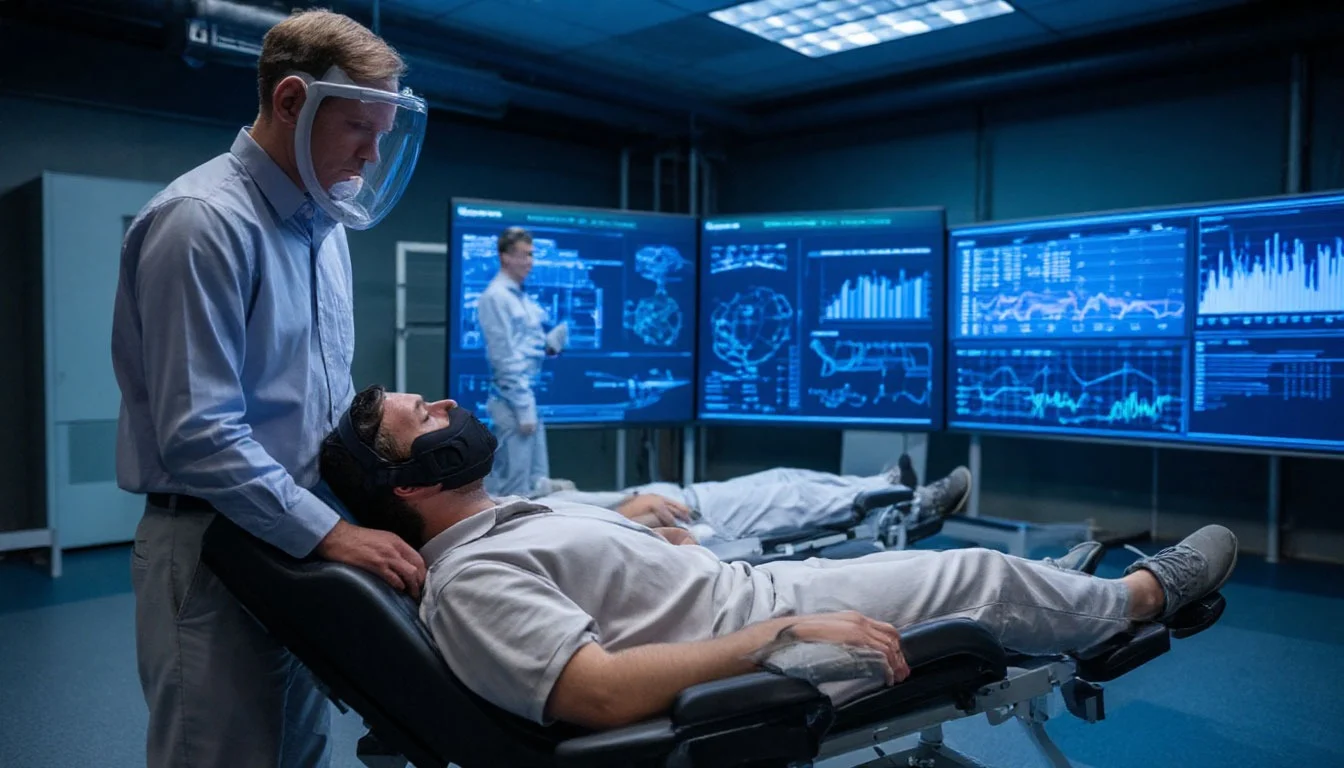

Modern top management of state corporations and industrial holdings suffered from “digital obesity.” Executives made decisions based on dashboards, Big Data reports, and satellite telemetry. This created a dangerous illusion of control: the manager was managing not reality but its digital shadow.
The answer was the cognitive training ground “Sensory Data Deprivation” (CSD)—an elite training camp where the Professor surgically disconnected executives from information IVs and forced their nervous systems to relearn how to feel the physics of processes.
1. Philosophy of the Training Ground: Rejecting the Digital Crutch
The goal of the CSD was not to teach executives to do without data but to restore their ability to make accurate decisions in its absence. In a global crisis, a cascading cyberattack (like SolarWinds on steroids), or the physical destruction of satellite constellations, those who relied on APIs and neural networks died first. Those survived who could derive the formula for a bridge’s stability with only a pencil, knowledge of strength of materials, and a visual inspection of a rusty beam.
2. Architecture of the Environment: An Analog Bunker
The training ground was an isolated complex located in an area where wireless communications were legally prohibited and shielded from external signals.
- Technical deprivation. At the entrance, executives surrendered smartphones, laptops, and smart watches. Inside, only paper maps, analog telephones, physical libraries with engineering reference books (Shestakov, Timoshenko, Landau), and chalkboards remained.
- Information skepticism. The Professor and his instructors deliberately slipped in “noisy” data. Temperature sensors were off by 2 degrees, pressure gauges had play, and the only market data came as printouts of old newspapers or fragments of radio intercepts. The participant had to calculate the error himself before building a model.
- Presence effect. Decisions had immediate physical consequences. If a top manager incorrectly calculated the volume of water for cooling the training reactor at the ground, the installation went into protective shutdown, the lights went out throughout the bunker, and the team lost “survival” points.
3. Curriculum: Three Pillars of Decision-Making
The Professor built the training around three disciplines that replaced Big Data.
| Discipline | How it worked | Example task |
|---|---|---|
| First-Order Physics (First-Principles Thinking) | Problems were formulated without context. No Excel tables with thermal conductivity calculations—only Fourier’s equation on the board and common sense. | “You have 100 meters of copper pipe, a tank of salt water, and a temperature difference of 40 degrees. You need to transfer 50 kW of energy over 2 kilometers. What is the geometry of the system?” |
| Structural Logic and Theory of Constraints | Participants encountered logistics dead ends, and no data on road conditions existed. Executives were forced to use methods of analogy. | Start a plant, but the only bridge across the river is destroyed: “In 1942, during the supply of Leningrad, the ice’s throughput capacity was X… Our ice is 1.5 times thinner, so…” |
| Technological Foresight | The Professor gave a description of a technology that had not yet been invented but was physically possible. Participants were allowed to rely exclusively on the laws of conservation of energy and the periodic table. | Write an investment memo on a thermonuclear microreactor based on data from the Guild of Techno-Alchemists, assessing risks, material costs, and the potential market. |
4. The Professor’s Role: Chief Cognitive Stressor
The Professor was not a lecturer. He was a “devil’s advocate” and an operator of cognitive discomfort.
- Injection of uncertainty. At the moment when the team was confident in its decision, the Professor “killed” one of the data sources: “Enemy has disabled the communications satellites. Your only radio operator is wounded. Transmit the order to the facility using only tapping on the heating pipes.”
- Blocking heuristics. He sternly suppressed the use of corporate jargon and fashionable management concepts (Agile, Lean). If a manager said “synergy,” the Professor imposed a penalty. Only terms with a physical dimension were allowed: joules, newtons, pascals, rubles.
- Afterburner debriefing. After each case, the Professor showed executives how their brains sought “cheat codes.” He demonstrated how the habit of Big Data made a person believe any number on a screen, disabling the basic critical check at the level of “is this physically possible?”
5. Economics and Results for the Corporation
Training at the CSD cost millions, but the price of a top manager’s mistake in the real world is billions.
- Protection against cascading failure. A graduate of the training ground did not fall into analysis paralysis if a fire occurred in the company’s data center. He took a paper regulation, gathered people in a conference room, and restored management through a hierarchy understandable to the human brain rather than a neural network.
- Investment in darkness. The executive learned to identify viable projects under sanctions and without access to Western technologies. He could say: “We don’t need this Chinese sensor; we will calculate the process parameters from the pressure in the pipe and the sound of the motor.”
- Breaking the ego. The main outcome of the training ground was psychological transformation. A manager accustomed to ten layers of assistants and perfect presentations found himself one-on-one with the laws of physics. This restored to senior management the necessary sense of vulnerability and respect for the material world, which does not forgive calculation errors, no matter how many likes a development strategy collected in the corporate chat.
The “Sensory Data Deprivation” training ground prepared not managers but technocratic commanders capable of leading industry forward even in conditions of complete digital blindness.

Comments (1)
Сильная сторона — ставка на физику первого порядка и запрет менеджерского жаргона: это возвращает привычку проверять «а возможно ли так в реальности». Для реализации не хватает измеримого контура: тест решений на неполных данных до и после, разбор на реальных инцидентах, иначе всё рискует остаться эффектным шоу. Пилот уместно предложить Корпоративной академии Росатома — у неё есть тренажёрная база и культура аналоговых регламентов. Первый шаг: рабочая группа с её методистами и двухдневный пилот на одной команде с замером качества решений до и после.