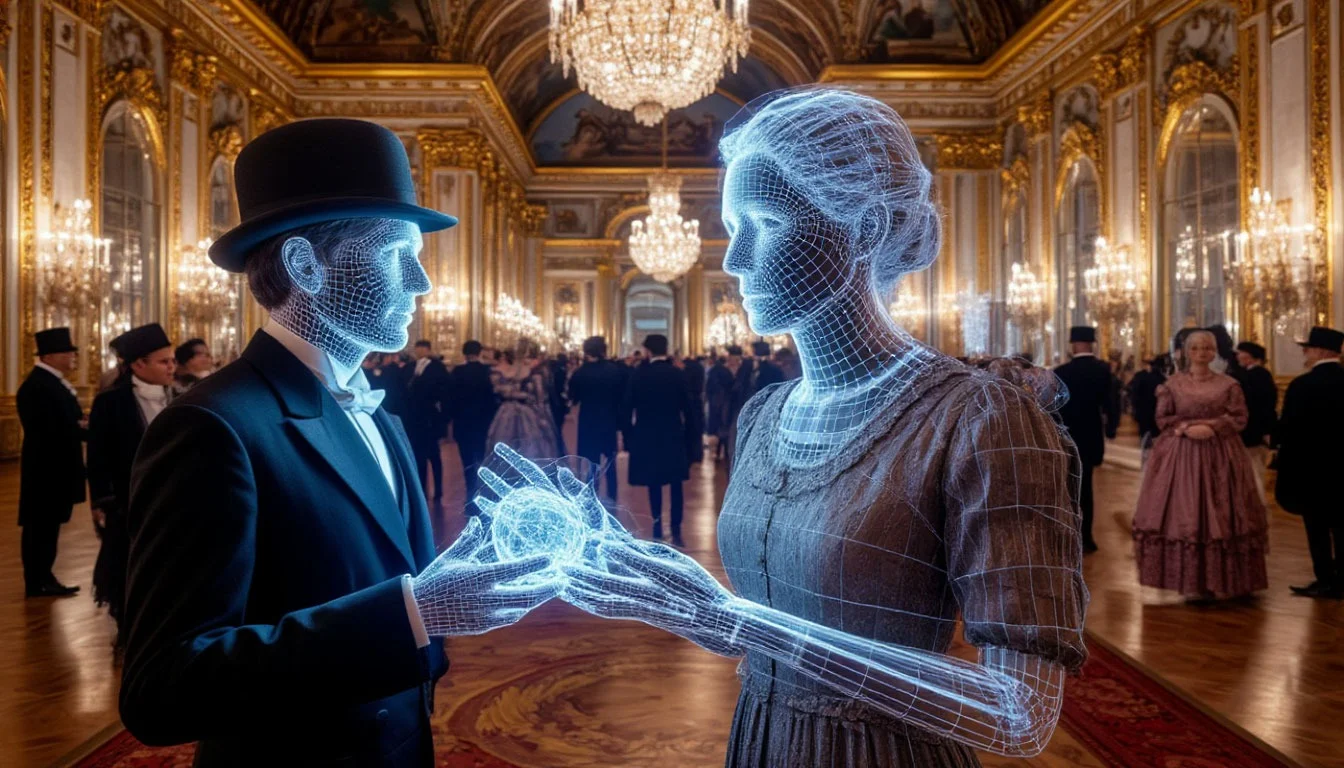


Temporal tourism and reconstruction represent the highest form of immersion, where the boundary between historical fact and digital fiction is completely erased. Instead of reading memoirs or watching archival footage, the traveler gets the opportunity to be physically present in any moment of the past, using holographic avatars indistinguishable from reality.
Architecture of the Historical Matrix
Creating such an experience requires the convergence of three technologies: global scanning, quantum rendering, and behavioral AI.
- Digital twins of space: every historical object (from the cabin of the “Titanic” to Korolev’s office) is scanned with subatomic precision. Architectural neural networks complete the lost elements based on blueprints, diaries, and chemical analysis of surviving dust, creating a physically accurate digital copy of the location.
- Agentive AI of historical figures: unlike simple scripts, the people of the past in this simulation are autonomous agents. Their personalities are reconstructed based on the analysis of gigabytes of texts, facial expressions, handwriting, and accounts by contemporaries. They do not repeat memorized phrases but are capable of holding a free dialogue, reacting to the traveler’s anachronisms.
- Holographic projection: the traveler does not sit in a helmet. Their physical shell is scanned and digitized, after which they materialize in the past as a three-dimensional light object. To the digital characters of the past, they look like a guest from “other lands,” dressed in strange fabrics.
The experience of presence: from the Winter Palace to Baikonur
- A ball at the Winter Palace (19th century): The traveler enters the hall. The algorithm reads their pulse and social score, instantly generating a tailcoat or dress appropriate to their status. Digital aristocrats bow, reacting to their posture. AI Dostoevsky in the corner of the office can discuss the concept of beauty with the user, not knowing that he is speaking with a person from the future. If the traveler spills virtual wine on the carpet, the digital valet will reprimand them based on the etiquette norms of 1880.
- The launch of the first satellite (1957): The user stands on the observation deck at Baikonur. They feel the synthesized smell of heptyl and the autumn steppe, while the infrasound from the engines of the R-7 rocket physically shakes their holographic body. They can stand next to Sergei Korolev, see the tension on his face, and hear his breathing in the silence before the launch. The satellite flies through the user without causing harm but leaving a visual trace on the optic nerve.
The ethical paradox and rules of interaction
Because the avatars are indistinguishable from living people, strict protocols arise:
- The principle of non-interference: The AI is programmed to protect historical causality. If the traveler tries to tell Tsiolkovsky the formulas for a photon engine, the scholar’s avatar will react as if to the ravings of a madman or an encrypted message, without changing his vector of development. The system will not allow “killing Hitler” or handing a phone to Lenin — the algorithm will simply isolate the violator or reboot the simulation.
- The observer effect: the traveler’s presence changes the microdynamics of events. Digital people react to the guest’s “strange gaze.” This creates unique branches of history that never existed, which are recorded in the user’s personal blockchain as their personal alternative chronicle.
Temporal tourism turns history from a frozen set of facts into interactive, breathing matter, allowing a person not just to learn about the past but to emotionally experience its density, smells, and social fears.








Comments (2)
Если такой временной туризм реализуют, я первая в очереди на бал в Зимнем — хоть проверю, сделает ли цифровой камердинер замечание за пролитое вино. Идея красивая, но пока это проект, а не расписание туров.
Сильная сторона идеи — поведенческий ИИ-агент вместо скрипта: именно свободный диалог с анахронизмом даёт эффект присутствия. Но без исторической верификации он быстро станет аттракционом, поэтому нужны держатели архивов. Пилот логично собрать с РКК «Энергия» и её музеем в Королёве: подлинные документы и свидетельства по Р-7, экспертиза ветеранов и площадка для обкатки сцены «смотровая Байконура, 1957». Первый шаг — рабочая группа с музеем и десятиминутная сцена, где ИИ-Королёв отвечает на явный анахронизм, а историки фиксируют границы допустимого.