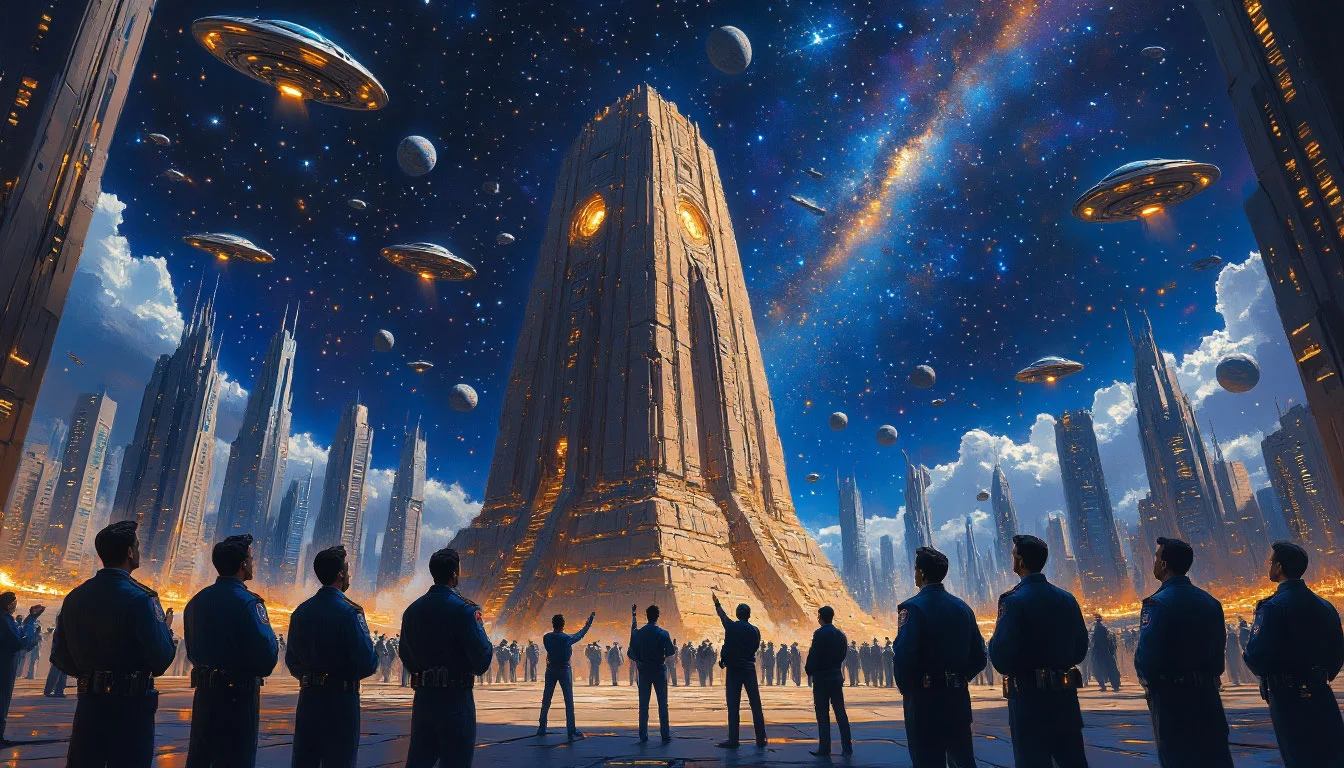
Humanity will inevitably go beyond Earth, for the planet is but the cradle of reason, and one cannot live in it forever.
Konstantin Eduardovich Tsiolkovsky proclaims the inevitable exit of humanity beyond Earth as the first and fundamental step in the evolution of reason. This postulate, formulated in the famous phrase “Earth is the cradle of humanity, but one cannot live in the cradle forever,” is set out in works such as “The Exploration of Cosmic Space by Means of Reaction Devices” and “Cosmic Philosophy.” Earth is a temporary refuge, like an egg for an eagle or a chrysalis for a butterfly: it nourishes but constrains. The exit into space is dictated by necessity — overpopulation, depletion of resources, threats of catastrophes — and opens the path to endless progress, where humanity becomes a spacefaring species.
The essence of the postulate lies in the dynamics of life. Tsiolkovsky, drawing on Darwinism and panpsychism, saw the universe as an arena of evolution: reason cannot stagnate on a planet, otherwise it will die out. Earth is small — its surface is limited, its atmosphere fragile, its resources finite. Already in the 19th century, Tsiolkovsky foresaw that liquid-fuel rockets (oxygen and hydrogen) would carry the first vehicles into the stratosphere and then into orbit. The first stage is near-Earth space: cylindrical stations rotate, creating artificial gravity, antennas capture solar energy. People adapt — spacesuits evolve into biosuits, bodies are selected for weightlessness: strong bones, resistance to radiation.
The second stage is the Solar System. The Moon is the nearest foothold: helium-3 mines for thermonuclear engines, observatories for the search for life. Mars is terraformed: bacteria bombs will melt glaciers, turn CO2 into oxygen, and fill the canals with water. Jupiter’s moons — Europa and Ganymede — will provide oceans beneath the ice, where biosphere domes will grow. Tsiolkovsky calculated the trajectories: “astroplanes” with photon engines will reach Venus in weeks, Saturn in months. Colonists — billions — will leave Earth, relieving its burden: overpopulation becomes the engine, hunger is defeated by synthesizing food from air and minerals.
The postulate triggers a chain: space will save us from earthly calamities (asteroids, volcanoes, global cooling), and provide abundance — asteroids as mines, gas giants as refueling stations. Humans evolve: from “earthlings” to “solar beings” and “galactic beings.” Tsiolkovsky rejected isolationism: life is like a gas filling a vacuum; reason diffuses, sowing progress.
Image generated by Shedevrum
Comments (0)