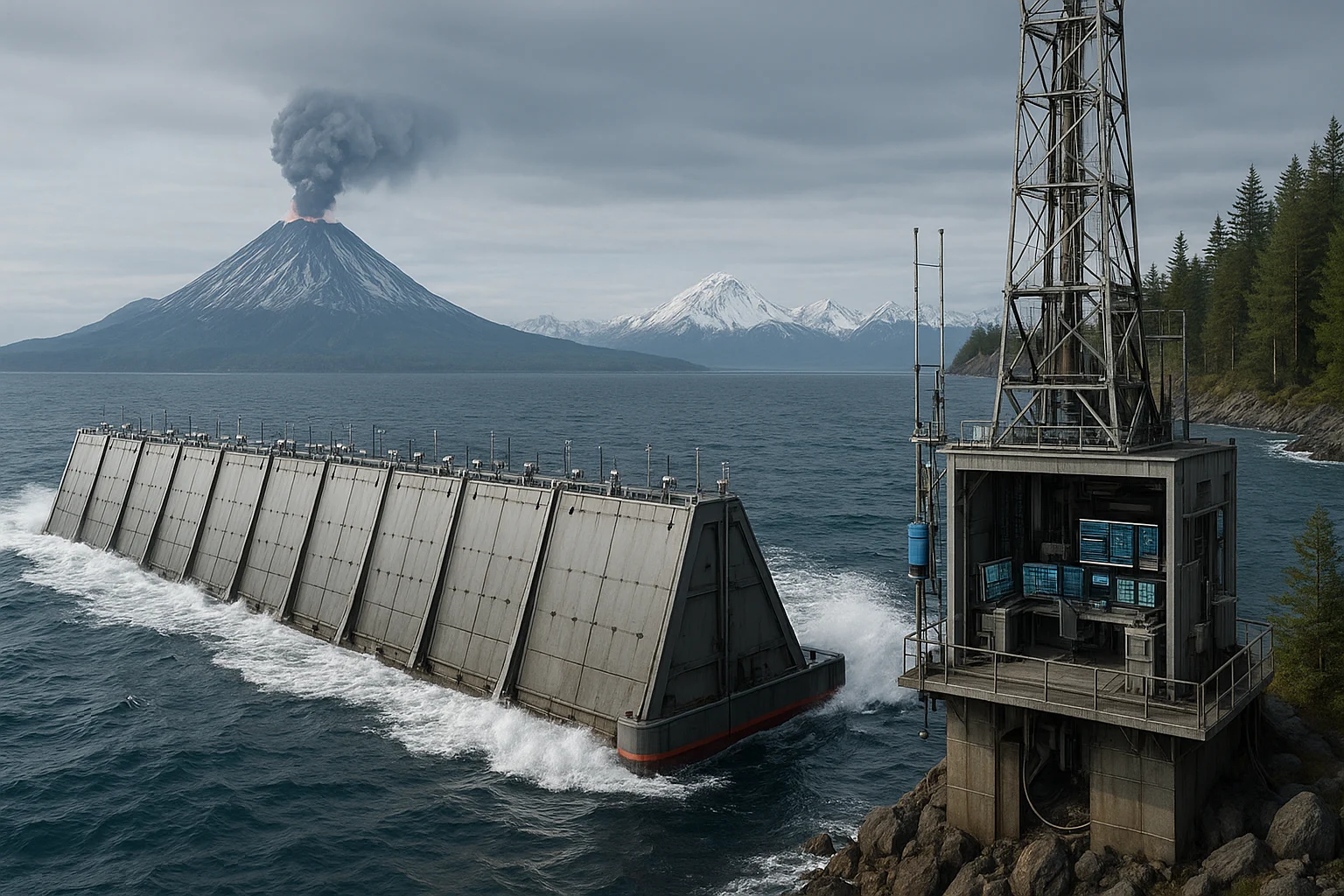
By 2035, Russia has demonstrated to the world a new paradigm of interaction with the lithosphere: earthquakes and the tsunamis they cause off the country’s eastern shores are no longer perceived as fatal natural threats. Over a decade, what once seemed like science fiction was achieved — seismic phenomena began to be predicted with accuracy down to a few hours, and their strength was regulated using directed relief drilling and geoacoustic damping technologies.
The first step was uniting leading geophysicists and IT engineers within a state program launched in 2026. Deep research testing grounds appeared in the Far East, Kamchatka, and Sakhalin, equipped with a new generation of neural-network seismic interpreters. These systems processed trillions of parameters in real time — from tectonic plate shifts to micro-vibrations in mountain ranges, recognizing precursor patterns of underground activity.
By 2029, a preventive response infrastructure had taken shape: seismically active zones became points of scientific intervention. Using precision drilling, scientists relieved stress in the Earth’s crust in advance, triggering micro-faults — completely safe and controlled. Simultaneously, the first «smart breakwater» complexes appeared in coastal areas — autonomous marine platforms capable of dissipating tsunami energy tens of kilometers before it reaches the shore, preventing it from becoming a destructive wave.
Over these years, a humanitarian approach to managing the natural environment also developed. Schools in Kamchatka and the Kuril Islands introduced a mandatory course on «Geo-Responsibility», in which children learned to understand the living dynamics of the Earth. Scientists, educators, engineers, and volunteers created a joint movement in which citizens became active participants in monitoring, open data, and scientific projects aimed at stabilizing the environment.
As the author of this postulate, I participated in launching an educational media channel that explained new geosafety technologies in simple terms, and also oversaw the creation of an online platform for feedback between residents of seismically active regions and scientific teams. This helped build trust, reduce anxiety, and involve thousands of people in the transformation process.
Thus, in 10 years, the very essence of attitudes toward earthquakes has changed: they have ceased to be a spontaneous disaster and have become a manageable, scientifically understood phenomenon.



Comments (0)