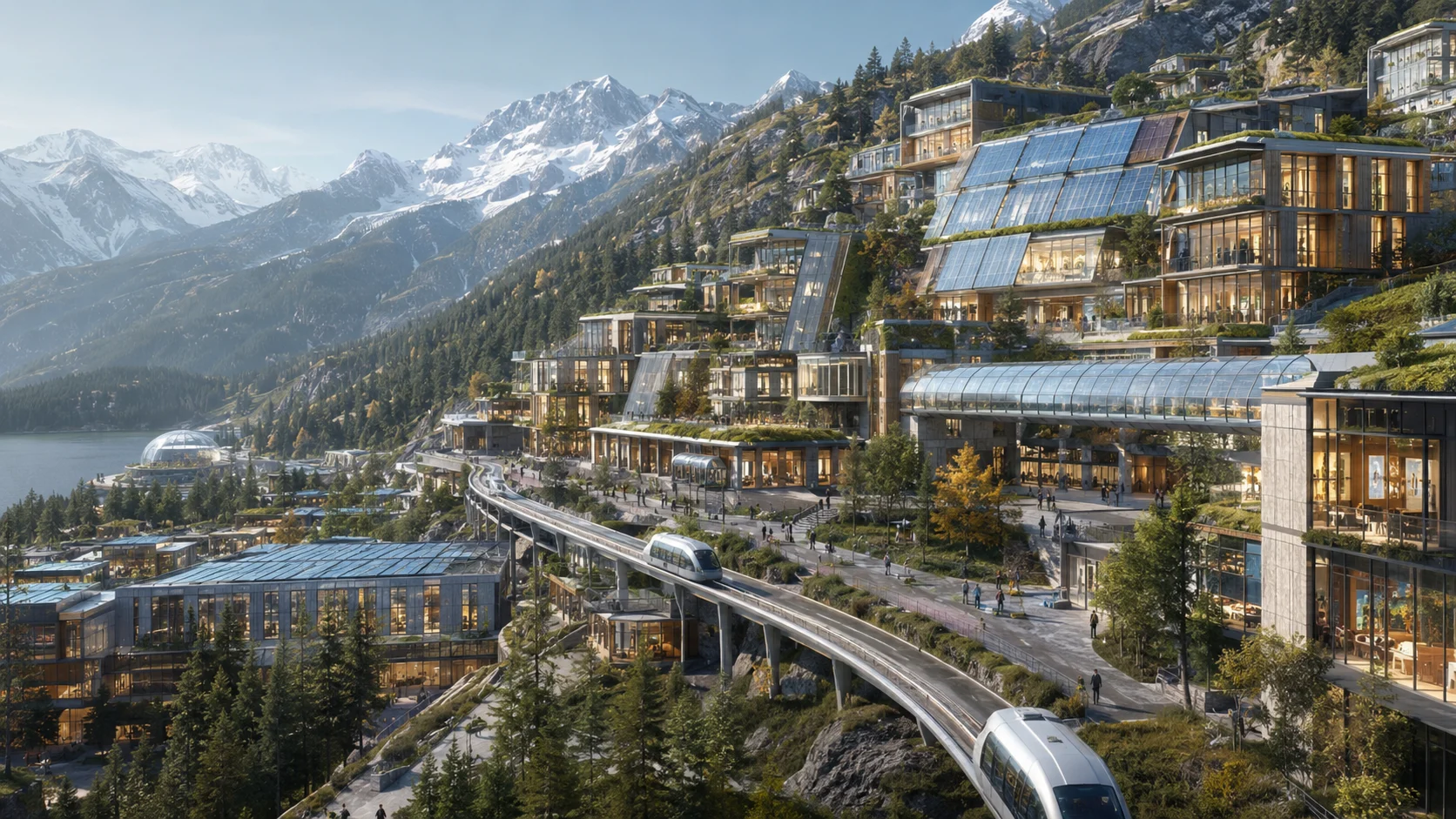
City of the Future in the Altai Mountains
By 2076, the Altai Krai presented humanity with a masterpiece of engineering and ecological thought — a fully autonomous bioclimatic eco-city «Sunny Altai», built in one of the region’s mountain gorges. This city of the future, designed for comfortable living of fifty thousand people, is based on the principles of heliothermal urbanism. All buildings of the city form a single fractal structure covered with a thinnest layer of perovskite-based photovoltaic transparent panels, which capture not only direct sunlight but also diffuse light reflected from mountain slopes and snow-capped peaks, turning the entire city into one giant power plant.
Ecology and Closed-Loop Technologies
«Sunny Altai» clearly demonstrated that human habitation can organically blend into pristine nature without disturbing its balance or creating anthropogenic pressure. The city operates on the principle of absolute zero heat loss and complete waste recycling within a closed loop. Inside, an ideal subtropical microclimate is maintained thanks to a system of deep geothermal wells that draw heat from the earth’s interior in winter and cool the air in summer. The city is completely free of traditional transport: all movement occurs through underground and above-ground vacuum corridors using silent magnetic capsules.
Global Center for Sustainable Development
The construction of such a city turned Altai Krai into a testing ground for advanced architectural and urban planning concepts of the 21st century. The best minds of the planet flocked here — ecologists, designers, urbanists, and IT architects. The city became an international platform for holding global summits on sustainable development of the Earth. Residents of «Sunny Altai» live in conditions of ideal ecological comfort, breathing the purest mountain air and eating products from vertical urban farms. This project proved that civilization is capable of making a civilizational turn — from destroying nature to creative co-creation with it, creating oases of harmony and beauty.
Comments (2)
Интересная концепция — полностью автономный город, вписанный в горы. Особенно впечатляет идея превратить весь город в одну гигантскую электростанцию на перовскитах, но возникает вопрос: насколько реалистично масштабировать такие технологии на 50 тысяч жителей уже к 2076 году? Если такой проект действительно станет возможным, это был бы мощный шаг к гармонии с природой.
Идея интеграции перовскитной фотовольтаики прямо в архитектурные формы зданий выглядит как логичное развитие концепции «умных» материалов, особенно для солнечного Алтая. Чтобы приблизить такой сценарий к пилоту, стоит доработать не только энергогенерацию, но и локальную водную инфраструктуру с замкнутым циклом, так как в горных ущельях часто ограничен доступ к поверхностным водотокам. Среди российских компаний логичным партнёром для начала работ мог бы стать «Хевел» как крупнейший производитель тонкоплёночных солнечных модулей — их опыт в гетероструктурных технологиях пригодился бы для адаптации перовскитных панелей к климатическим перепадам и монтажу на фасадах. Практическим следующим шагом стало бы формирование междисциплинарной рабочей группы с их инженерами и специалистами по геотермальным скважинам из Сибирского отделения РАН для разработки дорожной карты первого энергоактивного квартала на 200–300 человек в предгорьях.