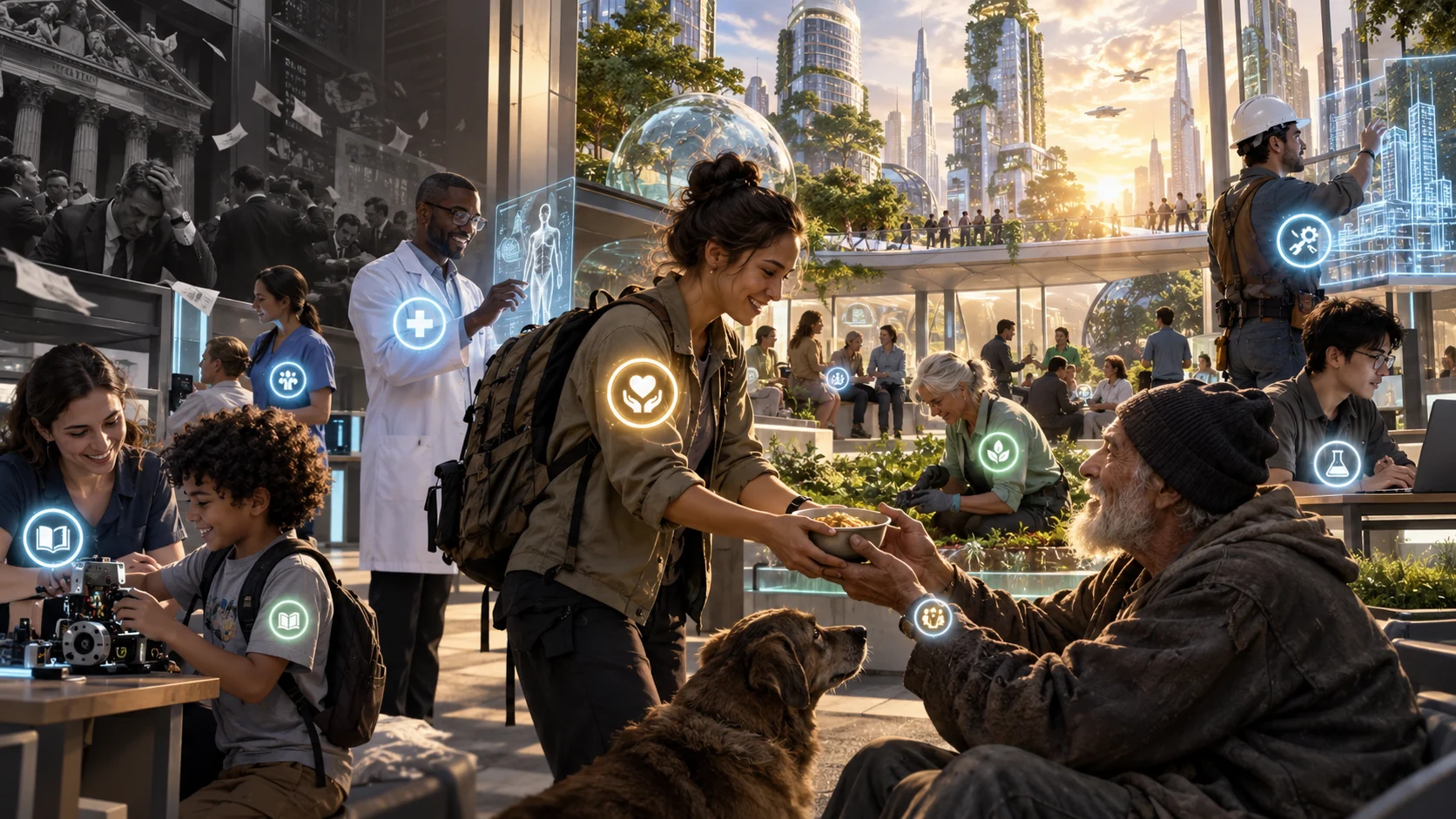



Money stopped determining a person’s value
Money no longer determined a person’s value or their opportunities. Instead, a system of human contribution tokens emerged.
Tokens were awarded for actions that brought measurable benefit to society: education, medical care, scientific discoveries, restoring nature, creating technologies, helping others, and solving complex social problems.
How contribution was assessed
For a long time, the main problem of the new system was obvious: who decides what is considered useful?
Therefore, contribution assessment no longer belonged to a single state, company, or AI. It was formed at several levels at once: public councils set basic values, independent expert systems checked consequences, and AI analyzed data and showed the long-term effect.
| Level | Task |
|---|---|
| Public councils | Set basic values |
| Independent expert systems | Check consequences |
| AI | Analyzes data and shows the long-term effect |
Disputed decisions could be appealed, and the criteria themselves were regularly revised through open voting.
What is guaranteed, and what tokens provide
Basic needs — housing, healthcare, education, and a minimum level of comfort — no longer depended on the number of tokens. They were guaranteed to everyone.
Tokens, however, gave access to additional opportunities: complex projects, rare resources, travel, research, and new technologies.
Society’s new question
The system did not become perfectly fair. But it changed the question itself: society stopped asking “How much did you earn?” and began asking “What useful thing appeared thanks to you?”
A person’s value was no longer reduced to how much they accumulated. What became more important was what changed for the better thanks to their actions.







Comments (1)
Автор предлагает сильную развязку: ценность измеряется эффектом, а не накоплением, и главный риск — субъективность оценки — снимается многоуровневой проверкой. Для пилота логично взять корпоративные социальные программы: у «Норникеля» есть площадки в Норильске, опыт оценки эффекта проектов и данные по волонтёрским инициативам. Первый шаг — рабочая группа с «Добро.рф» и независимыми экспертами: в одном городе начислять условные токены за обучение и экологические акции и полгода сверять их с реальным долгосрочным эффектом.