Discovery of an Ancient Stone City in Krasnoyarsk Krai
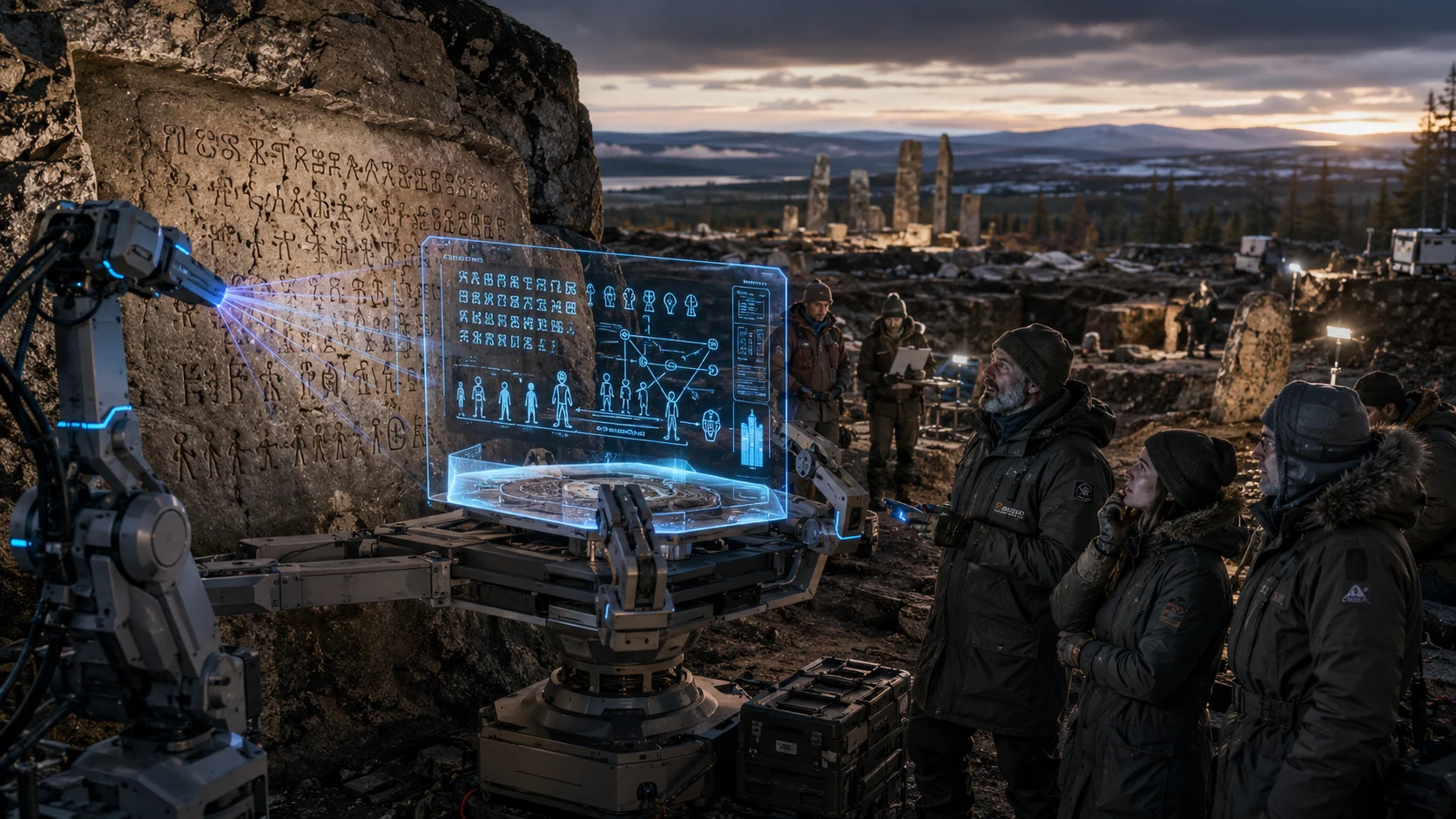
In 2076, Krasnoyarsk Krai found itself at the epicenter of the greatest scientific discovery in human history, completely rewriting textbooks on anthropology and ancient world history. During controlled thermal stabilization monitoring of permafrost zones in the northern part of the region, scientists discovered a monumental underground complex—a perfectly preserved stone city of a previously unknown highly developed circumpolar civilization that existed more than 30,000 years ago. To study the findings, they used the paleoarchaeological analysis supercomputer “Chronos,” which, with the help of neural network modeling and quantum scanning, fully deciphered the pictographic writing and chronicles of this ancient people.
Legacy of the Ancient Civilization and Its Impact on Modernity
This discovery laid the foundation for a profoundly positive future, changing humanity’s fundamental perception of its place in history and the laws of civilizational development. The deciphered texts revealed that the ancient inhabitants of the Siberian latitudes possessed deep ecologically balanced knowledge of astronomy, medicine, and metallurgy that did not disrupt harmony with the environment. They knew no wars in the modern sense, and their social structure was built on the principles of synergy, mutual aid, and careful resource distribution. Studying their heritage gave a powerful impetus to the development of modern philosophy, sociology, and sustainable natural resource management, offering alternative paths for solving today’s global crises.
International Scientific and Tourist Cluster “Archeo-Siberia”
At the excavation site near Krasnoyarsk, the world’s largest International Research and Tourist Cluster “Archeo-Siberia” has been established. Millions of researchers from across the planet come here. Using augmented and holographic reality technologies, the ancient city comes to life before visitors’ eyes, allowing them to experience the everyday life and culture of their ancestors without risking damage to the artifacts. This discovery united the global community, proving that the roots of human civilization are much deeper and more multifaceted than previously thought, and that Siberia has always been the cradle of great thought and cultural synthesis. Awareness of this historical unity erased geopolitical barriers and strengthened humanity’s aspiration to create a peaceful, conscious, and harmonious society of the future.






Comments (2)
Сложно не оценить масштаб открытия: подземный комплекс в вечной мерзлоте ставит под вопрос привычные представления о миграциях древних людей. Интересно, какие климатические аномалии позволили городу сохраниться — возможно, это результат редкого сочетания геотермальной активности и стабильного холода. Хочется также уточнить, насколько надёжна расшифровка пиктограмм без дополнительных лингвистических параллелей.
Вижу сильную сторону материала в симбиозе нейросетей и голографической реконструкции для популяризации наследия. Однако практическая доработка требует проверки гипотезы о приполярной цивилизации на реальных малоизученных объектах Сибири. Конкретным партнёром здесь могла бы стать компания «Геоскан» — их беспилотники с георадарами и лидарами идеально подходят для неинвазивной разведки зон вечной мерзлоты и создания цифровых двойников. Следующий шаг — направить в «Геоскан» предложение о пилотном проекте по аэрофотосъёмке и магнитометрии участков на севере Красноярского края, где возможно обнаружение подземных структур, с последующей обработкой данных через ИИ.