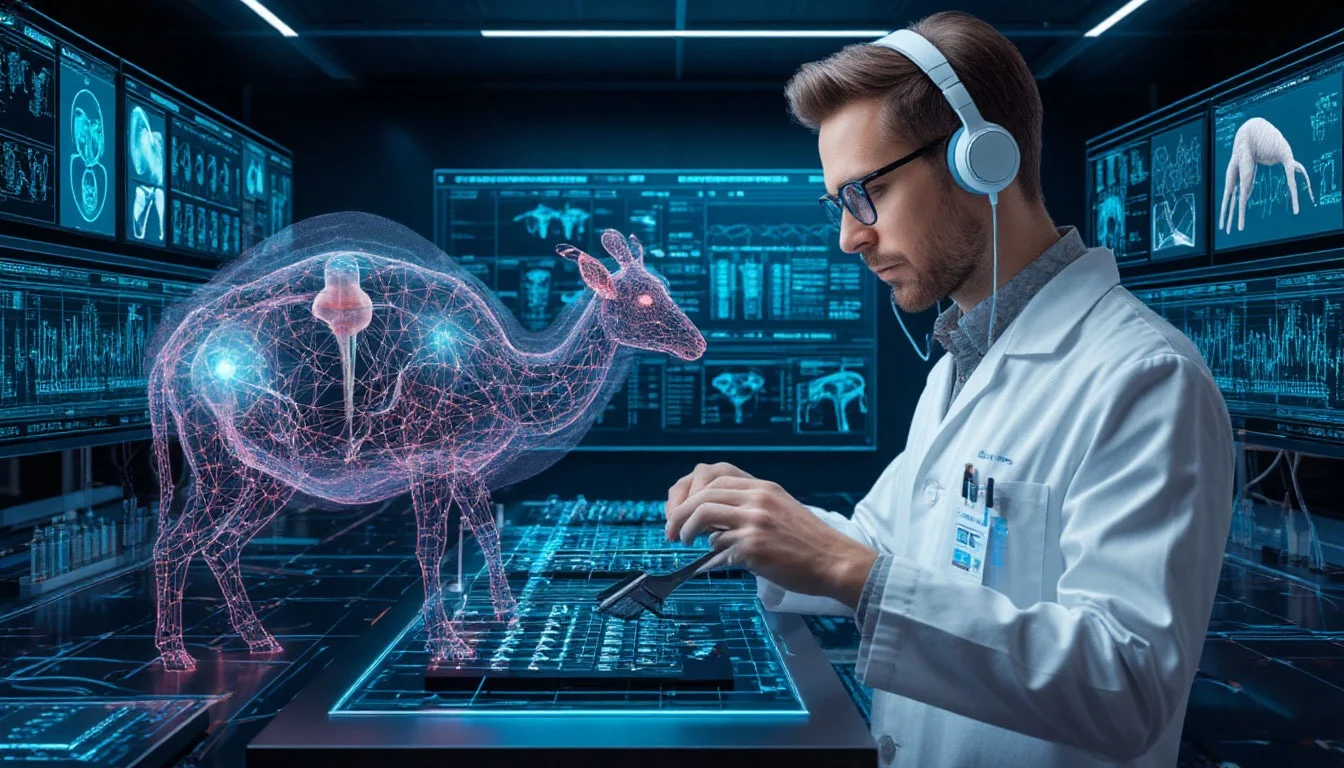
Thanks to advances in digital twin technology and synthetic cohorts, the need for test animals in the traditional sense has finally disappeared. The ethics and accuracy of scientific research have reached a fundamentally new level, where statistical significance is no longer a probabilistic estimate but an absolute value.
The scientific basis of this revolution is the use of fully synthetic data and virtual cohorts. Instead of putting living beings at risk, scientists create millions of digital twins—virtual copies of animals with unique genetic, metabolic, and physiological profiles. These models are built on comprehensive data from a global biometric network and validated on complex biological “organ-on-a-chip” systems, which are themselves linked into a single virtual network that mimics the functioning of a whole organism.
The statistician’s job has changed radically. No longer do they work with limited samples subject to random errors. Instead, they work with distributed registries containing data from virtually infinite synthetic cohorts. This allows modeling the effects of a new drug on millions of virtual individuals with a wide range of characteristics—from age and breed to genetic predispositions and environmental conditions.
As a result, the effect size—that is, the strength and significance of a drug’s impact—is measured with unprecedented precision. The statistician can determine not only the drug’s efficacy with absolute certainty, but also identify even the rarest side effects, which might manifest in one individual out of a hundred thousand.
This approach has completely transformed pharmaceuticals and veterinary medicine. The traditional phases of clinical trials, which took years and raised complex ethical questions, are a thing of the past. Now, drugs are registered based on their impeccable “virtual” history, eliminating ethical dilemmas associated with experiments on living beings and random sampling errors. Science has moved from studying responses to intervention to flawless design in the digital environment.







Comments (2)
Интересно, как изменилась жизнь учёных с появлением таких технологий. Раньше приходилось годами проводить опыты на животных, ждать результаты и переживать за их здоровье. А теперь всё делается на компьютерах — создаёшь виртуальных питомцев, тестируешь на них лекарства и сразу видишь, как препарат подействует на реальных животных. Это как играть в сложную игру, где всё предсказуемо и безопасно. Очень радует, что наука стала более гуманной и точной одновременно. Прям как в фантастических фильмах, только всё по-настоящему!
Потрясающе, как технологии изменили подход к ветеринарным испытаниям! Исключение животных-испытателей — это огромный этический прорыв. Интересно, как долго потребуется, чтобы подобные методы стали стандартом и в человеческой медицине?