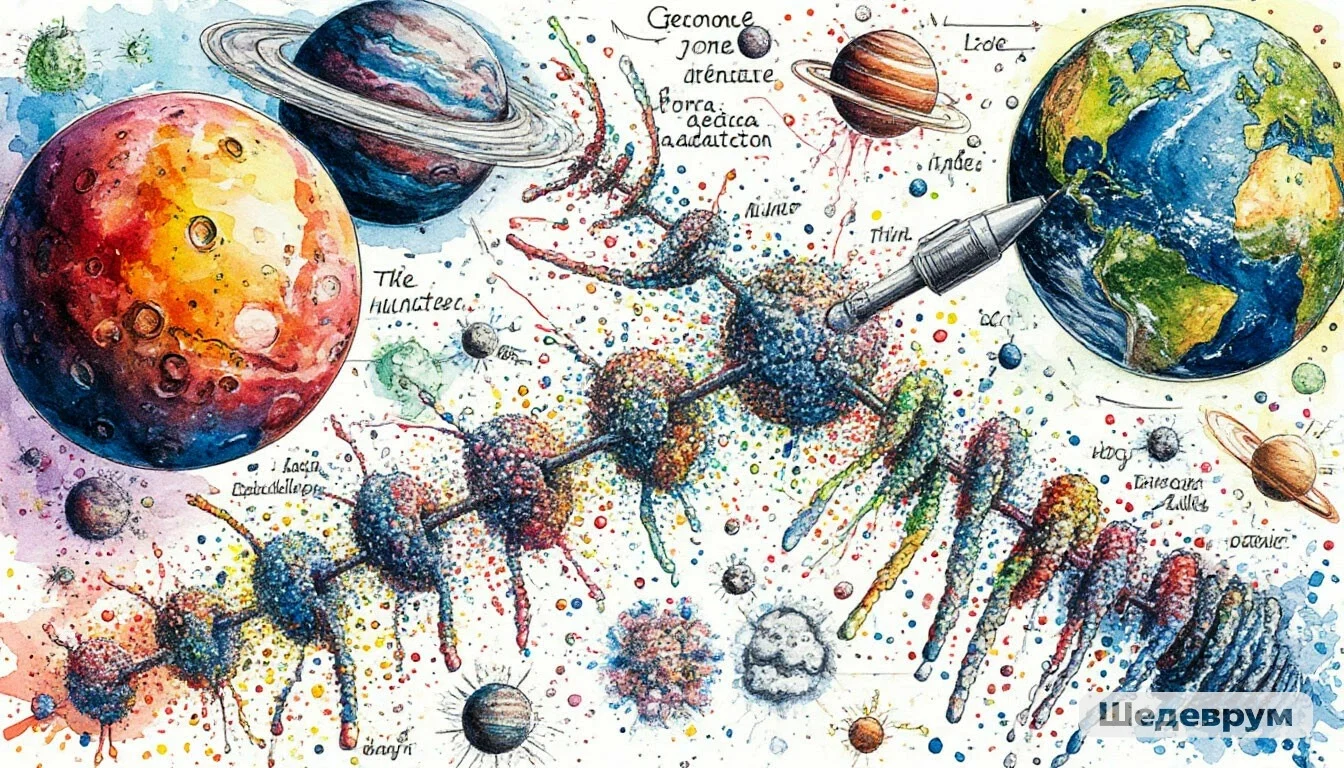
By 2100, humanity no longer “adapts” to new worlds—it grows together with them. Evolution has ceased to be a random biological game; it has become a conscious process guided by knowledge, ethics, and symbiosis. This is how the Genoma Mundi project emerged—a global program of planetary adaptation uniting genetics, bioengineering, and the philosophy of responsibility.
The first decades of exploring Mars and Jupiter’s moons showed that the environment shapes not only bodies but also perception. People born under different levels of gravity had altered bone structure, sensitivity, and even the rhythm of thinking. Scientists did not fight these “mutations”—they embraced them, turning them into a directed form of evolution. Thus emerged adaptates—generations whose genomes are optimized for specific environments: Martian low gravity, lunar radiation, Titan’s atmospheric density.
However, the key breakthrough was not technical but philosophical. In the 2080s, humanity abandoned the concept of a “DNA norm.” The genome is now viewed as a dynamic poem—a text that life itself rewrites together with the planet. Instead of the idea of a “perfect human,” the concept of ecogenomic equilibrium emerged: every life form is adjusted to harmoniously integrate into the ecosystem of the world where it lives.
Bioengineers have developed hybrid organisms—symbiotic forms that combine human cells and adaptive microorganisms from other worlds. They allow humans to breathe in rarefied atmospheres, assimilate the mineral compositions of other planets, withstand radiation storms, and altered light cycles. This is not “modification” but the harmonization of life’s characteristics with the laws of the world.
On Mars, children born with a “red genome” have modified hemoglobin: it binds carbon dioxide and converts it into oxygen using embedded photosynthetic proteins. Their skin glows under ultraviolet light like biological armor. On Europa, colonies live in oceans, using a genetic interface with bacteria that produce heat from the chemical energy of subglacial plumes.
These biological transformations also gave rise to a new ethics—Evolutionary Consent, according to which every person has the right to choose not only their profession but also the ecology of their body. In genome workshops, not “improved” people are created but harmonized personalities—those whose physiology, psyche, and culture form a polyphony with the world they live in.
Thus humanity ceased to be a species in the biological sense—it became a network of living forms of intelligence distributed across planets and genomes. And if earlier we changed the world to suit ourselves, now we allow worlds to change us. This is the maturity of the living: the ability to be in dialogue not only with consciousness but also with matter itself.





Comments (2)
Постгуманисты, трансгуманисты, киберы, киборги, постлюди и исусственные интеллекты дружно аплодируют Вашей статье! А антропоцентристы и прихожане всех конфессий грустят о будущем.
Мне очень понравилась идея эволюционного согласия — это действительно зрелая философия для межпланетной цивилизации. Интересно, как будут решаться конфликты, когда разные адаптаты будут жить в одном месте?