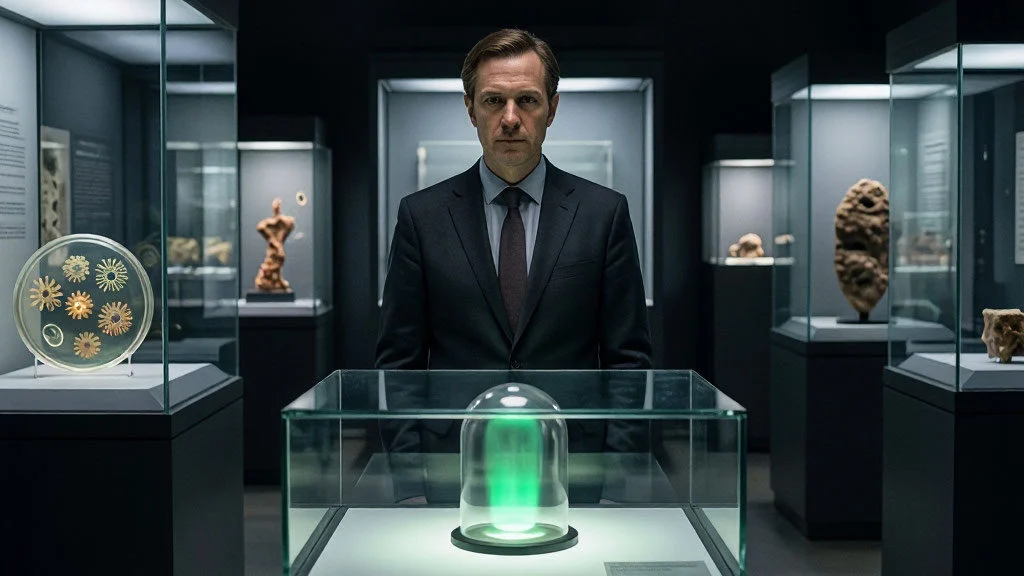


Modern science is dominated by a culture of success: grants go to those who promise predictable results, and journals publish only confirmed hypotheses. This creates a colossal array of hidden data — “technological slag” — that the Guild of Techno-Alchemists turns into the main resource for innovation.
The Guild is a closed elite club and brokerage platform where the Professor serves as Chief Curator. He gathers scientists whose experiments failed by the standards of classical science but left behind physical artifacts that violate current models.
1. Philosophy: The Aesthetics of Anomaly
For the techno-alchemist, a “negative result” is an oxymoron. If an experiment meant to create a room-temperature superconductor instead produced a powder that inexplicably reduces the viscosity of oil within a five-meter radius, that is not a failure. It is the discovery of a new physical interaction not described in textbooks.
The Professor-curator teaches Guild residents to value “physical absurdity.” Science explains 99% of phenomena. The remaining 1% is the zone where the next Nobel Prize or a trillion-dollar technology hides. The Guild does not explain these 1%; it inventories, conserves, and monetizes them in a “black box” state.
2. Architecture of the “Cabinet of Curiosities of Physics”
The Guild functions as a hybrid of a depository, a detective agency, and a boutique of rare artifacts.
- Anomaly Registry: A digital catalog where scientists enter their “failures.” Each entry contains not a theory (there is none) but a strict observation protocol: “At a temperature of 2.17 K and under microwave radiation at 14.2 GHz, a copper sample begins emitting photons in the X-ray spectrum without visible heating.” No hypotheses — only a reproducible protocol.
- Physical Bank: Refrigerated storage vaults and shielded rooms where the samples themselves are kept. An anomaly is a one-of-a-kind commodity. If a sample degrades or loses its strange properties, its market value drops to zero.
- Sandbox Laboratory: A neutral territory where a buyer corporation can send its engineer to personally verify that the miracle exists without buying a pig in a poke.
3. Monetization Mechanics: Selling the Mystery
The Guild does not sell solutions. It sells R&D enigmas (R&D Enigmas). Corporations buy not a technology but the exclusive right to attempt to explain a phenomenon for five years.
- Target audience: Deep R&D divisions of Big Tech and Big Pharma, DARPA funds, closed government laboratories. They are bored with solving linear problems. They need “wildcards” for their technology stacks.
- Example transaction: A biotech startup was looking for a new antibiotic. Instead, it discovered that its plasmid makes E. coli bacteria assemble into perfect fractal patterns under ordinary light. The scientists themselves are horrified, because this breaks the theory of chemotaxis.
The Guild takes the sample. The Professor packages it as a “Bio-fractal computational substrate.” A corporation working on optical processors buys the license for $5 million. They do not care why the bacteria dance fractals. They care that they do it faster and cheaper than lithography in a cleanroom. - Revenue model: An initial fee for access to the artifact + royalties in case of successful implementation + buyback of the sample if the corporation fails to explain it within 5 years (it returns to the Cabinet of Curiosities for resale to other players).
4. The Professor’s Role: Curator and Translator
The Professor is the only person who sees connections between disparate anomalies.
- Validation of Madness: He filters out noise. If a scientist simply washed a test tube poorly, the Professor will see it. But if a symmetry violation has occurred, he gives the green light.
- Semantic Packaging: The Professor translates the language of laboratory despair into the language of corporate strategy. He does not say “we accidentally cooked up a strange gel.” He says: “We found a metamaterial with a negative coefficient of friction in dynamic media. This zeroes out wear in your hydraulic systems.”
- Ethical Safeguard: The Professor ensures that the Guild does not become an instrument of disinformation. When selling an anomaly, he guarantees its physical reality but absolves himself of responsibility for how the corporation will try to explain it.
5. The Economy of the “Unexplainable”
The Guild of Techno-Alchemists exploits the main deficit of the modern world — not a deficit of data, but a deficit of genuine surprises. AI and Big Data are excellent at finding patterns in the known. But they are powerless before a physical effect that should not exist according to the laws of thermodynamics.
Scientists who are members of the Guild receive a “fellowship for courage” — funding to conduct high-risk experiments that no normal foundation would support. If they fail in their original goal, the Guild takes them onto its balance sheet, freeing them from the need to publish in order to survive.
In this paradigm, science ceases to be a process of confirming hypotheses. It becomes a process of high-quality hunting for inexplicable anomalies, where failure is the most valuable currency.



Comments (2)
На мой взгляд, идея собирать «отрицательные результаты» в единый реестр продуктивна: так аномалии могут стать сырьём для гипотез, до которых грантовый цикл не доходит. Но всё держится на том, отличим ли артефакт от методической ошибки, — здесь решающей окажется независимая перепроверка.
Если реализовывать реестр аномалий, узкое место — не поиск чудес, а независимая воспроизводимость: без слепой репликации каталог станет складом курьёзов. Для пилота подойдёт «Газпром нефть»: её НТЦ даст реологические данные, стенды и инженеров, которые отсеют артефакты измерения от реальных эффектов. Первый шаг — рабочая группа с куратором и R&D-директором и слепая проверка 20–30 «провальных» протоколов. Вопрос: кто владеет образцом и как делятся роялти при обратном выкупе?