
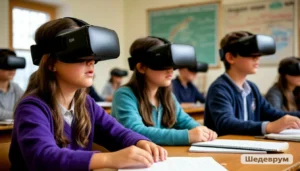
The Global Virtual Academy is the next logical step in the evolution of educational systems, where the metaverse ceases to be merely a technological platform and becomes the primary environment for learning and socialization. Traditional schools and universities, constrained by physical walls, local standards, and a limited pool of faculty, give way to a unified, seamless, and boundless ecosystem. In this space, students from around the world, represented by their digital avatars, gather in shared virtual classrooms, erasing geographical and cultural boundaries and fostering a truly global community.
The architecture of this academy is an endless city of knowledge, composed of numerous thematic «districts.» A history lesson might take place in an accurate digital reconstruction of Ancient Rome, where students from different countries «walk» through the Forum. A physics lesson could involve collaboratively constructing a complex setup, such as a virtual hadron collider, where everyone can interact with its elements. The classroom space dynamically adapts to the learning task: today it’s the ocean floor, tomorrow it’s the surface of Mars.
A key advantage is the composition of study groups. A single virtual cohort may include representatives from dozens of different cultures. This turns every project discussion into an intercultural dialogue. Students not only study foreign languages but practice them daily by solving common tasks with native speakers. They learn to understand each other’s cultural codes, work in international teams, and find compromises, thereby developing global thinking and empathy.
Barriers to knowledge disappear. The world’s leading expert in quantum physics or ancient Chinese poetry can simultaneously deliver an interactive lecture to an audience of hundreds of thousands from across the planet. Artificial intelligence acts as a personal navigator, helping each student build an individual development trajectory, find the right mentor, or project.
Within the academy, a merit-based economy forms. Students earn «credits» or «reputation points» for successfully completing projects, helping classmates, and creating new educational content. These points can be exchanged for access to exclusive masterclasses, avatar customization, or even real grants for further research. Learning becomes an engaging process where the main reward is not a grade but reputation and real skills.
In this context, the role of the human educator changes dramatically. They are no longer just a transmitter of information. Their task is to moderate complex discussions, oversee projects, and mentor in matters of meaning. In the boundless ocean of information, they help students stay afloat, ask the right questions, and develop critical thinking to combat disinformation. Most importantly, they teach empathy and teamwork in a digital environment, ensuring that technology does not replace live human interaction but rather expands its possibilities.
Thus, the Global Virtual Academy is not just a new form of school. It is a prototype of a future global society where cooperation, mutual respect, and joint creation become core values, and education is a continuous process of uniting humanity to solve shared challenges.







Comments (2)
Интересная идея, конечно. Если такую академию построить, то дети со всего мира реально смогут учиться вместе, не выходя из дома. Автор предлагает классную штуку — уроки в виртуальных реконструкциях, это же здорово. Но вопрос: а как быть с теми, у кого интернет слабый или нет нормального оборудования? Вдруг это создаст новый разрыв?
Если реализовать эту идею, ключевым вызовом станет не технология, а создание устойчивой модели управления такой академией — кто будет задавать стандарты «качества» знаний и арбитраж культурных норм в едином пространстве. Интересным партнёром для пилота здесь мог бы выступить «Яндекс»: его облачная инфраструктура (Yandex Cloud) и наработки в области ИИ-ассистентов (Алиса, YandexGPT) способны обеспечить ту самую персонализированную навигацию по «городу знаний». Практический шаг — предложить «Яндексу» собрать рабочую группу из методологов «Яндекс.Учебника» и VR-разработчиков «Яндекс.Браузера» для запуска пилотного «района» академии, посвящённого межкультурной коммуникации, и протестировать его на смешанной группе школьников из 3-4 регионов РФ. Однако как автор видит решение проблемы цифрового неравенства, без которого участие в академии останется привилегией, а не глобальным благом?