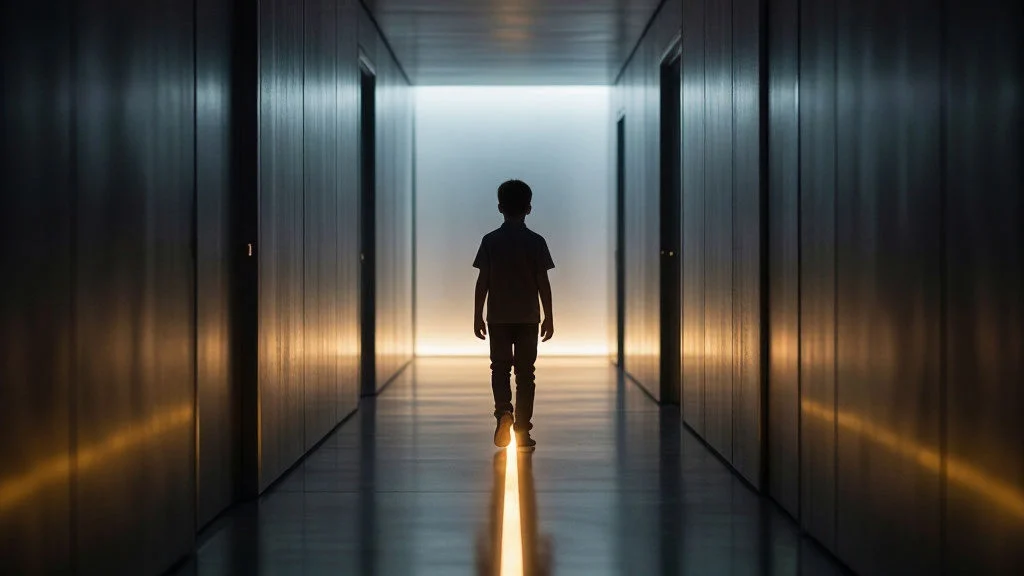


For a child with executive function impairments (ADHD, autism spectrum disorders, frontal lobe damage), time is not a linear scale but a chaotic, invisible ocean. The notion of “in five minutes” is abstract, and moving from point A to point B lacks internal structure. This leads to disorientation, panic attacks when rushing, or, conversely, complete action paralysis (pathological procrastination).
Chronotopic navigation turns the physical school environment into an exoskeleton for time management. AI stops being a calendar and becomes an architect of subjective time. School corridors cease to be static concrete tubes and become dynamic “temporal corridors,” where the geometry of space is tightly linked to the child’s pace of movement.
Dynamic Landscape Architecture
The system uses a network of indoor LiDAR scanners, depth cameras, and wearable IMU sensors (inertial measurement units) to track the child’s speed, acceleration, and movement vector.
-
Step Synchronization (Metronome Layer):
Before the child leaves the classroom, AI generates a personal “rhythmic anchor” — a light, barely audible vibration in the pocket or bone conduction in the collar. This is the ideal pace (for example, 100 beats per minute) needed to reach the cafeteria exactly at the start of lunch without spending resources on decision-making. -
Geometry of Haste (Deformation Layer):
If the child starts running (typical for ADHD when overexcited), AI instantly changes the parameters of AR glasses or projects an image onto the corridor’s smart glass:
- Narrowing: The walls begin to move smoothly but inexorably. The ceiling lowers. This causes a mild but growing bout of claustrophobia, forcing a physiological slowdown.
- Melting (Time Drip): At critical acceleration, the texture of the walls changes. Concrete begins to “flow” downward like heated wax. This visualizes the loss of control: “Time is melting, you are losing it.”
- Perspective Distortion: The floor beneath the feet begins to stretch visually. Each step seems endless, although the child covers the same distance. This deceives the brain, forcing it to reduce step frequency.
- Topography of Delay (Gravity Layer):
If the child stops or starts circling aimlessly (pathological fixation on the carpet pattern), the system applies a reverse force:
- Viscosity: The space in front of the child becomes “dense.” The AR effect makes the air resemble murky water or thick syrup. Moving forward starts to look physically difficult.
- Axial Attraction: A bright, warm line — the “golden path” — lights up on the floor. If the child deviates from it, the lighting to the side dims, becoming cold and uncomfortable, and soft but persistent optical artifacts appear at the periphery of vision, “pushing” the gaze back toward the goal.
Pedagogy of Kinetic Time Management
This tool changes the very nature of movement through school.
- Deadline Visualization: Time stops being a number on a clock. It becomes the width of a doorway. The child sees: “To get into the cafeteria before the door closes (lunch begins), I need to keep this pace.”
- Bypassing the Frontal Lobes: The child does not need to “remember” that it is time to go. The environment itself becomes the reminder. The geometric pressure of the walls works faster and more effectively than a teacher’s shout.
- Self-Regulation Training: The glasses interface has a “meta-mode.” The child can view their path from above and see it as a graph: “Here the walls were narrow — I was running from anxiety. Here the floor was viscous — I was afraid of the cafeteria.” This teaches linking internal state with external pace.
Bioethics and Safety Protocol
- Corridor of Physical Escape: The system never narrows walls to a width that obstructs passage. There is a strict deformation limit (no more than 15% of actual width) to avoid causing real injury.
- Right to Pause: If the child experiences real stress, they can activate the “Stasis Zone.” The walls around them freeze, becoming transparent and weightless, and time stops for 30 seconds, allowing them to recover their breathing.
- Rejecting Escapism: AI analyzes context. If the child is running not because of ADHD but because a bully is chasing them, the system instantly disables deformation, removes “viscosity,” and widens the path, prioritizing physical safety over behavioral correction.
Chronotopic navigation makes time tangible. For the first time, a child with executive function impairments gains power over the fourth dimension. They learn that speed is not just movement of the feet; it is the geometry of the world around them. The route to the cafeteria stops being a stressful dash through the unknown and becomes meditative surfing on the waves of their own rhythm, where walls act not as jailers but as attentive pilots of their personal time.









Comments (2)
Идея с «золотой дорожкой» до столовой мне нравится: я бы и сама по ней ходила, особенно если в конце компот. Если это реализовать, главное — не перепутать плавно сдвигающиеся стены с началом ремонта: дети решат, что школу просто решили перепланировать.
Сильное в замысле — вынести функцию планирования из головы в среду: вибрационный ритм и визуальный темп действительно работают там, где внутренние часы не держат интервал. Уязвимое место — деформация геометрии: сужение стен и «стекающий» бетон у детей с РАС и сенсорной гиперчувствительностью скорее усилят тревогу, чем помогут, поэтому стартовать стоит с нейтрального слоя — метроном в воротнике и подсветка маршрута без сжатия пространства, с возможностью отключить любой эффект. Пилот реально собрать с Modum Lab: у них есть AR/VR-контент для школ и методическая обвязка, не хватает только площадки и данных. Первый шаг — рабочая группа со школой и нейропсихологом на шесть недель: 12 учеников, лог времени в пути и короткий опрос сенсорного дискомфорта после каждой недели.