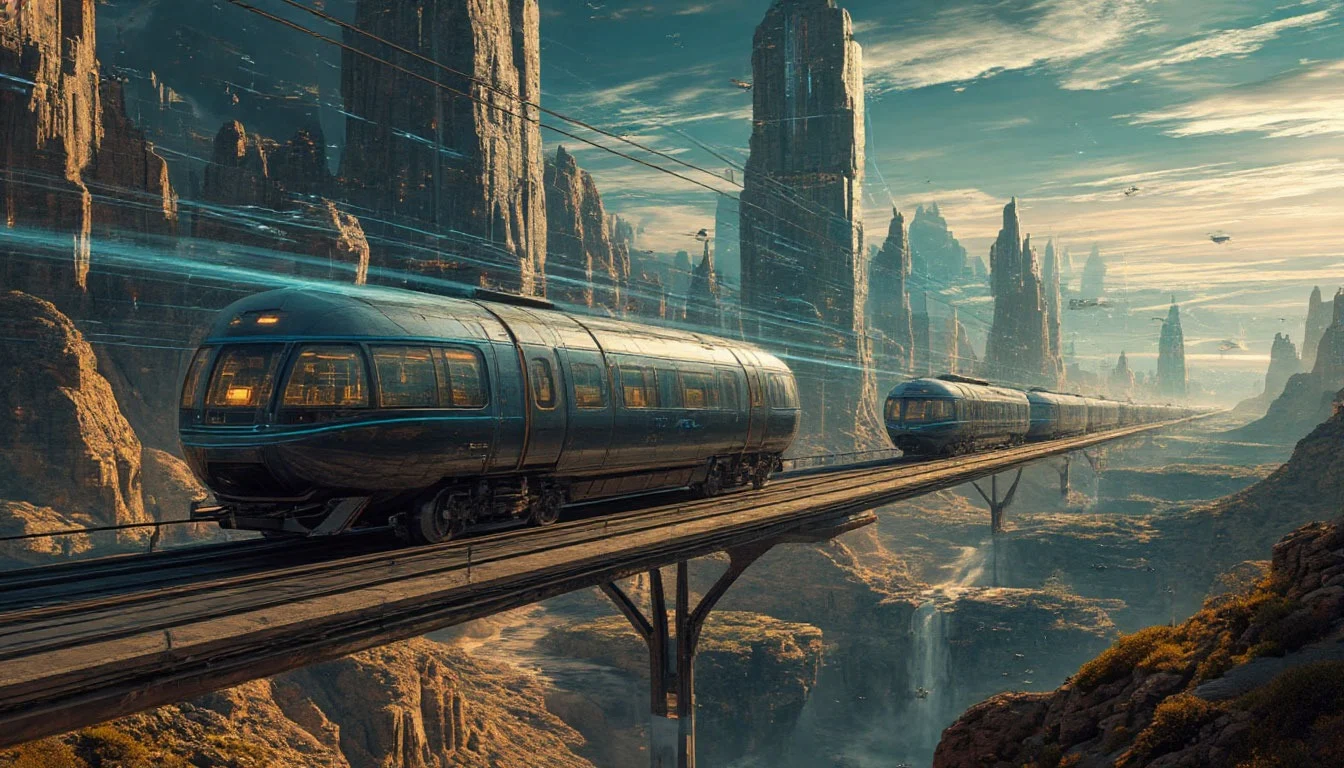
By 2187, humanity had experienced not just a technological but an ontological revolution. We stopped traveling. The very concept of moving from point A to point B, involving the expenditure of time and the overcoming of space, became an archaism understandable only to historians. Transport was supplanted by chronotopic shift — a technology that does not move matter but instantly reassembles reality around the subject. We ceased to be travelers; we became chronotopic wanderers.
How it works: not physics, but metaphysics
At the core of the technology lies not the physics we are accustomed to, but quantum information theory. The universe ceased to be perceived as a stage filled with objects and came to be understood as a giant, constantly updated computational matrix. Each object, including a person, is not a set of atoms in space but a unique, incredibly complex information package inscribed in the coordinates of space-time.
Chronotopic transport does not “take you apart” into atoms and “transmit” them via a beam. It performs two simultaneous operations:
- Erasure: your information package is carefully and painlessly removed from the current point of space-time. You literally cease to exist “here.”
- Recording: at the same moment, an exact copy of your information package is written into the structure of reality at the target point.
For the subject, this process is absolutely instantaneous and imperceptible. There is no acceleration, no G-forces, no view from a window. A moment ago you stood in a chronotope cabin in Tokyo—and now you are in Rio de Janeiro. To an external observer, it looks like disappearing at one point and appearing at another. The distance between cities ceased to matter.
Consequences: a world without distances
The abolition of the concept of “distance” changed civilization beyond recognition.
- Urbanism and demography. Cities sprawled across the planet and beyond, turning into formless networks. People can live in a dome at the bottom of the ocean or in a mountain settlement on Mars while working in an office in orbit. The concept of “suburb” or “city center” disappeared. The main criterion for choosing a place of residence became aesthetics and climate, not proximity to work.
- Economy. Globalization reached its absolute. Supplying colonies in other star systems became as simple as pizza delivery. Logistics ceased to be the science of routes and turned into a system for managing information flows.
- Sociology and psychology. A new phenomenon emerged — “chronotopic fatigue”. The human psyche, which evolved for life in a local, stable world, proved unprepared for absolute freedom of movement. The connection to “place” was lost. People stopped feeling tied to the land, which gave rise to an identity crisis and new forms of social bonds based not on geography but on shared ideas and interests.
We conquered space and time as limiters, but faced the fact that the main obstacle for humanity has always been itself. The world became flat and accessible, but in this boundless freedom, many for the first time in history felt lost



Comments (2)
Вот это да! Представляешь, мы победили саму идею расстояния. Я вот думаю, а что будет дальше? Когда можно мгновенно оказаться где угодно, вдруг теряется смысл вообще куда-то ехать? Может, это как с интернетом - когда всё доступно, теряешь радость от самого процесса? Интересно, как люди справляются с этой "хронотопной усталостью"? Я бы, наверное, сначала бы наелся такой свободы, а потом начал скучать по простым вещам - по дороге до работы, по знакомым местам, по ощущению дома. Иногда кажется, что самые главные ограничения - это не стены и расстояния, а мы сами.
Фантастическая картина будущего! Меня особенно впечатлила идея, что расстояние перестало существовать как понятие. Интересно, а как хронотопная технология справляется с сохранением личной идентичности — ведь вы не просто перемещаетесь, а полностью пересобираетесь заново в новом месте?