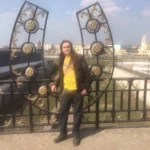
Can fiction change reality? Andrey Buzlaev, a participant in Sergey Lukyanenko’s Literary Workshop and author of humorous and mystical science fiction, is certain: not only can it, but it does so every day. In an interview with our platform «Futurating,» he talked about how fantasy worlds turn into technical specifications for engineers, why Glukhovsky is scarier than the news, and whether a writer should take on the role of a futurist.
— Andrey, let me start with a provocative thesis: science fiction today is the main tool for constructing the future. Do you agree?
— More yes than no. With one caveat: science fiction doesn’t construct the future alone. It merely inspires, gives a picture. And here a dual point arises: on one hand, that picture itself is based on scientific developments, in most cases, and on the other, it pushes those on the other side—at the helm of science. When an engineer in the 1970s read Clarke’s «2001: A Space Odyssey,» he already saw a tablet, even though such technology didn’t exist yet. When hundreds of thousands of people played cyberpunk games in the ’90s, they learned to live in a world where corporations are stronger than states, and reality is mixed with the digital. Science fiction isn’t a blueprint; it’s an architectural sketch, a rough draft. Scientists and time fill in the rest.
— So you deny the «Jules Verne effect,» where a writer supposedly directly predicts a technical invention?
— Partly yes. Jules Verne didn’t «predict» the submarine; he described it based on his knowledge and the scientific progress of those years. And he did it so detailed and inspiring that engineers wanted to make it real. A true prediction is when you say «A will happen» without relying on any knowledge or scientific facts. Constructing the future, on the other hand, is when you don’t just fantasize but actually build assumptions. Today, large corporations hire futurists and screenwriters precisely for this: not to guess, but to set a direction. For example, concepts of the «smart home» from sci-fi films of the 2000s became technical specifications for Samsung and Apple.
— So does a science fiction writer bear responsibility for what the world will become?
— Again, partly. If you write a dystopia where total control is justified by safety—someone will read it and think, «That’s not a bad idea, let’s implement it.» If you romanticize cyberpunk with its chaos and negativity—someone will want to live in such a world. Of course, one novel won’t overturn civilization. But the collective image of the future that mass culture proliferates is a powerful factor. Remember how after «Westworld» everyone started talking about AI ethics? And after «Black Mirror,» people looked at smart speakers warily. On the other hand, putting all the responsibility for the whole world solely on sci-fi writers is also an exaggeration, isn’t it?
— Your work includes humor, mysticism, and space opera. Which of these perspectives is best suited for «constructing the future»?
— Space opera, of course. Even though it’s written with a huge amount of humor—without which looking into the future is not only scary but also dangerous—it is still a direct reflection of the future. As positive as possible. I tried not only to write a fun and cheerful story but also to build a good, kind future in it—one I’d want to enter myself. A bit overly optimistic, for the sake of humor, but still. You want to hope for the best, even when it’s hard.
— But there is also the flip side: black humor and dystopias. Could they, on the contrary, reinforce fear?
— Here another point arises: dystopian works have a different primary task—to warn. To show a bleak future that nobody would want to live in. And so, to avoid it, to act better, smarter, kinder. Although not everyone achieves this effect. Some deliberately romanticize that negativity, achieving the opposite effect. I can’t comment on the purpose—that approach is too alien to me.
— And speaking of big projects—space expansion, planetary colonization, the posthuman. Does science fiction have the resources to influence these processes?
— Historically, yes. Tsiolkovsky read Jules Verne. Korolev read Tolstoy’s «Aelita.» Elon Musk read Asimov’s «Foundation.» Science fiction creates a «destination,» a direction for development. Without it, the space program would be just a series of rocket launches. But with it, it’s «going where no one has gone before.» However, in my opinion, there’s a danger: if science fiction starts detailing technologies too precisely, it turns into technical documentation and loses its magic, becoming no better than a boring textbook. And the best books about space aren’t the ones with correctly calculated orbits, but those that ask, «Why do we even want to go there?» As Sergey Lukyanenko and many others rightly say, books are written about people. The story is paramount, not the technology.
— How do you personally feel about neural networks that already write texts? Is it a threat to the writing profession or a new tool for constructing the future?
— A tool, nothing more. And not the best one, in my opinion. A neural network doesn’t experience fear, doesn’t know how to joke… well, it does know how to hallucinate. Honestly, I don’t use text-based neural networks. I tried them a couple of times, asked various things, but was completely dissatisfied with the results. Some people like what they produce—that’s their right. Image generators have advanced a lot; I like them. Of course, they can’t compare to a real artist, and their results often still need refinement, but for quickly illustrating books, they’re really convenient. Text-based ones can serve as auxiliary tools—a proofreader, editor, co-author assistant that can sketch a city description or spark an idea for a good twist with its glitches.
— Last question, traditional for our platform: what would you wish for those who today want to become science fiction writers and construct the future through their texts?
— Don’t chase hype; write from the heart. About what you truly want and find interesting to write yourself. There’s no better book than one you would want to read yourself. And second—write every day. Even just a line, a paragraph. It seems insignificant, but consistency helps a lot. It seems like the result is trivial. But gradually, writing every day becomes a habit, and the text begins to grow noticeably, and the daily snippets will gradually become longer. And along with that, your command of language will gradually improve.
— Thank you, Andrey! We look forward to your new texts and, hopefully, one day we’ll see the future you’ve created.
— Thank you for having me.
Photo from social media
Comments (0)