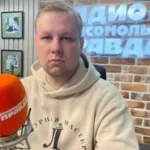
Andrey Potapov is a Russian writer, a master of humorous fantasy and science fiction. The author gained popularity with the «Vtorostepenny» (Secondary) series, which ironically plays with clichés about people transported to other worlds. His texts are characterized by a light style and a sailor’s humor, accumulated over years of service in the navy. His books are actively published by T8 RUGRAM. Today, in an interview with the Futurating platform, Andrey shared his opinion on what might influence the image of the future and what role literature plays in this.
Today, science fiction is often divided into that which predicts technology and that which explores humanity. Which of these vectors, in your opinion, is more important for shaping the future and why?
— For me, science fiction has always represented the story of a person in carefully constructed circumstances, where a fantastic premise pushes them to their limits—precisely to reveal the true nature of a person under such conditions. Technology certainly plays a key role here: it needs to be deeply explored, predicted, and used to inspire scientists to bring it to life. However, this approach is doomed to fail if we focus solely on technological predictions. A person must always remain at the center of the narrative. We are not just studying technology—we are analyzing how humanity will coexist with it. Through the prism of this interaction, its potential, its idea, and the moral dilemmas associated with it are revealed. Thus, we get a symbiosis where a person is invariably at the forefront. Megatrends describe large-scale shifts, but cultural codes are formed from many local stories.
Where is the new cultural code born today—in global narratives or in intimate, almost everyday scenarios of the future?
— Interestingly, what first comes to mind is memes—those concise cultural artifacts that accompany global transformations for decades, reinterpreting them in an accessible form. The cultural code of the future, as a rule, is formed precisely from such intimate, almost everyday scenarios, as you noted in the question. Many small stories add up to a grand world. This echoes a well-known idea: the death of a million is a statistic, while the tragedy of one person touches the soul deeply. Here, we are moving in the opposite direction—from the particular to the general. It is these minor upheavals, born of global shifts, that weave the fabric of the cultural code. Some experiences take root, others are forgotten, but ultimately it all builds on these elementary narratives. Science fiction often serves as a testing ground for moral dilemmas that humanity has yet to face.
Does the role of the writer change when these dilemmas cease to be speculative and invade reality?
— The role of a science fiction writer essentially does not change. He still has to calculate the consequences, anticipate challenges for humans, and sort them out—this is the eternal task of the genre. What changes is perhaps the urgency of predictions. If once speculative scenarios materialize here and now, we move from describing them to analyzing their consequences, accepting them as a starting point for new forecasts. What’s the beauty of our work? A writer doesn’t have to be a seer or a prophet. We build hypotheses of any configuration but are not responsible for their accuracy—unlike governments. The essence of science fiction is in exploring human morality, in studying individual behavior in altered paradigms. We inspire technology, but the focus is on ethics. Our mission is to stay ahead of time, to identify potential problems. If they don’t come true, so much the better. It is said that literature is losing its function of designing the future, giving way to games, series, and algorithmic recommendations.
Do you agree with this, and what in that case remains the exclusive prerogative of a science fiction book?
— The question is not simple, and it’s not about a change in genres or forms of expression. The point is the capitalist logic of modern society, where the vast majority of art—from literature to games—is oriented primarily towards profit. This is nothing new, of course, but now the aggravation has reached its peak: content is created not out of a creative duty or moral imperative, but dictated by demand. Literature, series, films, games—everything has turned into a product generated by the consumer himself, with authors acting only as proxies, executors of investors’ orders. Literature has no unique prerogative, and no significant changes are expected. There will be two poles: mass production for consumption and rare, singular works for connoisseurs of the truly authentic and original. This is a universal law of all media—literature is no exception. Books are written either for the market or to say something important.
If we try to look fifty years ahead: how do you think literature’s very mode of existence in culture will change—will it become more elitist, dissolve into cross-genre hybrids, or return to its ancient role of storyteller that helps society digest a rapidly changing reality?
Art always reacts to external stimuli. Now, when there is a lot of tension and uncertainty in the world, we see a massive demand for «cozy» things—cozy detective stories, cute, distracting narratives. This is a trendy escapism, when people just need to take their minds off things so that, as they say, their «screw doesn’t come loose.» But this is only one side of the coin. In parallel, there is always another niche where authors reflect on what is happening, dig deeper, and try to build new concepts. People are different, and sometimes you need to be distracted, and sometimes you need to dive deep.
I often think about this through the prism of the normal distribution curve. It governs our world, and in art it works the same way: there is always everything, and in roughly the same proportions. Regardless of changes in eras, regardless of what the demand for certain genres will be, the distribution will remain more or less the same. Even in a closed group of people, like in the film «Cube,» there will always be different types represented in a certain percentage. So, although the forms of presentation, tropes, and ways of conveying an idea may change, at its global core nothing will change. No one will dissolve anywhere; everything will still remain. And that, in fact, is great.
Photo from open sources
Comments (1)
Книга (а в принципе и любое творчество), как творческий долг и моральный императив. Мне понравилась такая мотивация. Спасибо за интересное интервью!