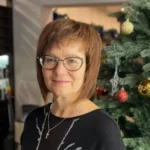
Elena Borisovna Pereslegina is a Russian psychologist, organizer of trainings and business games, and writer. She was born in 1962 in Leningrad and has lived in this city all her life, while traveling extensively across her native country and the world. Speaking about her family in 2025, she says: «My optimism was shaped by my parents, Gusev Boris Nikolaevich, a reserve colonel of the missile forces, and Guseva Lyudmila Georgievna, an economist, a wonderful homemaker, wife, and mother. They are no longer alive, but their home retains warmth and care. My older sister is 70 years old, and I have someone to discuss plans and life logistics with; she is my support in all my affairs and surpasses me in organization. My husband’s mother, Lyudmila Vladimirovna, is alive and worries about our nomadic life. She is the most wonderful elder one could imagine. We are friends and gather around her as a big family.»
Elena Pereslegina, as part of the «Constructing the Future» group, participated in conducting foresight studies commissioned by the Ministry of Education and Science: «Foresight of Scientific and Technological Development of the Russian Federation» (2008), the Ministry of Health: «Development and Implementation of a Research and Development Program for the Program on Forming Priorities for a Healthy Lifestyle among the Population of the Russian Federation ‘HEALTHY RUSSIA’ for 2009,» the Research Institute of Atomic Reactors (Dimitrovgrad) «Forecast of Global Energy Development for the Period 2010–2030 with Individual Estimates for the Period 2050–2075.» She is one of the developers of the course «Fundamentals of Foresight Thinking» commissioned by the Skolkovo Open University (2011).
She says the following about her life priorities: «I measure my worldview with three main words: God, Motherland, Family. These are the things I cannot lose, for which I will fight and am ready to die.»
— Do you think science should be left to experts and trusted to them, or does it make sense to ask people broadly—I won’t call them ‘laypeople’?
— To me, this question even carries some biblical meaning. You know, at the wall of Jerusalem, Joshua asked a warrior ready for battle: «Whose side are you on? Are you for us or for them?» And he thought and said: «I am not for the reds or the whites; I am for the army of the Lord.» This is my loose translation of the Bible. So, I am not for the reds or the whites; I am for the army of the Lord.
There was also a very common notion in the Soviet Union, and I come from there: someone who ran away from home at 15 is unlikely to understand someone who studied at a special school, except for those who ran away from home to a special school. So, you see, I am about those who ran away from home to a special school, for those who are for the army of the Lord. Therefore, I am equally indifferent to professionals and laypeople, but not indifferent to those who truly intend to live in the future.
If today you intend to live in the future—you are ready to master a new cognitive paradigm, because the old empirical cognitive paradigm of thinking is coming to an end. And we can look at its greatest ultimate technologies—physics, chemistry, biology, anthropology. But when you see ultimate technologies, it means some phase is ending.
And at that moment—and glory to your project—suddenly the «flickering splashes» of those very real people «at the bottom» become in demand, who, in your opinion, are not laypeople at all. But these are the ones who ran away from home to a special school. It is useless to ask about the future from a person who is not interested in anything beyond their own existence. They will tell you about how much they will earn, what car they will buy, where they will go on vacation. They probably won’t even say how many children they will have or how their education will be arranged. But, however, people in the same social and salary bracket may turn out to be deeply future-seeking individuals who have, as you rightly said, their own very interesting concepts and paradoxical views. You see, when the future knocks on our door, it knocks for everyone. It’s like God. But not everyone hears it. It’s just that we need a technology for assembling these very illuminations of ordinary people, as well as the non-trivial statements of experts, because trivial ones don’t interest anyone.
— Artificial intelligence handles this task quite well.
— Artificial intelligence is happy to paint you pictures of the future no worse than our esteemed experts. But it won’t create anything paradoxical or non-trivial for you. And yet, we «ran away from home» of forecasting, created our own methods, got our bumps, were disliked by no one, and now we can say: this path is very difficult, but possible, because we preserved that very «inquisitive ordinary» when you, from another specialty, for some reason become interested in everything that will be in related specialties, then in completely unrelated specialties, then in what will be in society, and then for some reason you miraculously want to reform the education of the entire country, so that—well, so that, as Stepashin said about our book train: «There is a war going on, and we are carrying books across the country so they will read.» There is something in this life that demands our attention, despite all the inconveniences associated with it.
Therefore, there are absolutely wonderful experts, philosophers, who say they are «not specialists about the future,» and yet put forward completely incredible concepts about what might happen to the principles of humanity’s existence. These are very important things. If you don’t understand how it will be in principle, you won’t understand how it will be in process, and even less will you understand what the facts will be.
— There is an opinion that by collecting non-expert forecasts, we gather «garbage»…
— Because it’s discussed on the bench? What we discuss on the bench is like children’s attempts to draw the future. They won’t draw the future. But they will draw either what they like or what they are afraid of, because they are children. And laypeople won’t draw the future because they don’t know «why even think about it at all.» And, by the way, they will be aggressive and say that all these thoughts lead nowhere. But in practice, many mechanisms already function in government agencies to peek into the future. There is a need for this.
— What is the role of science fiction in «peeking into the future»?
— Science fiction is wonderful. What does science fiction do? It explores possible models of the future using quite non-trivial literary means. Science fiction is not about fantasizing. Science fiction is, as it were, about prediction. It constructs new hypotheses, creates new worlds. We are now living in a world of realized science fiction. Everything that science fiction writers wrote has, one way or another, been realized in our world. But we are far from Efremov, because he covered a large period. But take Sergei Lukyanenko, for example: look at how many completely existential changes in the world Lukyanenko predicted! He is a very intelligent person, a wonderful writer, and a brilliant forecaster. For instance, take «The Road to Wellesberg.» Remember that phrase «young adults»? These young adults are already 15 years old today. And the Japanese 15 years ago had already announced the existence of «young adults»: a generation of people who, in their teenage years, surpass adults in terms of responsibility and intellectual conformity. People have appeared who, at a very young age, have the will of an adult. This is fantastic from the perspective of a conventionally patriarchal world. It can’t be, but it exists.
— But science fiction writes not only about a bright future.
— Sometimes you have to write something to prevent it from happening. This is, as it were, a big task for writers. To show a ray of light in a world where everything seems hopeless, and all inertial scenarios lead to war. And to show how not to act to avoid a catastrophe. To draw a positive scenario is a task for the very brave. Science fiction has two functions, I think: positive-prognostic and warning. I greatly respect all those who today, despite the rapid fluidity of our lives, create science fiction clubs. It is, as it were, a normal task for an intelligent person—to attract the future into their mind. Those who dare to fill the future with light. Not their own, but God’s. Or noospheric: if people do not believe in God, they believe in the power of the cosmos. And they dare. And then they succeed, if not in a positive scenario, then in a scenario of overcoming, exiting through crisis to new achievements. This is a very worthy and very difficult work.
— What do you think is needed for these «flickering splashes» of the future to appear?
— Read more, set an example for children. Children look at their parents. If parents spend all day discussing how to get out of poverty or, conversely, how to renovate the kitchen again, buy a new car, go somewhere, then «it’s too late to drink Borjomi.» Why demand dreams from people when adults don’t initiate them? But if a person dreams, whether they are on foot or on horseback, whether they are a teacher or a janitor, children and everyone who comes into contact with them will dream alongside.
Cats dream, understanding our 300 words, initiating dreams and feelings. Even more so our children, who certainly have greater cognitive abilities than we do. Therefore, I would like to focus on myself. As much as we dream, so much will our children and grandchildren have. We must take the future seriously, we must invest in it.
— Do you think thoughts are material? That self-fulfilling prophecies exist?
— I completely agree with the esteemed colleague Valery Mityakin that thoughts are material. Therefore, I think it is quite possible that 800 varieties of positive development scenarios for Russia are «lying around» somewhere. I love my homeland very much, so I am interested in what is useful for Russia, and the world comes later. In general, these scenarios exist, but they just haven’t broken through. Suppose there is a science fiction writer. Some prophetic thoughts came to them. And, as the colleague correctly said, the thought is material, it already lives in them, it is planted in them.
And so the author comes out and even writes their work, and reads it with a trembling voice at their seminar. And what happens is that they cannot bear it, because they have been sent to the Golgotha of criticism. And that’s it. Where do these scenarios lie? There are plenty of them! In St. Petersburg, there are many smart, wonderful writers who will tell you anywhere, just ask—on the street, in a store, in a bookstore—absolutely wonderful things about the future. These scenarios won’t «find themselves.» But they can be found. For example, your project, your respected organizer—you are setting up such a «futuro-sieve.» Why? To sift through thousands of future scenarios and find at least one positive one. Why do we need a field of negativity? It is only useful to those who think that in the land of the blind, the one-eyed man is king.
— Is it necessary for a future scenario to be precise?
— Even the brightest idea can be written childishly or not argued conventionally logically, with a crooked model. So what? Artificial intelligence will make you any straight model today. So let there be all ideas, and something good will inevitably grow from them. It’s a pity that this cannot be said about happiness. Happiness always has holes, is always somehow crooked, strange, and it’s unknown how it came to us. But it is our happiness.
Comments (0)